Deep Crocoblock vs Toolset audit: features, workflow, pricing, TCO/ROI, risk and buyer decision framework. Built for agencies and data-driven WordPress sites.
1) Executive Summary
1.1 Strategic conclusion (what an expert would recommend)
Crocoblock and Toolset solve the same core problem—turning WordPress into a data-driven system (custom content types, relationships, dynamic templates, search/filter, front-end submission)—but they optimize for different operating models:
-
Crocoblock is an ecosystem product optimized for speed-to-launch, builder-native workflows, and predictable commercial scaling. Its value is created by reducing coordination + development overhead through a unified suite (JetPlugins).
-
Toolset is a framework product optimized for structured modeling, developer control, and long-term custom builds. Its value is created by increasing precision and reducing reliance on third-party UI layers, at the cost of steeper onboarding.
Most commercial WordPress buyers (agencies, affiliate operators, directory builders) are economically better served by Crocoblock because the main bottleneck is rarely “feature possibility”—it’s execution time, iteration speed, and cost predictability.
1.2 Quick wins / fast failures (buyer-facing reality)
✅ Crocoblock wins quickly when you need: dynamic listings, filters, template systems, and page builder integration without assembling a patchwork stack.
⚠️ Toolset fails quickly for non-technical teams when time-to-competency becomes the hidden cost (documentation depth + configuration).
✅ Toolset wins quickly when your project depends on complex content relationships and you already operate with a developer-led workflow.
⚠️ Crocoblock fails quickly only when you require edge-case precision that exceeds the suite’s abstractions—or when your team refuses any builder-driven workflow.
1.3 Bottom-line guidance (clear and usable)
-
If your success depends on launching and iterating fast → Crocoblock is the rational choice.
-
If your success depends on deep relational modeling + developer control and you accept higher operational cost → Toolset is strategically justified.
2) Industry Context & Market Landscape
2.1 Category definition (what market they’re in)
Both products compete in the category:
WordPress Dynamic Content & Custom Data Infrastructure
This category enables WordPress to behave like a lightweight application platform:
-
Directories (locations, services, professionals, listings)
-
Marketplaces (inventory-like objects, multi-step filtering)
-
Content databases (structured content, faceted search)
-
Membership sites (role-gated content + front-end editing)
2.2 Market trends shaping buyer decisions
Three trends matter because they determine “best tool” outcomes:
-
Low-code economics is winning. Teams choose tools that reduce dependency on scarce dev time.
-
Search/filter and template workflows are now “core,” not optional. Buyers judge value on how quickly they can build and maintain dynamic frontends.
-
TCO beats license cost. The strongest products are those that minimize integration drift, debugging overhead, and “plugin stack entropy.”
Your decision should be framed less as “which has more features?” and more as:
Which platform reduces the total friction of building, shipping, and maintaining data-driven WordPress experiences?
3) Platform Profiles (Strategic Positioning)
3.1 Crocoblock (JetEngine-led suite)
Business model: Suite licensing (All-Inclusive + lifetime tiers).
Target buyer: Agencies, builders, growth operators who want a consolidated toolkit across common dynamic use cases.
Positioning: “A complete JetPlugins ecosystem for building dynamic websites.”
Strategic advantage: Crocoblock behaves like a platform bundle: one purchase reduces the need for multiple vendors, decreasing integration overhead and accelerating delivery.
3.2 Toolset (developer-first framework)
Business model: Site-based annual licensing (1 site / 3 sites / unlimited).
Target buyer: Developer-led teams and technical agencies that prioritize structured modeling and long-term maintainability.
Positioning: “Everything you need for advanced WordPress without coding” (custom types/fields, templates, searches, forms, access, etc.).
Strategic advantage: Toolset behaves like a cohesive framework built for advanced custom content architecture, with strong emphasis on relationships and controlled output.
4) High-Level Comparison Table (Decision Compression)
| Dimension | Crocoblock | Toolset | Practical meaning |
|---|---|---|---|
| Operating model | Ecosystem suite | Framework toolkit | Suite = faster assembly; framework = deeper modeling |
| Primary users | Builders + agencies | Developers + technical teams | Impacts onboarding and handoff cost |
| Typical success path | Launch fast → iterate | Model carefully → implement | Different ROI curve |
| Key value driver | Time-to-value | Structural control | Choose based on bottleneck |
5) Pricing & Cost Comparison (Expanded, Clear, and Decision-Useful)
5.1 Sticker price (what you pay before hidden costs)
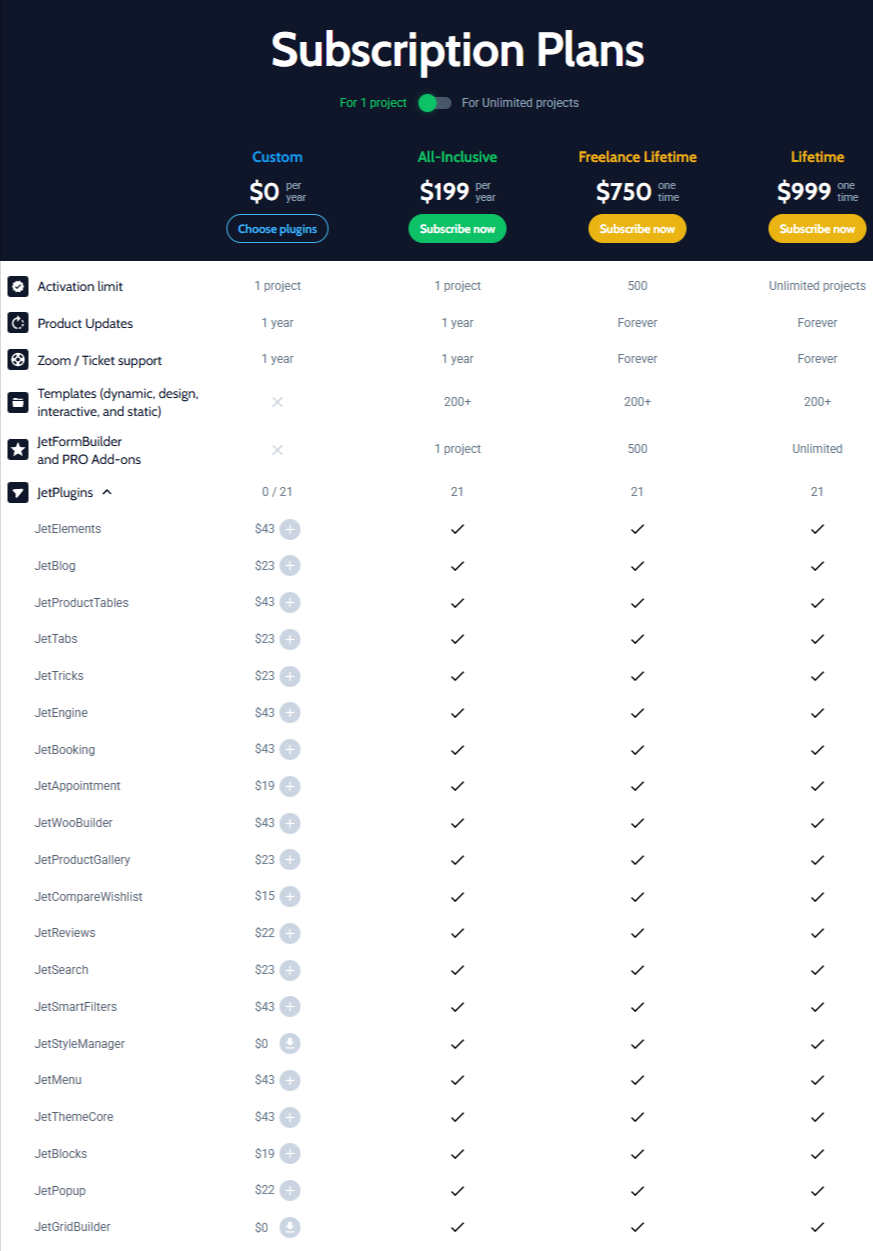
Crocoblock (official plans) include:
-
All-Inclusive: $199/year
-
All-Inclusive Unlim: $399/year
-
Freelance Lifetime: $750 one-time
-
Lifetime: $999 one-time
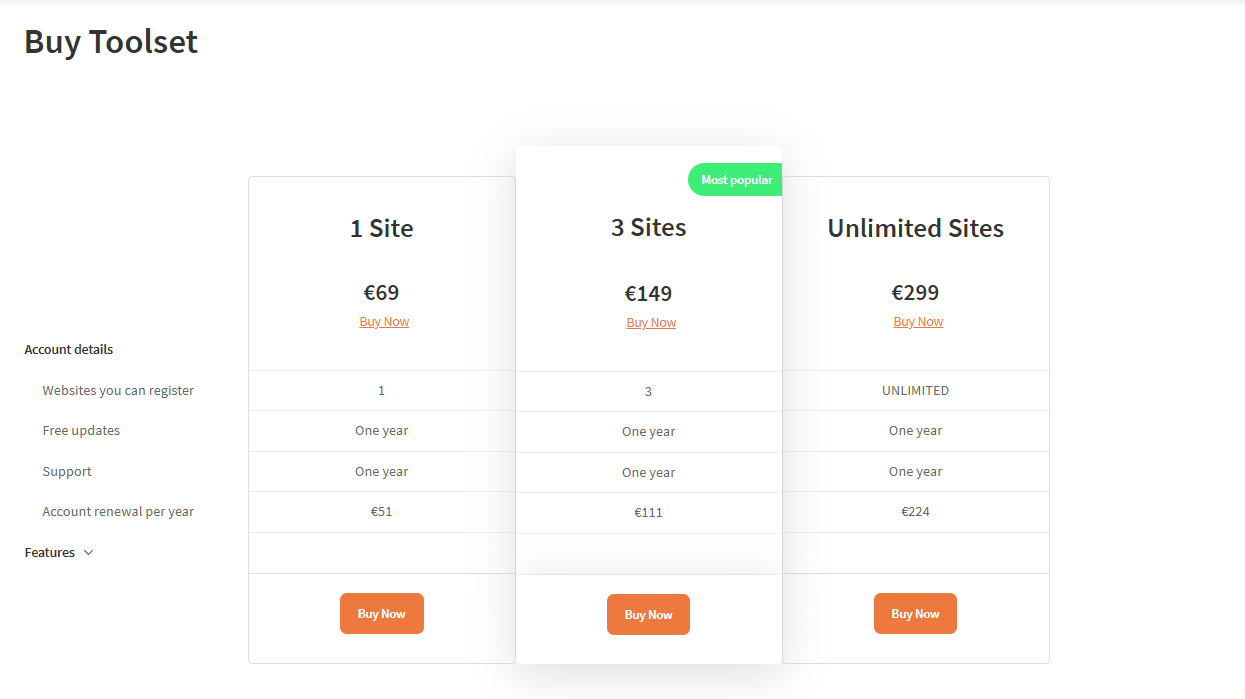
Toolset (official buy page):
-
1 Site: €69
-
3 Sites: €149
-
Unlimited Sites: €299
5.2 Pricing structure impact (why the same price “feels” different)
This is where most reviews get sloppy. The pricing isn’t just “cheaper vs more expensive.” It changes your operational strategy:
-
Crocoblock’s suite pricing incentivizes consolidating around one vendor. This reduces plugin stack complexity and typically lowers integration time.
-
Toolset’s site-based pricing can be attractive if you only need its core capabilities and you have technical capacity to implement. But the cost advantage disappears when you add dev hours and additional tools for a comparable builder-first workflow.
5.3 Cost realism: TCO is the real battleground
The relevant question is: What does it cost to deliver the same business outcome?
A practical TCO model needs assumptions. Here’s a conservative consulting-grade model:
Assumptions (typical agency/internal team reality):
-
A “data-driven” WordPress site needs: CPT/fields, templates, dynamic listing, faceted filtering/search, front-end submission (often), and role-based access (sometimes).
-
Developer time is the most expensive input. Even if you’re the dev, your time has opportunity cost.
TCO components
-
License/subscription fees
-
Build time (setup + integration)
-
Maintenance time (updates, conflicts, regressions)
-
Iteration cost (how expensive is change?)
Strategic implication:
-
Crocoblock generally lowers (2), (3), and (4) by keeping more capabilities inside one ecosystem.
-
Toolset can lower long-term complexity for dev teams, but it often increases (2) and (4) for mixed-skill teams.
5.4 Pricing verdict (buyer-facing)
-
If you are a solo builder / growth operator / agency shipping multiple dynamic projects → Crocoblock’s suite pricing is typically a net win because it reduces stack fragmentation.
-
If you are a developer-led team that prioritizes structured data design and can absorb longer implementation cycles → Toolset can be efficient at scale, especially on unlimited licensing.
6) Deep Audit (Tighter, More Granular)
6.1 Features & Technology (capability-to-outcome mapping)
What buyers actually need: not “features,” but capabilities that produce outcomes.
A) Content modeling (CPT, fields, relationships)
-
Toolset is strong for structured modeling and relationships; it’s built as a “data architecture” product.
-
Crocoblock (JetEngine-led) supports custom content structures and offers a suite-driven approach to dynamic content creation.
Consulting view:
If your site is essentially a database with a UI, Toolset’s structured mindset can be an advantage. If your site is a growth surface that must ship quickly and evolve, Crocoblock’s integrated approach usually wins.
B) Dynamic front-end rendering (templates, listings, queries)
This is where ROI is created or destroyed.
-
Crocoblock: suite bundles templates, dynamic tools, and related plugins, lowering the cost of building “dynamic screens.”
-
Toolset: provides the building blocks and supports templates/search/forms as part of its package, but implementation often becomes more configuration-heavy for non-technical teams.
Verdict: Crocoblock tends to produce faster dynamic UI delivery in builder-centric environments.
C) Forms and user-generated content
Both position around advanced site functionality. Toolset explicitly highlights forms as part of the toolkit; Crocoblock includes broader suite coverage and also has relevant tooling inside its ecosystem.
Decision cue:
If front-end submission is a core product feature (UGC marketplaces), evaluate which workflow your team can maintain without regressions.
6.2 UX & Workflow Efficiency (where time is lost)
This dimension is where most “tool comparisons” become real:
-
Crocoblock reduces context switching by centralizing capabilities in one ecosystem. That means fewer vendor docs, fewer compatibility uncertainties, and faster team onboarding.
-
Toolset tends to be more configuration/architecture oriented. For dev teams, that’s a feature. For mixed teams, it often becomes friction.
Strategic statement:
If your workflow includes designers, marketers, and operators—not just devs—Crocoblock generally has a lower organizational adoption cost.
6.3 Performance & Reliability (risk-adjusted view)
Both solutions can run stable production sites. The real risk variable is implementation quality:
-
Toolset’s performance outcome is more dependent on developer execution (strong upside, but also higher variance).
-
Crocoblock’s performance outcome tends to be more standardized (lower variance) because common patterns are embedded into the ecosystem.
Risk framing ⚠️
Toolset can be excellent, but it is less forgiving when teams lack deep implementation rigor.
6.4 Scalability & Business Readiness (scaling content + teams)
Scalability is not just “can it handle traffic?” It’s:
-
Can your team add new content types without breaking templates?
-
Can you onboard new staff without weeks of ramp time?
-
Can you change business rules (taxonomy, filters, permissions) quickly?
Crocoblock typically scales better organizationally (more repeatable patterns).
Toolset scales strongly technically, but demands higher technical governance.
6.5 Security & Compliance (pragmatic)
Neither product is inherently “unsafe” in concept; the bigger security factor is:
-
keeping a smaller plugin stack,
-
minimizing inconsistent vendors,
-
reducing abandoned integrations.
From that angle, suite consolidation can lower exposure surfaces (fewer vendors). Crocoblock’s “all-inclusive ecosystem” strategy supports that consolidation effect.
7) Pairwise Strategic Comparison (Strength → Weakness → Business Impact)
Crocoblock vs Toolset (in one tight narrative)
-
Crocoblock is a growth system: it reduces build friction and shortens time-to-value by bundling a broad set of dynamic-site tools into one license and workflow.
-
Toolset is an architecture system: it enables more controlled and deliberate data modeling, best exploited by developer-led teams with strong implementation discipline.
Business impact:
-
Choose Crocoblock when your primary constraint is speed, iteration, and predictable operations.
-
Choose Toolset when your primary constraint is data structure precision and you can afford longer cycles.
8) Scoring Matrix (1–10, risk-adjusted) 📊
| Metric | Crocoblock | Toolset | Why |
|---|---|---|---|
| Value for money | 9 | 7 | Crocoblock bundles broad capability at $199/year |
| Usability | 9 | 6 | Crocoblock suite lowers onboarding; Toolset more technical |
| Feature depth (data modeling) | 8 | 9 | Toolset’s framework strength |
| Reliability (outcome variance) | 8 | 7 | Toolset depends more on execution quality |
| ROI potential | 9 | 7 | Faster time-to-launch tends to monetize earlier |
| Vendor lock-in risk | 6 | 7 | Both have lock-in; suite can intensify it |
9) Financial Analysis: ROI & TCO (12/24/36 months)
9.1 License-only cost (simple baseline)
Crocoblock: $199/year (All-Inclusive), or $399/year (Unlimited), or lifetime tiers ($750 / $999).
Toolset: €69 / €149 / €299 depending on site count.
9.2 TCO reality (where buyers get surprised)
If you track only license fees, Toolset may appear cheaper.
If you track time-to-launch + iteration cost, Crocoblock frequently becomes cheaper in practice for non-dev-heavy teams because it shortens delivery cycles.
Consulting rule:
When the product must ship and evolve quickly, the cheapest license is rarely the cheapest system.
10) Buyer Decision Framework (Decision Tree Logic) 🧠
Step 1: What is your operating model?
-
Builder-led / mixed team (designer + marketer + operator) → go Crocoblock
-
Developer-led (you have technical governance) → continue
Step 2: Is relational data complexity central to the product?
-
Yes (relationships are core) → lean Toolset
-
No (dynamic UI + speed is core) → lean Crocoblock
Step 3: What is the business priority?
-
Launch fast and monetize (affiliate, directory SEO, MVP) → Crocoblock
-
Architect for long-term custom workflows → Toolset
11) Risk Audit & Limitations ⚠️
Crocoblock risks
-
Suite dependency: you become invested in JetPlugins patterns.
-
Abstraction ceiling: rare edge cases may need workarounds.
-
Some teams overbuy the suite when they only need a small subset (though the “bundle vs stack” economics often still favor the suite).
Toolset risks
-
Hidden adoption cost: if non-technical team members must maintain the system, cost rises.
-
Delivery speed risk: architecture-first choices can slow iteration.
-
Increased reliance on experienced implementers.
12) Final Strategic Verdict (Clear, Role-Based)
Best overall for most commercial buyers 🏆
Crocoblock (All-Inclusive at $199/year is a strong “bundle economics” anchor).
Best for developer-led architecture-first builds
Toolset (especially at multi-site/unlimited tiers when a dev team exists).
Best for agencies shipping multiple sites quickly 🚀
Crocoblock Unlimited ($399/year) or lifetime tiers depending on planning horizon.
13) Actionable Recommendations + CTA 🚀
If you are choosing for business outcomes (launch, SEO, monetization)
Pick Crocoblock when your priority is shipping dynamic experiences fast with a consolidated toolset and predictable iteration costs.
👉 For deeper implementation guides, real-world comparisons, and affiliate-focused tooling strategies, visit:
https://esapplication.com/