https://esapplication.com/FullEnrich Review 2026: Is This Waterfall Enrichment Platform Worth It?
Quick Verdict
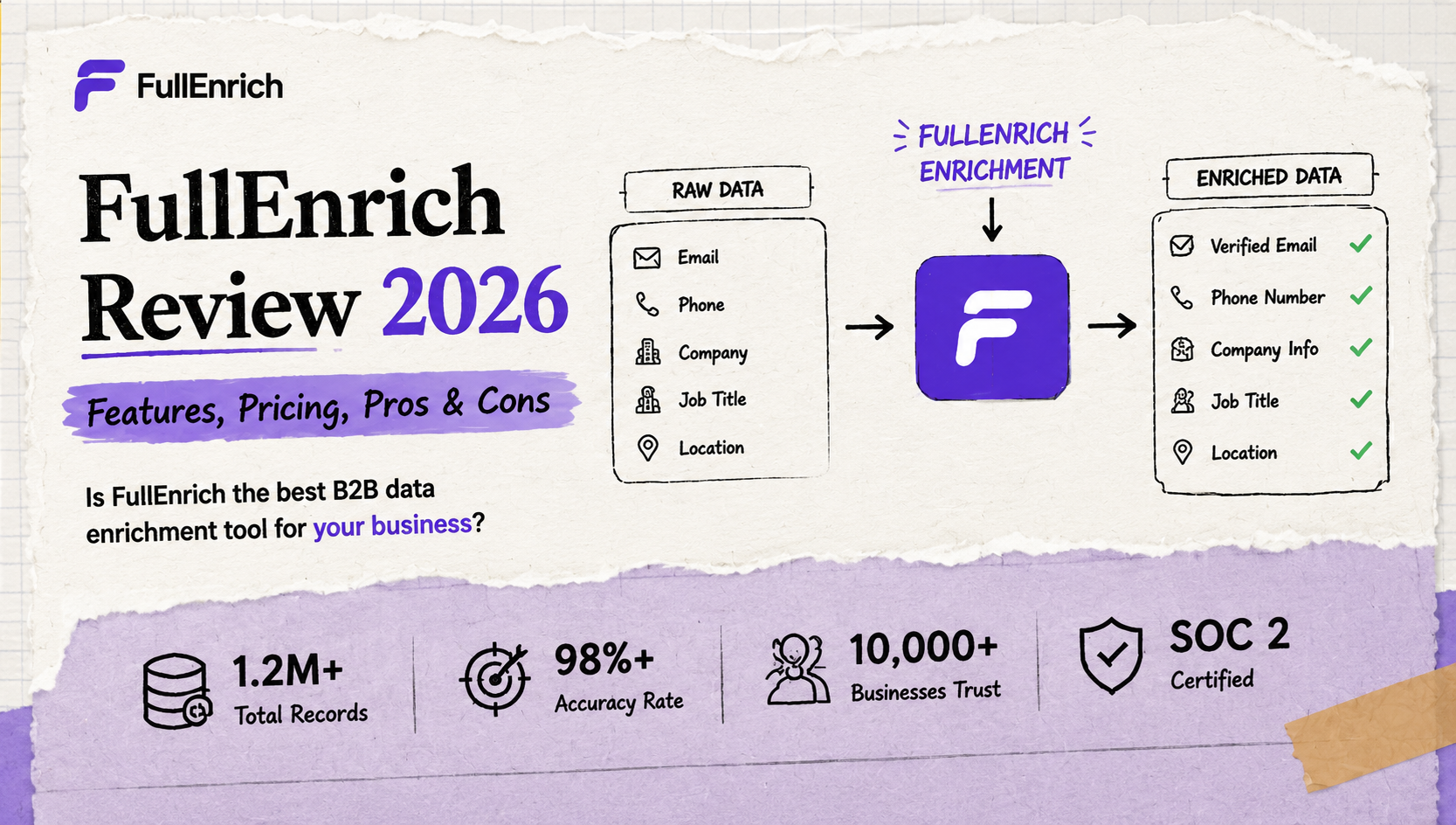
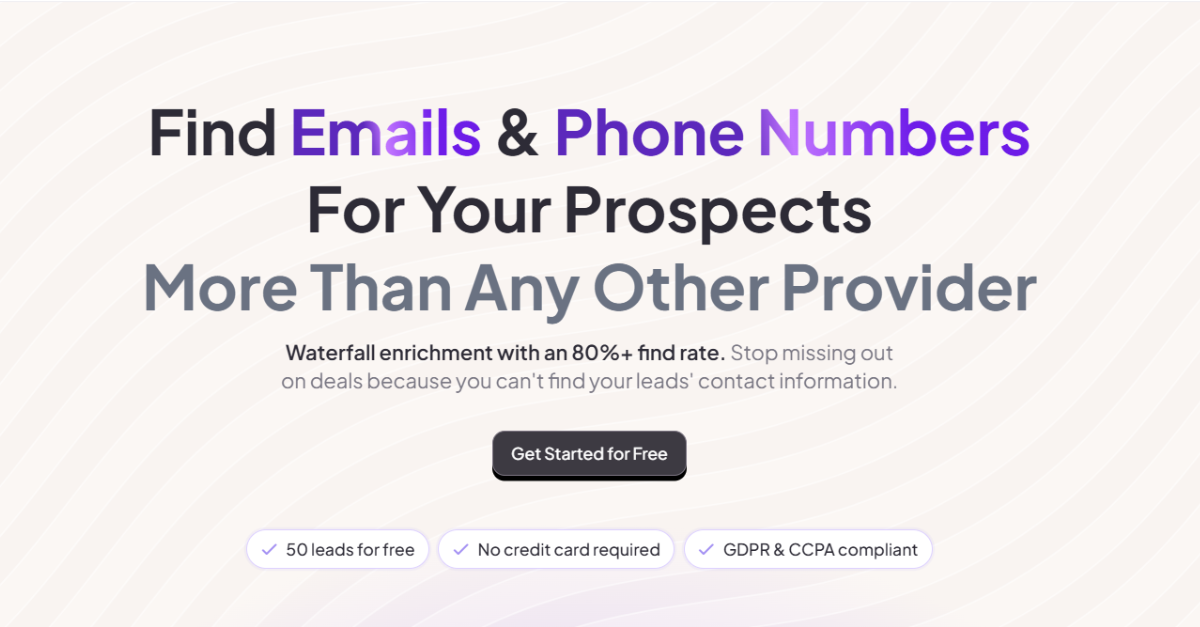
FullEnrich is a B2B contact data enrichment platform that helps sales, marketing, recruiting, and Revenue Operations teams find verified work emails, personal emails, mobile phone numbers, and company information.
Its biggest differentiator is waterfall enrichment. Instead of depending on one contact database, FullEnrich checks multiple providers in sequence. If the first source cannot find a contact, the system moves to the next provider until it finds a result or exhausts the available sources.
FullEnrich also offers People and Company Search, reverse email lookup, CSV enrichment, API access, CRM integrations, no-code automation, and an MCP server for AI-agent workflows. Its credit-based pricing only charges when requested data is found, although mobile phone numbers consume considerably more credits than work emails.
Pricing begins at approximately $29 per month for 500 credits, while 1,000 credits cost around $55 per month. Work emails cost one credit, personal emails cost three, and mobile numbers cost ten. New users receive 50 free credits without providing a credit card.
Best for: B2B sales teams, lead-generation agencies, RevOps, recruiters, growth teams, developers, and AI-agent builders.
Skip it if: You only need occasional emails, want an unlimited database, need a built-in outreach sequencer, or cannot justify ten credits per mobile number.
FullEnrich at a Glance
| Category | Details |
|---|---|
| Product | FullEnrich |
| Product type | B2B contact data enrichment platform |
| Primary use | Finding and verifying emails, mobile numbers, and company data |
| Core technology | Waterfall enrichment |
| Data sources | More than 20 providers; 25+ sources advertised in some workflows |
| Best for | Sales, marketing, RevOps, recruiters, agencies, and developers |
| Work email cost | 1 credit |
| Personal email cost | 3 credits |
| Mobile phone cost | 10 credits |
| Reverse email lookup | 1 credit |
| Starting price | Approximately $29 per month |
| Free trial | 50 free credits |
| Credit rollover | 3 months monthly; 12 months annually |
| Users | Unlimited users advertised on all plans |
| Overall rating | 4.5/5 |
What Is FullEnrich?
FullEnrich is a B2B data enrichment platform designed to complete partial prospect and company records. A team may have names, companies, domains, job titles, LinkedIn URLs, or incomplete CRM records. FullEnrich attempts to add verified work emails, personal emails, mobile numbers, person profiles, and firmographic information.
Unlike a traditional provider searching one primary database, FullEnrich sends a record through a sequence of data sources. If one source cannot find a verified result, the system moves to another. This is known as waterfall enrichment.
The benefit is coverage. No individual provider has complete global data. Combining multiple sources can produce more matches, particularly across different regions and hard-to-find audiences. FullEnrich says these searches occur in real time rather than relying exclusively on a static, persistent contact database.
Who Is FullEnrich Built For?
B2B sales teams
SDRs and account executives can use FullEnrich to find direct contact information for decision-makers instead of relying only on company switchboards or generic inboxes.
Lead-generation agencies
Agencies can enrich CSV files, connect data to outbound systems, and reduce the need for several independent provider subscriptions. Credit usage should still be tracked per client.
Marketing Operations and RevOps
Operations teams can complete CRM fields, prepare campaign audiences, enrich new leads, refresh existing records, improve field completeness, and standardize enrichment across departments.
Recruiters
Recruiters can find professional and personal contact information for potential candidates, subject to privacy and local outreach requirements.
Developers and AI-agent builders
API and MCP access make FullEnrich useful for applications, automated pipelines, and AI agents that require verified contact data without maintaining multiple provider integrations.
How Does FullEnrich Work?
1. Provide prospect information
Submit a name and company, domain, LinkedIn profile URL, existing email, or CSV file. More accurate input data generally makes person matching easier.
2. Choose the required data
Request work email, personal email, mobile number, person profile, company data, or reverse email lookup. Selecting only necessary fields helps control credit use.
3. Run the waterfall
FullEnrich manages provider access, API connections, billing, and sequence logic behind one interface.
4. Verify the result
Emails are checked for deliverability. Phone workflows may include line activity, carrier, mobile-line, and ownership checks. No data provider is perfect, so teams should monitor bounces, wrong numbers, and user reports.
5. Deduct credits only for results
FullEnrich says failed searches do not consume credits. Different data types have different credit costs.
6. Export or automate
Results can be downloaded to CSV, sent to a CRM or API, processed through Zapier, Make, or n8n, added to outreach systems, or used by an AI agent. FullEnrich enriches contact data; it is not primarily a cold email sending platform.
FullEnrich Key Features
1. Waterfall enrichment
FullEnrich automates searches across more than 20 providers. Potential benefits include higher match rates, broader international coverage, fewer separate subscriptions, less technical setup, and one credit system. It does not guarantee that every record will be found or correct.
2. Work email enrichment
A successfully found work email costs one credit. This feature supports cold outreach, recruiting, account-based marketing, CRM completion, and event follow-up. Teams should continue to monitor bounce rates and honor opt-outs.
3. Mobile phone enrichment
A successfully found mobile number costs ten credits. FullEnrich says it prioritizes mobile numbers, checks line activity and carrier information, and attempts to match ownership with the prospect’s name. Phone data is valuable but credit-intensive.
4. Personal email enrichment
Personal email enrichment costs three credits per successful result. Recruiting and contact-recovery workflows may benefit, but legal review is especially important when processing personal addresses.
5. Reverse email lookup
One existing work or personal email can be converted into associated person and company information for one credit. This can help qualify sign-ups and complete inbound lead records.
6. People and Company Search
FullEnrich provides more than 30 search filters covering titles, seniority, departments, industries, employee counts, geography, and company characteristics. Buyers needing a complete sales-intelligence database should compare search depth with platforms such as Apollo.
7. CSV enrichment
Upload names, domains, or LinkedIn URLs and receive an enriched file. CSV enrichment is one of the easiest ways to benchmark FullEnrich against an existing provider using a representative sample.
8. Email and phone verification
Verification is designed to reduce invalid addresses, hard bounces, outdated emails, and dead phone numbers. Catch-all domains remain difficult for every platform and may require additional review.
9. API and webhooks
Real-time API enrichment can support internal sales systems, SaaS products, lead routing, recruitment platforms, onboarding, and data pipelines.
10. MCP server
Compatible AI agents can identify a target, find a decision-maker, request contact details, update a CRM, and prepare outreach content. Human approval and compliance controls should remain in the workflow.
11. No-code and CRM integrations
Zapier, Make, n8n, APIs, and CRM workflows can automate enrichment. Some native HubSpot functionality has been labeled “Coming soon” on product pages, so verify whether your intended workflow is available natively or requires an automation tool.
12. Credit rollover and unlimited users
Unused credits roll over for three months on monthly plans and 12 months on annual plans. Unlimited users are advertised, although current cancellation and paused-subscription rules should be checked before accumulating a large balance.
FullEnrich Data Quality
A high match rate is not useful if results are outdated, incorrect, or produce high bounce rates. FullEnrich attempts to improve quality using multiple sources, real-time searches, email verification, catch-all resolution, bounce indicators, mobile-line identification, carrier checks, and phone ownership matching.
Public help documentation reports example mobile coverage of about 71% in EMEA, 76% in the US, and 81% in APAC, while emphasizing that outcomes depend on the audience. These are vendor-reported figures, not guaranteed results.
Benchmark FullEnrich using a real sample and measure match rate, valid email rate, bounce rate, correct phone rate, duplicate rate, regional performance, and cost per usable contact.
What Do FullEnrich Users Say?
At the time of research, FullEnrich displayed a G2 rating of 4.8/5 from 188 reviews. Users frequently praise contact accuracy, match rates, simple setup, international coverage, CSV enrichment, integrations, and paying only for successful results.
Common criticisms include rapid credit consumption for mobile numbers, higher cost at scale, absence of a current LinkedIn Chrome extension, occasional incorrect or outdated data, slower enrichments, integration limitations, uncertain emails, and concerns about access to accumulated credits after canceling or pausing.
The feedback supports a balanced conclusion: FullEnrich can improve coverage, but each team should test it against its own audience.
FullEnrich Pricing Explained
FullEnrich uses credit-based pricing. Current public information indicates a free trial with 50 credits, an entry plan around $29 per month for 500 credits, approximately $55 per month for 1,000 credits, higher-volume Pro options, and custom Enterprise pricing.
| Data type | Credit cost |
|---|---|
| Work email | 1 credit |
| Personal email | 3 credits |
| Mobile phone number | 10 credits |
| Reverse email lookup | 1 credit |
| B2B person/company data | Included with enrichment |
| Standalone profile/company data | Approximately 0.25 credit |
What can 1,000 credits buy?
The same allowance could return 1,000 work emails, 333 personal emails, 100 mobile numbers, 1,000 reverse lookups, or a mixture. For example, 500 work emails, 30 mobiles, 50 personal emails, and 50 reverse lookups would consume 1,000 credits.
Does FullEnrich charge for misses?
No. Credits should only be deducted when requested data is found.
Which plan should you choose?
- Free trial: Compare match rates using a real sample.
- Entry plan: Occasional enrichment and email-heavy workflows.
- Larger Pro allowance: Weekly outbound, bulk CSVs, mobile enrichment, or API automation.
- Enterprise: High volume, custom limits, agencies, resellers, data products, governance, and dedicated support.
Is FullEnrich Worth the Price?
FullEnrich can offer strong value when it replaces several subscriptions or eliminates the need to build a waterfall internally.
It may be worth it if:
- You need work emails and mobile numbers.
- One provider does not cover your market.
- You target multiple regions.
- You frequently enrich CRM records.
- You operate a lead-generation agency.
- You value pay-per-success pricing.
- You require API or AI-agent access.
- You need unlimited team members.
It may not be worth it if:
- You need only occasional emails.
- A cheaper single provider already covers your audience.
- You primarily request mobile numbers and consume credits quickly.
- You expect an unlimited database.
- You need a built-in outreach sequencer.
- You rely on a LinkedIn extension.
FullEnrich Pros and Cons
Pros
- Queries more than 20 providers.
- Automates waterfall enrichment.
- Finds work, personal, and phone data.
- Charges only for successful matches.
- Provides 50 free credits without a card.
- Includes verification and bulk CSV processing.
- Offers People and Company Search.
- Provides API, automation, and MCP access.
- Supports CRM workflows.
- Includes unlimited users and credit rollover.
- Strong G2 rating.
- SOC 2 Type II, GDPR, and CCPA claims.
Cons
- Mobile numbers cost 10 credits.
- Large jobs can become expensive.
- Results are not always current or correct.
- Catch-all results require caution.
- Some integrations are still developing.
- No current LinkedIn Chrome extension.
- Not a complete outreach platform.
- Pricing varies by volume.
- Match rates differ by market.
- Cancellation credit rules need checking.
- Compliance remains the user’s responsibility.
FullEnrich vs Single-Source Providers
| Category | FullEnrich | Single-source provider |
|---|---|---|
| Sources | 20+ providers | Usually one primary database |
| Match-rate potential | Higher | Limited by one source |
| Global coverage | Potentially stronger | Varies |
| Setup | Managed waterfall | Simple but limited |
| Verification | Included | Varies |
| Pricing | Per successful result | Credits, seats, or exports |
| Search speed | May take longer | Often faster |
| Best use | Difficult and international contacts | Well-covered target markets |
Best FullEnrich Alternatives
FullEnrich vs Clay
Clay is a broader GTM data orchestration platform with flexible enrichment tables, AI research, formulas, and provider selection. Choose FullEnrich for a simpler managed waterfall; choose Clay for complex custom workflows. FullEnrich can also be used inside Clay.
FullEnrich vs BetterContact
BetterContact is another waterfall enrichment platform. Compare source quality, email and mobile match rates, credit costs, catch-all handling, integrations, API performance, rollover, and geographic coverage using the same test list.
FullEnrich vs Apollo
Apollo combines a large B2B database with prospecting and outreach. Choose Apollo for an all-in-one database and sequencer; choose FullEnrich when multi-provider coverage and enrichment are the priority.
FullEnrich vs Lusha
Lusha provides sales intelligence, contact data, browser prospecting, and integrations. FullEnrich is more focused on querying multiple sources through one waterfall.
FullEnrich vs Hunter
Hunter specializes in domain email search and verification. It is simpler for email-only workflows, while FullEnrich also covers mobile numbers, personal emails, reverse lookup, and multi-provider searches.
FullEnrich vs Prospeo
Prospeo may provide better value for email-focused users. FullEnrich is potentially stronger when combining providers and retrieving phone numbers as well as email data.
FullEnrich vs Wiza
Wiza centers on LinkedIn and Sales Navigator workflows. Choose Wiza for browser-led prospecting; choose FullEnrich for managed waterfall and API-oriented enrichment.
Who Should Use FullEnrich?
- B2B sales and SDR teams
- RevOps and Marketing Operations
- Demand-generation and ABM teams
- Lead-generation agencies
- Recruiters
- Growth marketers
- Developers and automation specialists
- AI-agent builders
- Companies with incomplete CRM records
- Teams targeting several regions
Who Should Skip FullEnrich?
- B2C prospecting without a clear legal basis
- Occasional email lookup users
- Teams requiring unlimited mobile numbers
- Businesses wanting an all-in-one cold email sequencer
- Users dependent on a LinkedIn extension
- Teams already well served by one cheaper provider
- Businesses unwilling to validate results
- Anyone expecting every prospect to be found
Is FullEnrich Legit and Safe?
FullEnrich appears to be a legitimate, actively maintained platform with public terms, privacy policy, Data Processing Agreement, subprocessor list, security documentation, Trust Center, API docs, Help Center, and status page.
The company states that it is SOC 2 Type II compliant and aligned with GDPR and CCPA. It also says searches use selected providers in real time rather than a conventional persistent contact database.
These safeguards do not make every campaign compliant. Users remain responsible for a legal basis, local marketing laws, privacy notices, opt-outs, suppression lists, data security, authorized access, and special care with personal emails and phone numbers.
Final Verdict: Is FullEnrich Worth It in 2026?
FullEnrich is one of the more compelling B2B waterfall enrichment platforms available in 2026. Rather than relying on one database, it searches more than 20 providers and only charges when it finds requested data.
This can deliver meaningful value to sales teams, recruiters, agencies, and RevOps professionals working with incomplete lists or markets where one provider does not offer sufficient coverage. People and Company Search, reverse lookup, API access, no-code integrations, CRM workflows, and MCP support extend it beyond basic enrichment.
The weaknesses matter. Mobile numbers are expensive in credit terms, results still require validation, catch-all emails can create uncertainty, and the lack of a current LinkedIn extension may slow certain workflows. It is also not a replacement for a full outreach platform.
At about $29 per month for 500 credits, FullEnrich is accessible enough to test. Its 50 free credits allow buyers to compare performance using a real sample list.
Final rating: 4.5/5
Frequently Asked Questions
What is FullEnrich?
FullEnrich is a B2B contact data enrichment platform that finds and verifies work emails, personal emails, mobile phone numbers, person profiles, and company data.
What is waterfall enrichment?
It searches multiple data providers sequentially until it finds a result or exhausts the available sources.
How many data sources does FullEnrich use?
FullEnrich generally states that it queries more than 20 providers, with 25+ sources advertised in some workflows.
How much does FullEnrich cost?
Pricing begins at approximately $29 per month for 500 credits. A 1,000-credit allowance costs around $55 per month.
Does FullEnrich offer a free trial?
Yes. New users receive 50 free credits without a credit card.
How many credits does a work email cost?
A successfully found work email costs one credit.
How many credits does a mobile number cost?
A successfully found mobile phone number costs ten credits.
Does FullEnrich charge for failed searches?
No. FullEnrich says credits are deducted only when requested data is found.
Do credits roll over?
Credits currently roll over for three months on monthly subscriptions and 12 months on annual subscriptions.
Does FullEnrich include unlimited users?
FullEnrich advertises unlimited users without extra per-seat charges.
Can FullEnrich verify emails?
Yes, although catch-all and uncertain results may still require additional review.
Does FullEnrich have an API?
Yes. It provides API and webhook access for real-time enrichment and automated workflows.
Does FullEnrich work with HubSpot?
HubSpot workflows are supported through integrations, APIs, and automation tools. Confirm the current availability of native functionality.
Does FullEnrich have a Chrome extension?
Recent user feedback indicates that its previous LinkedIn Chrome extension is no longer available. Confirm current status if this is essential.
Is FullEnrich GDPR compliant?
FullEnrich states that it is GDPR and CCPA aligned and SOC 2 Type II compliant. Customers remain responsible for how data is used.
Is FullEnrich worth it?
It can be worth the price for teams needing higher contact coverage, verified email and phone data, API access, and multi-region enrichment.
Disclosure: Some links in this article may be affiliate links. If you purchase through them, we may earn a commission at no additional cost to you. This does not influence our editorial conclusions.