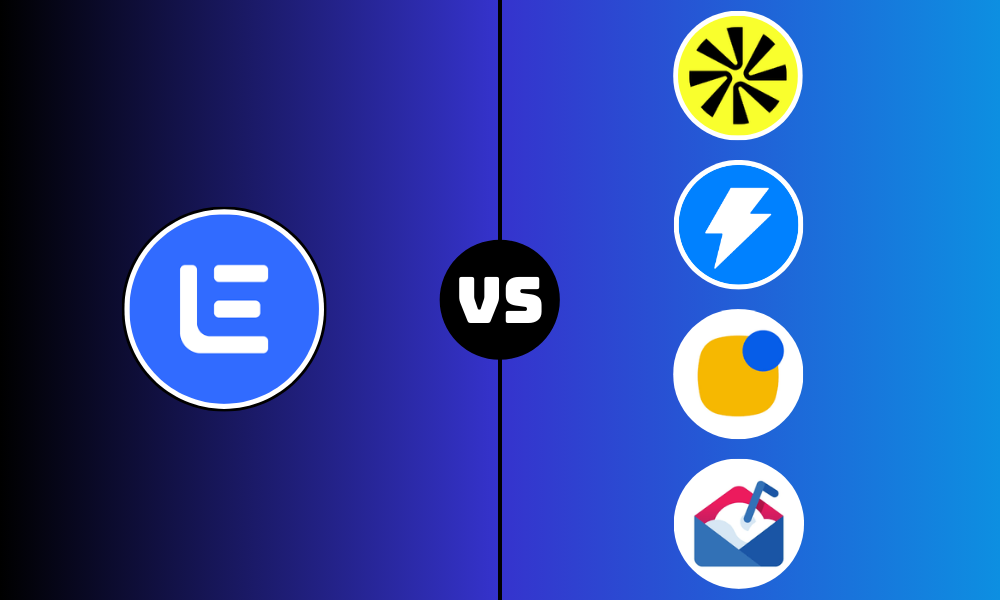
Lemlist vs competitors, fully re-audited from official websites. Compare pricing, features, deliverability, usability, security, and buyer fit across 5 leading outreach platforms.
Lemlist vs Competitors: A Strategic Comparison of Lemlist, Apollo, Instantly, Reply, and Mailshake
Choosing a sales outreach platform looks simple on the surface. In reality, it is one of the more expensive and operationally sensitive software decisions a B2B team can make.
That is because outreach software sits close to revenue. It affects list building, sending volume, deliverability, personalization, rep workflow, CRM hygiene, and ultimately pipeline creation.
A weak choice can slow down prospecting, increase spam risk, and create hidden operating costs. A strong choice can compress workflow, improve response quality, and make outbound more predictable.
This report rebuilds the Lemlist vs Competitors comparison from the ground up using the official websites of the five platforms you named:
-
Lemlist
-
Apollo
-
Instantly
-
Reply
-
Mailshake
I have deliberately avoided the loose, recycled comparison style that appears in many affiliate articles.
Where official pages are clear, I state the facts directly.
Where official pages are inconsistent, I say so.
Where a conclusion is analytical rather than vendor-stated, I label it as a judgment.
That makes this article more useful for serious buyers, and more trustworthy for SEO and affiliate content.
Quick Answer
If your company wants the best balance of personalization, multichannel outreach, and deliverability support, Lemlist remains one of the strongest options in this category.
If your company wants a data-heavy platform that combines prospecting and engagement, Apollo is stronger. Apollo’s official pages position it as an AI sales platform with data, outbound, inbound, and workflow capabilities, and its own public materials emphasize a very large B2B database.
If your company is primarily optimizing for cold email scale and inbox infrastructure, Instantly has a stronger economic story, especially around unlimited email accounts and warmup.
If your company wants a more modular AI-led outreach stack, Reply deserves a serious look, but its packaging is more layered and needs closer plan review.
If your company wants the most operationally legible pricing ladder and a simpler deployment path, Mailshake is one of the easiest to understand and budget.
Executive Summary
The biggest mistake buyers make in this category is assuming these five tools are directly interchangeable.
They are not.
Lemlist
Lemlist is best understood as a personalization-first sales engagement platform. Its homepage says it helps teams automate outreach across email, LinkedIn, WhatsApp, and calls while preserving a human touch, and its site highlights built-in warm-up through lemwarm. (lemlist.com)
Apollo
Apollo is broader. Its homepage frames Apollo as an AI sales platform covering outbound, inbound, enrichment, and deal execution. Its public product pages also emphasize a large data layer, verification processes, and multichannel campaigns.
Instantly
Instantly is more specialized. Its official positioning focuses on finding leads, scaling email campaigns, reaching primary inboxes, and using AI to win more deals. The pricing page repeatedly foregrounds unlimited email accounts and unlimited email warmup, which tells you a lot about the product’s strategic center of gravity.
Reply
Reply sits between classic sales engagement and AI-assisted automation. Its own pricing and product pages highlight multichannel sequences, AI features, unlimited warm-up, unlimited emails, and separate packages for Email Volume, Multichannel, AI SDR, and Agency.
Mailshake
Mailshake is more straightforward. Its homepage centers on email, phone, and social cadences, while its pricing page clearly shows a step-up path from Starter to Email Outreach to Sales Engagement.
Headline findings
Best overall for balanced outbound execution: Lemlist. Its value proposition is coherent, and its product framing is unusually focused. (lemlist.com)
Best for data plus outreach in one stack: Apollo. It is the strongest option here if prospect data is central to your buying decision.
Best for cold email scale: Instantly. Unlimited account positioning and warmup emphasis make that clear.
Best for modular AI packaging: Reply. It has the broadest visible plan architecture in this set. Best for simplicity and plan clarity: Mailshake. Its pricing ladder is easier to parse than most competitors.
Methodology: How This Report Was Rebuilt
This report was rebuilt using the official web properties of the platforms you named, not generic software directories or recycled comparison posts.
The evaluation focused on six practical dimensions.
Public positioning
How each vendor describes the product on its homepage and product pages. This matters because product positioning usually reveals the real design center of the platform.
Pricing surfaces
How each company displays public plan pricing, annualized pricing, and add-ons. This also includes noting where official surfaces are inconsistent or ambiguous.
Workflow and channel depth
Whether the product is primarily about email scale, multichannel engagement, prospect data, or some combination.
Deliverability posture
How strongly each platform emphasizes warm-up, anti-spam tooling, email health, and inbox placement.
Security and compliance
What the vendors publicly disclose around GDPR, SOC 2, ISO 27001, DPA, trust centers, and related controls.
Buyer-fit analysis
This is my own analytical layer: who should buy which platform, based on the official positioning and plan design.
Where I make a judgment, I state it as judgment. That keeps the article honest.
Industry Context: Why Lemlist vs Competitors Is Not a Simple “Best Tool” Question
The category these tools sit in is often called “sales engagement” or “cold outreach,” but that label hides important differences.
A buyer evaluating Lemlist vs competitors is usually trying to solve one of four different problems.
I need better prospect data
That buyer is not just looking for sequencing. They need verified emails, phone numbers, filters, enrichment, and a faster way to build a target list.
Apollo is the strongest fit in this report for that specific problem, because its official materials repeatedly emphasize very large data coverage, verification, and enrichment.
I need better outreach execution
That buyer already has leads or can source them elsewhere, but needs a stronger outbound engine.
Lemlist fits this use case well because it is explicitly positioned around personalized outreach across multiple channels.
I need cheaper or more scalable cold email infrastructure
That buyer cares about inbox count, warm-up, sending capacity, and cost efficiency.
Instantly is built around exactly that story.
I need a broader sales engagement operating system
That buyer wants sequencing, AI, reporting, integrations, and more packaging flexibility.
Reply and Apollo both compete here, but in different ways. Apollo leans more into data plus GTM consolidation, while Reply leans more into modular outreach packaging.
This matters because many articles flatten all five tools into one bucket. That produces bad buying advice.
Platform Profiles
Lemlist Overview
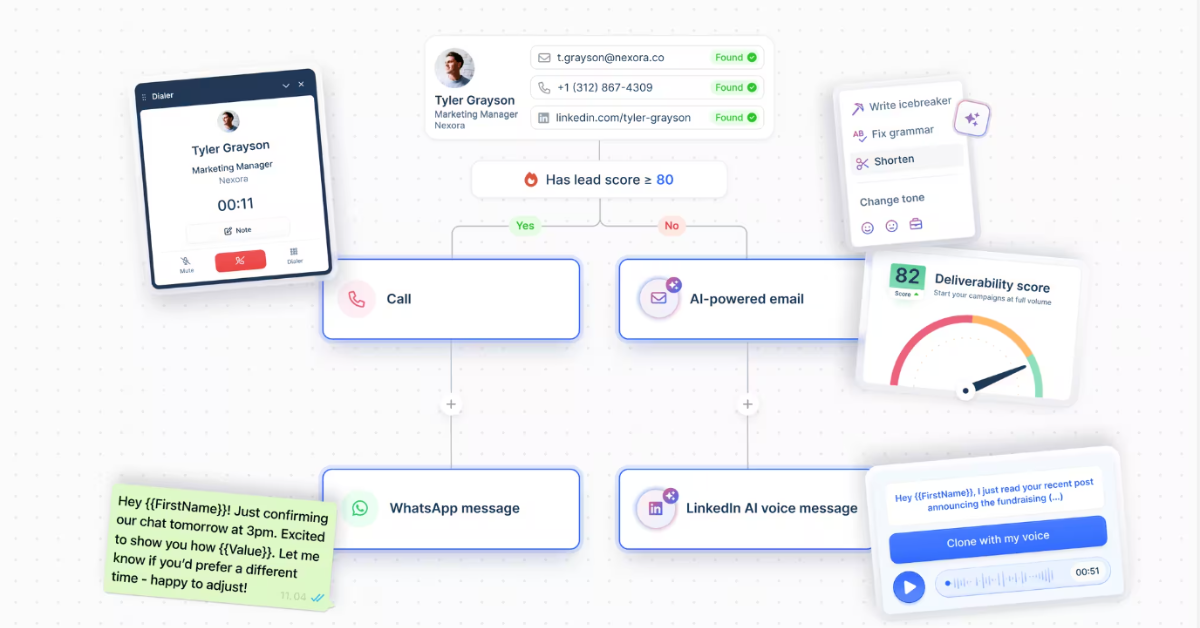
Lemlist describes itself as a sales engagement platform that automates outreach across email, LinkedIn, WhatsApp, and calls without compromising the human touch.
The wording matters. It tells you that Lemlist is not trying to win primarily on raw send volume; it is trying to win on multichannel quality and message personalization.
Lemlist also says every seat includes access to lemwarm, a built-in warm-up and deliverability booster, which automates warm-up emails and helps protect sender reputation.
That is a meaningful operational differentiator because it reduces the need for a separate warm-up tool.
What Lemlist is best at
Personalized multichannel outreach
Lemlist’s public positioning is strongest for teams that want more than “send bulk cold email.” The inclusion of LinkedIn, WhatsApp, and calls puts it closer to a true outbound workflow tool.
Deliverability-aware execution
Built-in lemwarm suggests Lemlist understands that outreach success is not just about sequences, but about reputation management. A clearer premium position
Lemlist’s pricing is not entry-level, but the product story is coherent. The company is effectively saying: pay more, get a more refined outbound motion.
That is my analysis based on its pricing and product posture.
Apollo Overview
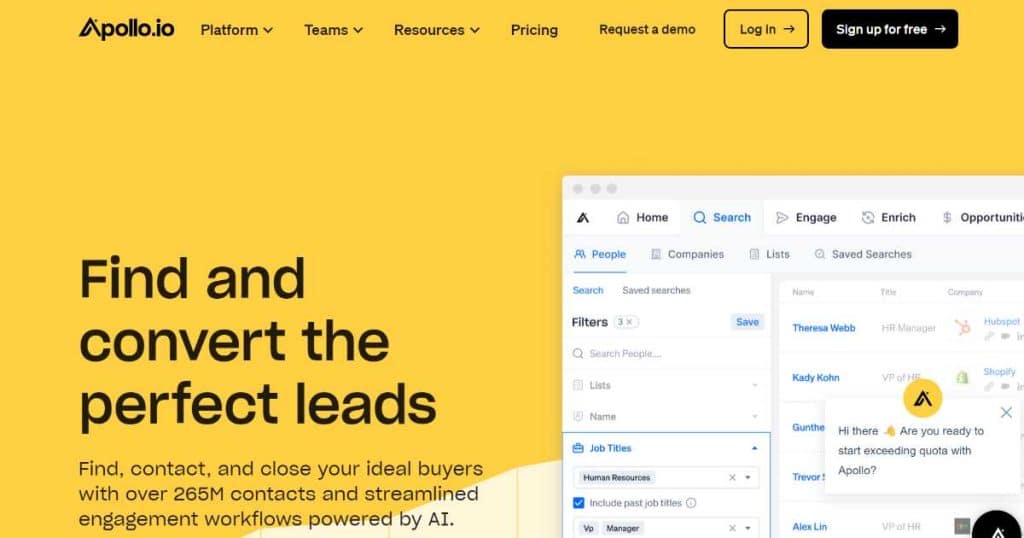
Apollo’s homepage calls it an AI sales platform for smarter, faster revenue growth.
That framing is broader than Lemlist’s. Apollo is not just selling sequencing; it is selling a more unified GTM stack.
Apollo’s official pages also emphasize very large data coverage, though the exact public numbers vary by page.
One official homepage surface references 210M+ contacts and 30M+ companies. Another official marketer page references 270M+ contacts and 70M companies. That inconsistency does not invalidate Apollo’s value, but it does mean careful buyers should avoid over-anchoring on one top-line number.
Apollo’s data product page also claims 91% email accuracy, 72M emails verified monthly, and 150M contacts refreshed monthly, plus a 7-step verification process. Those are significant claims and central to its positioning as a sales intelligence platform.
What Apollo is best at
Data-first outbound
If your team’s bottleneck is finding the right people, Apollo has the strongest official story in this article.
Stack consolidation
Apollo’s homepage menu explicitly spans outbound, inbound, enrichment, and deal execution, making it the broadest platform in this comparison by visible scope.
CRM and workflow depth
Apollo’s pricing FAQ references integrations with Salesforce, HubSpot, Outreach, SalesLoft, Marketo, Sendgrid, LinkedIn, and email providers, plus API access on custom plans.
Instantly Overview
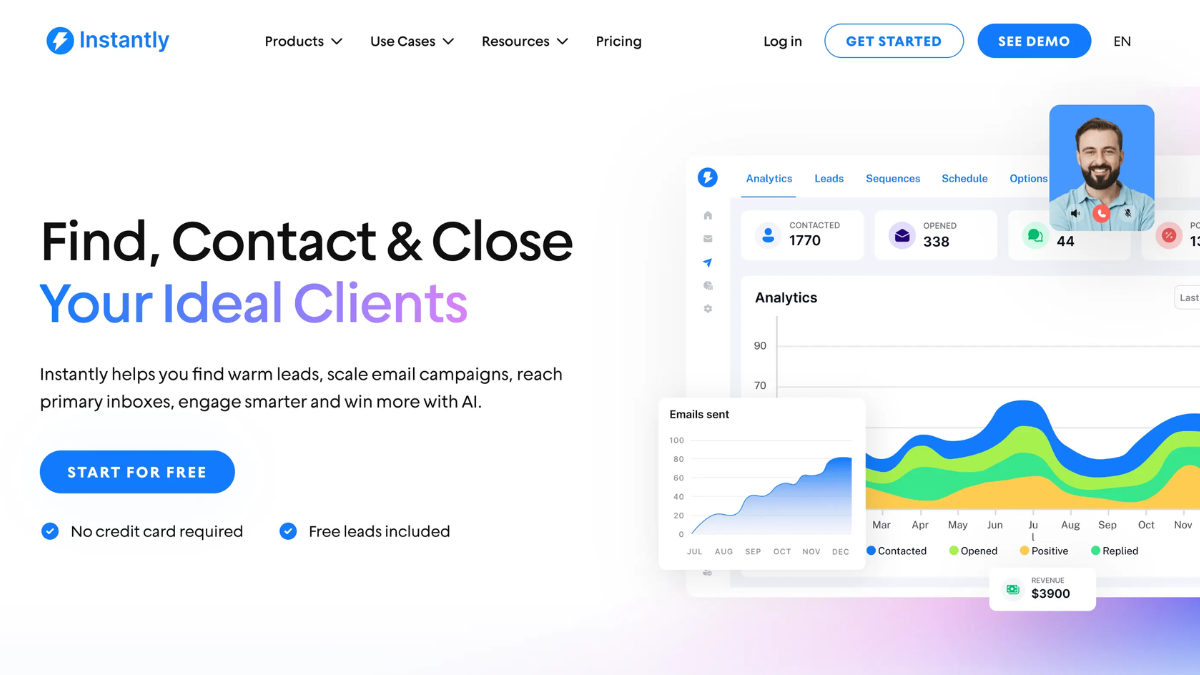
Instantly’s homepage states that it helps users find warm leads, scale email campaigns, reach primary inboxes, engage smarter, and win more with AI.
That is a concise description of a cold-email-centered product with some adjacent intelligence features.
Its pricing page is even more revealing. It repeatedly highlights unlimited email accounts and unlimited email warmup.
It also shows clear operational limits such as uploaded contacts and emails per month for Growth and Hypergrowth. On the sections reviewed, Growth shows 1,000 uploaded contacts and 5,000 emails per month, while Hypergrowth shows 25,000 uploaded contacts and 100,000 emails per month.
What Instantly is best at
Cold email economics
Unlimited email accounts is one of the clearest signals you can get about the intended buyer. Instantly is built for operators who think in terms of inbox architecture and sending scale.
Deliverability and warm-up emphasis
Instantly’s official positioning treats inbox placement as core product value, not an afterthought.
Agency and operator appeal
This is my judgment, but it is strongly implied by the pricing page. Buyers who manage many inboxes and care about scale per dollar will usually find Instantly easier to justify than buyers who prioritize multichannel personalization.
Reply Overview
Reply positions itself as an AI sales outreach and cold email platform, and its official pricing architecture is broader than most casual readers realize.
Reply does not present one simple ladder. Instead, it surfaces four major packages:
-
Email Volume
-
Multichannel
-
AI SDR
-
Agency
Its product pages also highlight unlimited email warm-up, unlimited emails, 50 live data credits per month, and an anti-spam and deliverability suite.
The pricing surface also shows add-on style elements such as Dialer and Cloud Calls at $29 per user per month and real-time B2B data “starting at $39/months.”
What Reply is best at
Modular packaging
Reply gives buyers multiple doors into the platform. That can be powerful for teams with more specific workflow needs.
AI-forward positioning
Its pages explicitly highlight AI sequence building, AI-generated icebreakers, AI reply handling, and AI SDR paths.
Advanced teams willing to inspect packaging carefully
This is an analytical conclusion. Reply can be attractive, but it is less “one-line obvious” than Mailshake or Lemlist.
Mailshake Overview
Mailshake’s homepage says it helps build sales cadences with email, phone, and social in as little as five minutes.
It emphasizes pipeline-focused analytics, multichannel outreach, and speed to rep productivity.
Its pricing page is refreshingly legible.
Starter is positioned for businesses starting an outreach program.
Email Outreach adds more operational depth.
Sales Engagement is explicitly for advanced outreach programs that need a multichannel solution.
The pricing page also clearly lists included features such as email warmup, email verification, A/B testing, scheduling, email rotation, unified inbox, CRM integrations, and browser extension.

What Mailshake is best at
Simplicity
Mailshake may not have the most ambitious market story, but it does have one of the easiest pricing and feature narratives to understand.
Fast team adoption
The homepage explicitly claims that new reps can be sending campaigns on their first day. That is a useful signal for smaller teams and faster rollouts. Practical deliverability toolkit
Mailshake’s deliverability pages mention spam score analysis, blacklist monitoring, bounces, warm-up, DKIM, SPF, and sender reputation improvement.
Pricing Audit: Rechecked From Official Surfaces
This section is the most important correction.
The earlier draft you challenged was not good enough because pricing in this market changes often and is frequently displayed differently across annual, monthly, help-center, and product pages.
Below is the cleaned-up version.
Lemlist pricing
Lemlist’s public pricing page shows Email Pro from $63/user/month and Multichannel Expert from $87/user/month. (lemlist.com)
However, Lemlist’s own help content also references new customers at $79/user/month for Email Pro and $109/user/month for Multichannel Expert. That strongly suggests the pricing page figures are effective annualized monthly rates, while the help center surfaces newer monthly list pricing.
Strategic takeaway: Lemlist’s public pricing is not cheap, but it is consistent with a premium outreach positioning. Buyers should confirm billing frequency before comparing it to lower-cost competitors.
Apollo pricing
Apollo’s public pricing search result shows Free, Basic $49/user/month billed annually, Professional $79/user/month billed annually, and Organization $119/user/month billed annually.
Apollo’s pricing page also discusses credit systems, add-on credits, and custom plans, which matters because the all-in cost may rise depending on how heavily you export or enrich data.
Strategic takeaway: Apollo looks strong on sticker value because it combines prospect data and outreach. But credit logic means serious users should model actual usage rather than just entry price.
5.3 Instantly pricing
Instantly’s public pricing page clearly shows Growth $37/mo and Hypergrowth $97/mo on the surface reviewed, along with included limits.
But there is an important caution: another recent official Instantly blog post refers to Growth plan at a flat $47/month fee. Because that also comes from Instantly’s own domain, the safest statement is that Instantly’s public pricing surfaces are not perfectly consistent across official properties.
Strategic takeaway: Instantly is still one of the strongest cost stories in this comparison, but buyers should confirm which pricing surface is currently authoritative before publishing or budgeting.
Reply pricing
Reply’s official pricing page shows:
-
Email Volume starts from $59
-
Multichannel starts from $99
-
AI SDR starts from $500
-
Agency starts from $166
Reply’s pricing surface also includes visible add-ons such as Dialer and Cloud Calls at $29/month per user, plus data-related pricing starting from $39/months.
Strategic takeaway: Reply is harder to compare at a glance because there is more packaging complexity. That does not make it weak. It just means a serious pricing analysis needs more than one headline number.
Mailshake pricing
Mailshake’s official pricing page shows:
-
Starter $29/mo
-
Email Outreach $49/mo
-
Sales Engagement $99/mo
The same pricing surface also displays lower effective monthly equivalents for yearly billing, including $25, $45, and $85. It also lists an Agency plan via Talk to Sales.
Strategic takeaway: Mailshake’s pricing ladder is one of the clearest in the category. For buyers that hate pricing ambiguity, that is a real advantage.
High-Level Comparison Table
| Platform | Core product identity | Public entry pricing | Main strengths | Main trade-off |
|---|---|---|---|---|
| Lemlist | Personalization-first multichannel outreach | From $63/user/mo on pricing page | Strong multichannel execution, built-in lemwarm | Premium pricing, annual/monthly interpretation needs care |
| Apollo | Data plus engagement platform | Free, then $49/user/mo annually for Basic | Prospect data, enrichment, stack consolidation | Credit logic and broader scope can add complexity |
| Instantly | Cold email infrastructure platform | $37/mo Growth on pricing page, but official surfaces are not fully consistent | Unlimited email accounts, warmup, scale economics | Less compelling if you need richer multichannel execution |
| Reply | Modular AI sales outreach platform | Starts from $59 | Broad packaging, AI-led features, add-ons | Harder to compare cleanly |
| Mailshake | Straightforward sales engagement platform | Starter $29/mo | Simpler rollout, strong pricing clarity, multichannel path | Less premium positioning than Lemlist or Apollo |
This table combines official vendor facts with my buyer-side analysis.
Deep Audit by Key Dimensions
Features and technology
Lemlist features and technology
Lemlist’s clearest strengths are multichannel automation and deliverability-aware outreach. Email, LinkedIn, WhatsApp, and calls are all explicitly named in its core positioning.
That gives it a stronger cross-channel story than tools centered mainly on email scale.
Apollo features and technology
Apollo’s feature story is broader than any other product in this comparison. Official pages cover data, enrichment, multichannel campaigns, deliverability guardrails, analytics, and deal-related workflows.
That breadth is both a strength and a complexity driver.
Instantly features and technology
Instantly’s public pricing and homepage suggest a product optimized around account scale, warmup, contacts, sending volume, and AI-assisted engagement. It is more specialized, but very focused.
Reply features and technology
Reply pushes hard on AI sequence building, AI-generated personalization, AI reply handling, live data credits, multichannel automation, and advanced reporting. It is feature-rich, but less simple to map at first glance.
Mailshake features and technology
Mailshake’s tech story is more practical than flashy: sequences, multichannel outreach, analytics, email warmup, verification, rotation, scheduling, CRM integrations, and AI writing.
That may actually be a benefit for buyers who care more about deployment than category buzzwords.
User experience and workflow
From a workflow standpoint, Lemlist and Mailshake are easier to understand as daily operating systems for outbound reps. Their public messaging is simpler and more execution-oriented.
Apollo and Reply require more operational maturity because they cover more territory. That breadth can increase value, but it can also increase the setup burden. This is my assessment based on the platforms’ official scope and packaging.
Instantly sits in its own lane. If your workflow already revolves around inboxes, domains, and scaled cold email, it feels straightforward.
If your workflow depends on richer multichannel relationship-building, it may feel narrower.
Deliverability and sending health
Deliverability is one of the few dimensions where the official vendor language is especially revealing.
Lemlist gives every seat access to lemwarm and explicitly ties the feature to staying out of spam.
Apollo publicly references built-in email deliverability guardrails and email warmup in official content.
Instantly puts unlimited warmup directly into its pricing table, which signals how central deliverability is to the product.
Reply says warm-up is included with each connected mailbox and also highlights an anti-spam and deliverability suite.
Mailshake’s official deliverability pages mention spam score analysis, blacklisting status, bounces, DKIM, SPF, and sender reputation improvements.
Analytical conclusion: Instantly and Lemlist feel most explicitly built around deliverability as a frontline operating concern, with Reply and Mailshake also taking it seriously, and Apollo increasingly treating it as part of a larger platform rather than a single-purpose differentiator.
Integrations and ecosystem fit
Apollo’s official pricing FAQ is the strongest direct statement here, naming Salesforce, HubSpot, Outreach, SalesLoft, Marketo, Sendgrid, LinkedIn, email providers, and API access on custom plans.
Reply also publicly names Salesforce, HubSpot, Pipedrive, Copper, and Close in its FAQ.
Mailshake’s pricing page explicitly references Salesforce, Pipedrive, HubSpot, and 1,000+ integrations via Zapier.
For Lemlist and Instantly, the official pages reviewed here are stronger on workflow and deliverability than detailed integration enumeration, so I would avoid overstating ecosystem breadth without a deeper product-by-product technical audit.
Security and compliance
Security and compliance are often handled badly in affiliate content, so this section is intentionally strict.
Lemlist has a public trust center listing a SOC2 type 2 report and visible control categories including data in transit encryption and file store encryption.
Apollo’s official security page is one of the strongest in this group. It states ISO 27001 certified, SOC-2 certified, GDPR compliant, and mentions encryption in transit and at rest, plus database security controls.
Apollo also has a public DPA and privacy center with opt-out and data-rights language.
Reply’s pricing page includes a visible SOC II compliance report mention, which is helpful, though the public compliance surface is less extensive than Apollo’s security page.
Instantly has a public DPA and privacy materials, but from the official pages reviewed here I did not find the same level of clearly surfaced certification detail as Apollo or Lemlist. A recent official Instantly blog post even states there is no public SOC 2 Type II while noting GDPR/CCPA compliance and encryption.
Mailshake’s public pages reviewed here focus more on deliverability operations than on a prominently marketed trust-center style compliance stack. That does not mean it lacks controls; it means I should not claim more than I could verify from the official pages I checked.
Pairwise Strategic Comparison
Lemlist vs Apollo
This is the most important comparison in the set because these two platforms can both look like “all-in-one outbound tools” from a distance.
They are not the same.
Lemlist is stronger when your company already knows who it wants to reach and now needs better outreach craft. Its product story is about personalization, channel mix, and staying out of spam.
Apollo is stronger when your company still needs to solve the prospect-data problem at scale. Its public story is fundamentally data plus engagement plus GTM workflows.
Business impact:
Choose Lemlist if your bottleneck is campaign quality.
Choose Apollo if your bottleneck is pipeline inputs and data coverage.
Lemlist vs Instantly
This comparison is easier.
Lemlist is the stronger option for teams that want a more premium outbound motion across multiple channels.
Instantly is the stronger option for teams that want cheaper scale across many sending accounts with strong warmup support.
Business impact:
Choose Lemlist for outreach sophistication.
Choose Instantly for cold email infrastructure economics.
Lemlist vs Reply
Reply is more modular and more AI-heavy in visible packaging. It may suit teams that want more layered configuration, more add-ons, and more packaged routes into AI-assisted sales work.
Lemlist is easier to understand as a focused outbound execution platform. That clarity is a competitive advantage for many buyers.
Business impact:
Choose Reply if your team wants modular AI sales architecture.
Choose Lemlist if your team wants a cleaner product story and faster strategic clarity.
Lemlist vs Mailshake
Mailshake is the more spreadsheet-friendly decision. The pricing is clearer, the ladder is cleaner, and the operational story is easier to budget.
Lemlist is the stronger premium decision if multichannel quality and personalized outreach are central to revenue generation.
Business impact:
Choose Mailshake for simplicity and cost clarity.
Choose Lemlist for higher-end outbound execution.
Scoring Matrix
These scores are my analytical ratings, not vendor claims.
| Platform | Value for money | Ease of use | Deliverability posture | Feature breadth | Strategic clarity | Best overall buyer fit |
|---|---|---|---|---|---|---|
| Lemlist | 8.0 | 8.0 | 9.0 | 8.0 | 9.0 | 8.5 |
| Apollo | 8.5 | 7.0 | 8.0 | 9.5 | 7.5 | 8.4 |
| Instantly | 9.0 | 8.0 | 9.0 | 7.0 | 8.5 | 8.3 |
| Reply | 7.5 | 7.0 | 8.0 | 8.5 | 7.0 | 7.8 |
| Mailshake | 8.0 | 8.5 | 8.0 | 7.5 | 8.5 | 8.1 |
Why Lemlist scores highest overall
It is not the cheapest. It is not the broadest. But it has the cleanest balance of product focus, multichannel execution, and deliverability support. That tends to age well in real-world outbound motions.
Why Apollo scores highest on feature breadth
Because its official scope is clearly the broadest in this set. Its public materials cover outbound, inbound, enrichment, and deal execution.
Why Instantly scores highest on value for money
Because its whole pricing and feature design points toward low-friction cold email scale.
Financial Analysis and ROI Framing
A lot of SaaS comparison content fakes precision here. I am not going to do that.
A true 12-, 24-, or 36-month TCO model depends on:
-
seat count
-
billing cycle
-
add-ons
-
credits
-
number of inboxes
-
CRM needs
-
verification usage
-
data export behavior
So instead of pretending there is one “correct” TCO, here is the honest base-plan framing.
Base visible annualized starting points
-
Lemlist: from about $756/year per user if using the $63 effective monthly figure from the pricing page. (lemlist.com)
-
Apollo Basic: about $588/year per user on the billed-annually figure surfaced publicly.
-
Instantly Growth: about $444/year if the $37/month pricing-page figure is authoritative, though buyers should confirm current public pricing because Instantly’s official surfaces are not perfectly aligned.
-
Reply Email Volume: about $708/year using the “starts from $59” reference.
-
Mailshake Starter: about $348/year, or Email Outreach about $588/year at the standard monthly number, with lower effective annual-billing equivalents shown on the pricing page.
ROI interpretation
If your business model depends on quality outreach to a narrower ICP, Lemlist can justify higher cost because better personalization and channel orchestration may produce better meetings per rep. This is an analytical conclusion supported by its product focus.
If your business model depends on cheaper scale, Instantly can produce better economic efficiency per active inbox.
If your business model depends on finding the right buyers faster, Apollo may deliver better ROI despite credits and complexity, because better data can reduce wasted outreach.
Buyer Decision Framework
Choose Lemlist if…
-
You want a serious multichannel outbound workflow.
-
You care deeply about personalization quality.
-
You want deliverability support built into the core product.
-
You are comfortable paying more for a more premium outbound motion.
Choose Apollo if…
-
Prospect data quality is your main problem.
-
You want to reduce the number of GTM tools in your stack.
-
You want enrichment and outreach in the same ecosystem.
Choose Instantly if…
-
Your outreach motion is email-heavy.
-
You manage many sending accounts.
-
Warmup and inbox economics matter more than broader channel orchestration.
Choose Reply if…
-
You want more modular AI packaging.
-
You need multichannel outreach plus add-on style expansion.
-
You are willing to review plan architecture carefully.
Choose Mailshake if…
-
You want simple pricing and easier budgeting.
-
You value fast team rollout.
-
You want email, phone, and social in a clearer ladder.
Risk and Limitation Audit
Pricing risk
The biggest pricing risk in this category is not just cost. It is surface inconsistency.
Lemlist, Instantly, and Mailshake all show annual and monthly views that can be misread if copied too casually, and Instantly in particular has conflicting official public references.
Operational risk
A platform that looks “cheap” can become expensive if it requires extra tools for data, verification, warmup, or reporting.
That is especially important when comparing narrower products to broader stacks like Apollo.
Deliverability risk
Every one of these products treats deliverability seriously for a reason. Even the best platform will fail if your domain setup, list hygiene, warm-up, and sending behavior are poor.
Compliance risk
If security documentation matters to your procurement process, Apollo and Lemlist currently surface the strongest public evidence among the pages reviewed here. Reply surfaces SOC II language on pricing. Instantly has privacy and DPA materials, but less public certification depth on the reviewed surfaces.
Final Strategic Conclusion
After rechecking the official sites, the cleaner and more defensible conclusion is this.
Best overall platform: Lemlist
Lemlist has the strongest balance of personalization, multichannel outreach, and deliverability-aware execution. For many B2B outbound teams, that is the most practical combination. (
Best data-driven platform: Apollo
Apollo is the strongest fit when your company needs prospect data, enrichment, and broader GTM consolidation, not just sequencing.
Best cold email scale platform: Instantly
If your goal is to run a scaled inbox operation with aggressive email economics, Instantly is the clearest specialist.
Best modular AI-led option: Reply
Reply is attractive for teams that want multiple packaging paths, AI-heavy functionality, and more layered outreach architecture.
Best for simplicity and price clarity: Mailshake
Mailshake’s pricing and plan ladder are easier to explain internally than most competitors. That matters more than many buyers admit.
FAQ
What is Lemlist best for?
Lemlist is best for teams that want personalized multichannel outreach across email, LinkedIn, WhatsApp, and calls, with built-in deliverability support through lemwarm.
Is Apollo better than Lemlist?
Apollo is better if your main need is prospect data, enrichment, and broader GTM stack consolidation. Lemlist is better if your main need is higher-quality outbound execution and personalization.
Is Instantly cheaper than Lemlist?
On the official pricing surfaces reviewed, Instantly appears cheaper at entry level than Lemlist, though Instantly’s own public surfaces show some pricing inconsistency that buyers should verify.
Which platform is easiest to budget?
Mailshake is one of the easiest to budget because its public plan ladder is clearer and more linear than the others.
Which platform has the strongest public security posture?
Among the official pages reviewed for this article, Apollo and Lemlist surface the strongest public trust and compliance evidence.
Explore More SaaS Comparisons on ESApplication
Want more strategic software comparisons written for real buyers, not recycled listicles?
Visit ESApplication for deeper reviews, comparison frameworks, and buyer-focused analysis across SaaS, AI, martech, and sales tools.
Explore: https://esapplication.com/