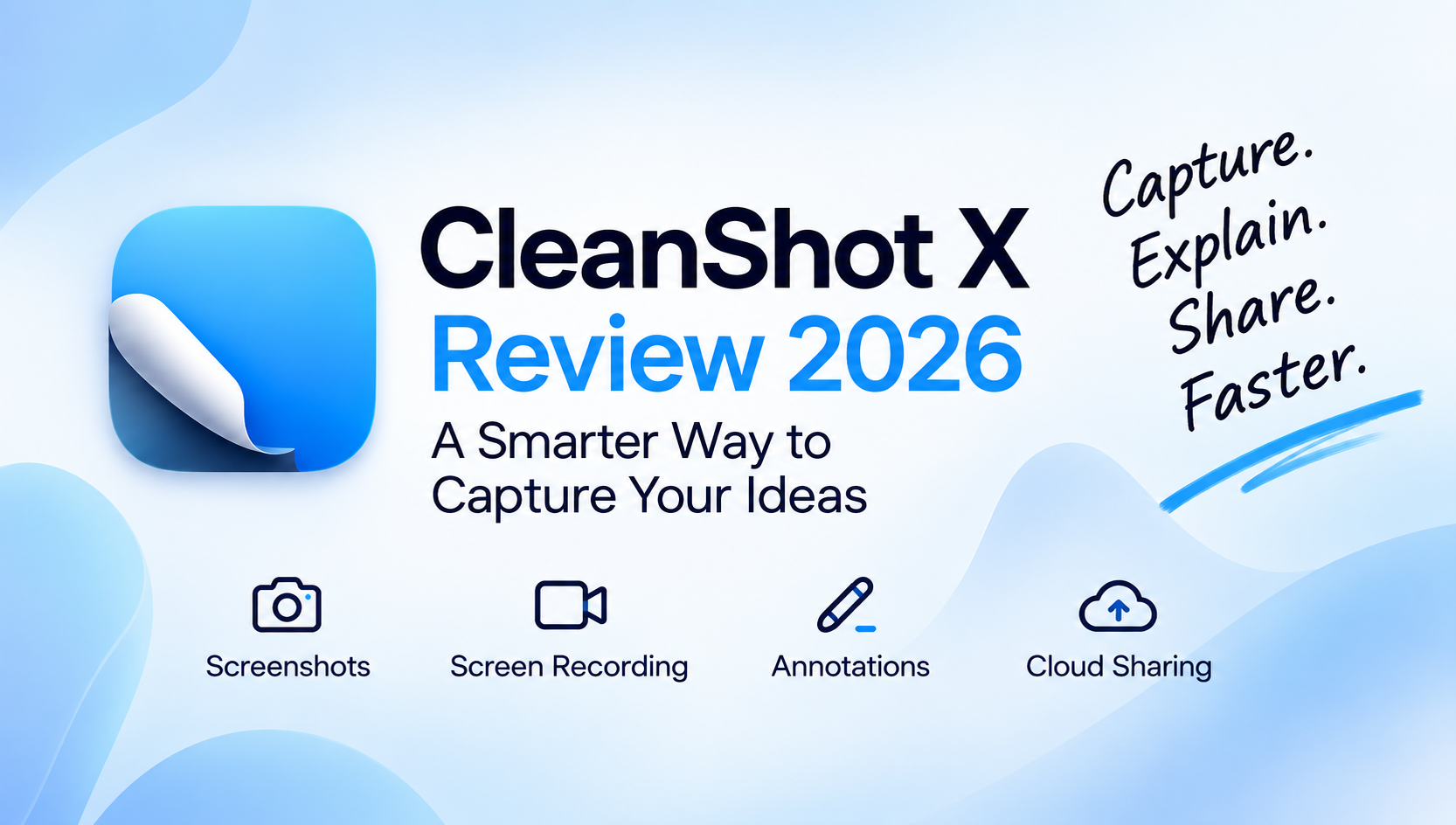
CleanShot X Review 2026: Features, Pricing, Pros, Cons & Is It Worth It?
CleanShot X takes a task that macOS already performs for free—capturing your screen—and builds an unusually complete workflow around it. This review looks beyond the feature checklist to examine how its screenshot tools, scrolling capture, annotation, OCR, screen recording, new Studio Mode, Cloud features, and pricing actually fit together, who benefits most, and where the product still has limitations.
Primary keyword: CleanShot X · Platform: macOS · Pricing checked: September 2026 · Version covered: CleanShot 5.0
Quick Verdict
CleanShot X is a strong fit for Mac users who capture, explain, polish, or share visual information throughout the working day. The value is not simply that it can take screenshots; macOS already does that well. The advantage is the connected workflow around the capture. A screenshot can move immediately into annotation, redaction, background styling, OCR, drag-and-drop sharing, pinning, Cloud upload, or Capture History without forcing you through several separate apps.
CleanShot 5.0 also makes the recording side much more important. Studio Mode adds Smart Zooms, a new Video Editor, cursor smoothing, motion blur, backgrounds for recordings, post-recording customization, and hardware-accelerated rendering. That gives creators, educators, support teams, and SaaS reviewers a practical middle ground between a basic screen recorder and a full professional video editor.
The main caveats are straightforward: it is Mac-only, casual screenshot users may not need it, there is a learning curve if you want to master the shortcuts and advanced workflows, and some team/Cloud capabilities require Pro. For frequent users, however, the $35 Basic license is easier to justify because it is a one-time purchase that includes the full Mac app and one year of updates.
Want to Try CleanShot X?
If CleanShot X matches your workflow, use the button below to view the latest version and current plans. Replace the placeholder URL with your own CleanShot X referral link before publishing.
What Is CleanShot X?
CleanShot X is a Mac-native screenshot, screen recording, editing, and sharing application. Calling it a “screenshot app” is technically correct, but it understates what the product is trying to do. The capture itself is only the beginning. CleanShot X is designed to shorten the path between seeing something on your Mac and turning it into a useful piece of visual communication.
That distinction matters because a normal screenshot workflow often becomes fragmented. You capture an interface, locate the file, open an editor, add an arrow, hide an email address, export another copy, upload it somewhere, and finally share the result. If the page is longer than the screen, you may need a scrolling-capture utility. If you need text from an image, you switch to OCR. If movement matters, you open a screen recorder. CleanShot X brings many of those jobs into one Mac application: area/window/fullscreen capture, scrolling capture, annotation and redaction, Background Tool, Quick Access Overlay, Text Recognition, Floating Screenshots, Capture History, screen recording, video editing, and Cloud sharing.
The practical benefit is therefore less about replacing Command-Shift-4 and more about replacing the small chain of apps and repetitive actions that often follow it. For a person who captures a screen only occasionally, this may be unnecessary. For a developer documenting bugs, a designer giving feedback, a marketer building visual assets, or a reviewer preparing dozens of screenshots for an article, those workflow improvements can compound quickly.
What’s New in CleanShot 5.0?
CleanShot 5.0 was released on September 1, 2026, and the company describes it as its biggest update yet. The central addition is Studio Mode, accompanied by a brand-new Video Editor. The release adds Smart Zooms that follow cursor activity, advanced trimming and fine-tuning, cursor smoothing, cinematic motion blur, backgrounds for recordings, post-recording control over cursor size, keystrokes and camera presentation, hardware-accelerated video rendering, and redesigned application settings.
This update changes the role of CleanShot X. Earlier versions were easy to understand primarily as advanced screenshot software with recording features. Version 5.0 makes screen-video creation a much more serious part of the product. A raw recording is often good enough for a quick bug report, but customer-facing tutorials and product demos have different expectations: the viewer needs to know where to look, cursor movement should not be distracting, mistakes should be removable, and the final video should look intentional. Studio Mode is built around those problems.
Smart Zooms are particularly useful for software demonstrations. When you record a large desktop, the interface element you are discussing may occupy only a tiny part of the frame. A zoom that follows the relevant cursor activity directs attention without requiring the viewer to hunt around the screen. Cursor smoothing tackles a different presentation problem: real mouse movement contains hesitation, overshooting, and tiny corrections that feel natural while using a computer but look messy in a finished tutorial. Motion blur and recording backgrounds are more cosmetic, yet they reinforce the same goal—turning a utilitarian capture into polished screen content.
The new Video Editor also reduces the pressure to record a perfect take. If you make a mistake near the end of a demonstration, trimming and post-recording adjustments can be faster than starting again. CleanShot still is not a substitute for a sophisticated multi-track editor when you are producing complex long-form video, but Studio Mode meaningfully expands how much screen-centric content can be completed without leaving the app.
CleanShot X Screenshot & Capture Tools: Detailed Analysis
Screenshots remain the foundation of CleanShot X. It can capture a selected area, an individual window, the full screen, a timed capture, or scrollable content. Those modes overlap with what macOS already offers, so the important question is not whether CleanShot can capture pixels; it is whether it gives you more control and a better workflow before and after the capture.
Area Capture is useful when you need only a specific part of an interface. CleanShot adds precision tools such as a crosshair and magnifier, which matter more when the screenshot is destined for publication than when it is merely temporary. A few stray pixels, inconsistent framing, or slightly different dimensions across a series of screenshots can make a tutorial or software review look untidy. All-In-One Mode also lets you specify size, lock an aspect ratio, and reuse the previous selection, which is valuable when you need a consistent image format throughout an article or documentation set.
Window Capture is where the product starts to move from “capture utility” toward “content preparation.” CleanShot can present a window with a background, adjust padding, use a custom image or plain color, and control shadows. That means a screenshot can leave the capture workflow already looking suitable for a presentation, blog post, or social update. For a content creator, this can remove a repetitive Canva or Figma step from dozens of images.
CleanShot also includes Freeze Screen, which is useful when the interface you need to capture changes as soon as you move the pointer. Hover states, temporary menus, tooltips, and moving UI elements can be awkward to stage. Freezing the screen lets you capture the state first and define the exact selection afterward. It is not the kind of feature that dominates a marketing page, but it solves a very real documentation problem.
The Background Tool deserves particular attention for publishers and marketers. CleanShot includes 20 built-in backgrounds, custom backgrounds, reusable presets, aspect-ratio controls, and an Auto Balance option that adjusts space around the captured content. Instead of taking a raw screenshot and then rebuilding the presentation in a design app, you can create a consistent visual treatment inside CleanShot. Saved brand presets are especially useful if every screenshot on a site or social account should use the same spacing, background, and overall visual language.
Annotation, Redaction & Image Editing
A screenshot becomes much more useful when it explains what the viewer should notice. CleanShot’s built-in Annotate environment includes crop and resize controls plus arrows, curved arrows, pixelation, blur, spotlight, counters, pencil, highlighter, rectangles, lines, ellipses, and multiple text styles. It also supports rotate and flip operations, a custom color palette, and combining multiple screenshots in one canvas.
The practical value is communication efficiency. A developer can point directly to a broken alignment rather than writing a paragraph describing where it is. A support agent can number three interface elements in the order a customer should click them. A marketer can spotlight the metric that matters in a dashboard. A software reviewer can mark the exact setting being discussed. In each case, the annotation is not decoration; it reduces ambiguity.
Redaction is equally important because screenshots frequently expose information that should not leave the Mac: email addresses, customer names, account IDs, internal URLs, financial figures, or private messages. CleanShot offers blur, pixelation, and solid redaction-style workflows. Its feature documentation specifically notes randomized pixelation for improved security. As with any redaction workflow, users handling truly sensitive data should choose the strongest appropriate method rather than assuming that every visual blur effect is equivalent to secure removal.
One of the more useful long-term features is the CleanShot project file format. Instead of permanently flattening all annotations into the image, you can save an editable CleanShot file and return later to adjust annotations, redactions, and styling. That matters for documentation and review sites because interfaces change. If a product moves a button or updates a pricing screen, being able to revisit the project is more flexible than recreating every annotation from scratch.
Scrolling Capture: One of CleanShot X’s Strongest Features
Scrolling Capture is one of the clearest reasons to use CleanShot X instead of relying exclusively on the standard macOS screenshot workflow. Much of the information people want to document does not fit inside one viewport: full webpages, long chats, dashboards, documentation, source code, settings panels, reports, and tables. The conventional solution is to capture several images and manually stitch them together. CleanShot can instead capture scrollable content as one continuous image.
The important detail is that CleanShot says the feature works across apps rather than only inside a browser. It supports both vertical and horizontal scrolling. Horizontal capture is especially useful for wide tables, timelines, code, dashboards, and other interfaces that extend sideways beyond the visible window. CleanShot 4.8 also improved image stitching and added multi-page printing for scrolling captures, showing that the feature has continued to receive development attention.
For a software reviewer, the benefit is obvious. A long pricing page or analytics dashboard can be shown in context rather than broken into disconnected screenshots. For documentation, a long settings page can remain visually continuous. For customer support, a conversation or workflow can be captured without losing what came before or after the visible section. Product Hunt feedback repeatedly mentions scrolling capture among the capabilities users value, and the feature also appears in independent G2 feedback about everyday CleanShot workflows.
Scrolling Capture is not magic: extremely dynamic pages, unusual rendering behavior, or very long content can still create edge cases, and CleanShot’s historical changelog includes continued algorithm and stitching improvements. But for ordinary webpages and scrollable app content, it addresses a task that otherwise requires a dedicated browser extension or manual assembly.
Quick Access Overlay, OCR, Floating Screenshots & Capture History
Quick Access Overlay may be the feature that best explains why CleanShot X feels faster than a collection of separate tools. Immediately after a screenshot or recording, a small overlay appears with actions to copy, save, annotate, inspect, upload, or drag the capture into another app. Its position, size, auto-close behavior, and multi-display behavior can be customized, and recently closed overlays can be restored.
This sounds minor until you compare the number of steps. A traditional temporary screenshot might become: capture → locate file → open destination → attach file. With CleanShot, it can become: capture → drag from overlay → destination. The difference is only a few actions, but those actions repeat every time you share a screenshot. The overlay also helps keep temporary captures temporary; you do not have to fill the Desktop with files that exist only to be pasted into Slack or a document once.
Text Recognition (OCR) solves a different kind of friction. CleanShot can recognize non-selectable text in images, videos, and scanned documents and copy it to the clipboard. The current feature page lists support for 30+ languages and QR-code reading, and says recognition is performed on-device so the selected content does not need to leave the Mac. The 4.8 update added automatic language detection, while earlier releases expanded language coverage. In practice, OCR is useful for error messages, URLs inside screenshots, serial numbers, scanned text, or any interface where the text cannot normally be selected.
Floating Screenshots let you pin a capture above other applications and adjust its size or opacity. This is particularly useful when coding from a design reference, transferring information between applications, comparing two versions of an interface, or following a checklist without constantly switching windows. Lock Mode can make it possible to interact with content beneath the pinned image, which makes the feature feel more like a temporary reference layer than an ordinary image window.
Capture History provides the safety net. CleanShot can keep up to one month of recent captures, allowing you to restore, copy, share, filter, or delete them. This reduces the need to save every temporary screenshot “just in case” and saves time when you dismiss a capture only to realize ten minutes later that you still need it. Together, Overlay, OCR, pinning, and history illustrate CleanShot’s broader philosophy: the product is designed around what happens to a capture after it is created.
Screen Recording & Studio Mode: More Than a Screenshot Utility
CleanShot X can record a selected window, a custom area, or the full screen as H.264 MP4 video, and it can also create GIF recordings. Recording controls include quality, frame rate, and resolution. The app can record microphone audio and computer audio, automatically enable Do Not Disturb, show or hide the cursor, display recording time in the menu bar, and hide desktop clutter while recording.
For technical communication, the most useful recording features are often the small ones. Click Capture can visually show when the pointer is clicked, with configurable color, size, style, and animation. Keystroke Capture can display all keys or only command keys, with controls over position, size, and light/dark presentation. This is valuable in tutorials because keyboard shortcuts are otherwise invisible to the viewer. Camera Recording can add a presenter bubble with adjustable position, size, shape, and fullscreen mode, while microphone plus system-audio recording makes the tool suitable for demonstrations where both narration and application sound matter.
These features support several distinct workflows. Developers and QA teams can record behavior that a static screenshot cannot explain, preserving the exact sequence of clicks and interface responses. Customer-support teams can replace a long set of written instructions with a short visual walkthrough. Educators can display shortcuts while explaining software. Marketers and SaaS reviewers can demonstrate a feature that only makes sense in motion. GIF output is useful when the interaction is too small to justify a conventional video.
CleanShot 5.0’s Studio Mode adds the layer that was previously missing for polished presentation. Smart Zooms can direct the viewer toward the active part of the interface; cursor smoothing reduces distracting mouse movement; motion blur can make movement feel more deliberate; backgrounds make recordings look more like designed assets; and the new Video Editor lets you trim mistakes and fine-tune the result. Post-recording customization of cursor size, keystrokes, and camera presentation is particularly helpful because it reduces the need to configure every visual detail perfectly before pressing Record.
Hardware encoding is another practical 5.0 improvement because it is intended to accelerate export using Mac-optimized rendering. The result is not a replacement for Final Cut Pro, Premiere Pro, or other full production environments, and CleanShot is still fundamentally screen-content software. But for product walkthroughs, onboarding clips, help videos, social demonstrations, and async explanations, the gap between “recording” and “finished content” is now much smaller.
CleanShot Cloud: Sharing & Collaboration
CleanShot Cloud extends the workflow from creation into distribution. Instead of exporting a capture and manually uploading it to another storage service, you can upload from CleanShot and create a shareable link. The screenshot product page also highlights contextual comments, allowing feedback to remain attached to the visual asset rather than being separated into a long message thread.
For individual users, the Cloud is mainly about speed: capture → upload → share link. For teams, the Pro plan adds unlimited storage, custom domain and branding, advanced sharing and security, centralized access management, SSO, and SCIM. That makes Pro more relevant to organizations that want CleanShot to become part of an ongoing visual-collaboration workflow rather than simply a local screenshot application.
The Cloud is also one area where not every user agrees with the workflow. Product Hunt’s review summary notes criticism around rigidity or “forced cloud usage” from some reviewers, while other users praise one-click uploads and custom-domain capabilities. This is a useful reminder that the Cloud should be evaluated separately from the core Mac app. A local-first individual may care much more about capture, annotation, OCR, and recording than about hosted collaboration.
CleanShot X Pricing 2026: Basic vs Pro
CleanShot currently offers two primary setups, and both include the full Mac application. That is important because Basic is not a heavily stripped-down version of the core capture tool; Pro mainly expands Cloud, branding, security, and team functionality.
| Plan | Price | Mac App | Updates | Cloud | Best Fit |
|---|---|---|---|---|---|
| Basic | $35 one-time | Full app / all app features | One year included | 1 GB | Individuals who want the complete capture/recording app without an ongoing subscription |
| Pro | $10/user/month, billed annually | Full app | Always up to date | Unlimited + custom domain/branding + advanced sharing/security | Teams and Cloud-heavy workflows |
CleanShot’s pricing page states that Basic is “pay once, use forever.” It includes one year of updates, while the purchased version remains usable after that period. Pro is subscription-based and keeps the Mac app current while adding the expanded Cloud and team capabilities. CleanShot requires macOS 13.0 or newer, prices are listed in USD, and taxes may apply at checkout. The company also advertises a 30-day money-back guarantee.
For most individual users, Basic is the more interesting plan because the core value of CleanShot X—screenshots, screen recording, Video Editor with Smart Zooms, annotation tools, and other app features—is included. Pro becomes easier to justify when the Cloud itself is part of the business process: branded sharing, unlimited hosted media, access management, SSO, or team administration.
Value therefore depends less on whether $35 is “cheap” and more on how often the workflow is used. Someone taking a few basic screenshots each month already has a capable free tool in macOS. Someone capturing and sharing screenshots dozens of times per day may recover the cost quickly through saved steps, fewer tool switches, and less manual image preparation.
See the Latest CleanShot X Plans
Check the current Basic and Pro options before purchasing. Replace the URL below with your referral link.
CleanShot X Pros & Cons
Strengths
- Connected workflow: capture, annotate, redact, style, copy, upload, pin, and restore without bouncing through multiple utilities.
- Excellent scrolling capture: useful for webpages, chats, documents, code, dashboards, and horizontal content.
- Deep annotation toolkit: practical tools for tutorials, bug reports, support, and visual feedback.
- On-device OCR: 30+ languages plus QR recognition without sending selected text to an external OCR service.
- Presentation-ready screenshots: backgrounds, spacing, shadows, presets, and Auto Balance reduce design work.
- Strong recording stack: system audio, mic, camera, clicks, keystrokes, GIFs, and now Studio Mode.
- One-time Basic option: the full Mac app is available without forcing individuals into a recurring subscription.
Weaknesses
- Mac only: there is no Windows version, limiting standardization in mixed-device teams.
- Overkill for casual users: basic macOS capture is already good enough for occasional screenshots.
- Learning curve: the large number of modes, shortcuts, and settings rewards learning but can initially feel like more than a simple capture utility.
- Cloud/team value is plan-dependent: advanced hosted sharing and administration are part of Pro.
- Not a full general-purpose video editor: Studio Mode is excellent for screen-centric content but is not intended for complex multi-track filmmaking.
- Some Cloud workflow criticism: independent Product Hunt feedback includes complaints about Cloud rigidity and revisiting older media.
CleanShot X vs macOS, Shottr, Snagit, Loom & Screen Studio
No comparison is useful if every alternative is treated as though it solves exactly the same problem. CleanShot X overlaps with several categories: screenshot utilities, documentation tools, async video platforms, and polished screen-recording software. The best alternative therefore depends on what part of the workflow matters most to you.
| Tool | Primary Strength | Screenshot Workflow | Recording Focus | Best Suited To |
|---|---|---|---|---|
| CleanShot X | Broad Mac capture workflow | Deep: capture, annotation, scrolling, OCR, backgrounds, pinning | Strong, especially with Studio Mode | Mac users who need screenshots and recordings in one workflow |
| macOS built-in | Free and immediate | Good for basic captures | Basic screen recording | Occasional users who do not need advanced post-capture tools |
| Shottr | Focused Mac screenshot utility | Strong screenshot-oriented workflow | Not the same broad video emphasis | Users prioritizing a lightweight screenshot tool |
| Snagit | Capture and documentation workflows | Strong capture/annotation orientation | Recording available | Documentation, training, and cross-platform-oriented capture workflows |
| Loom | Async video communication | Secondary to video | Video-first | Teams whose main output is shareable async video messages |
| Screen Studio | Polished screen-demo video | Secondary to recording | Highly presentation-focused | Creators whose main priority is polished product/demo videos |
CleanShot X vs macOS: this is the most important comparison because macOS costs nothing extra. If you need only area, window, fullscreen captures, and occasional basic recording, there is little reason to pay. CleanShot’s value begins when you repeatedly need scrolling capture, richer annotation, redaction, Background Tool, OCR, Quick Access Overlay, pinning, Capture History, or more polished recording. Macworld’s independent review reached a similar broad conclusion: Apple’s tools are sufficient for many people, while CleanShot is aimed at users who frequently document Mac apps and workflows.
CleanShot X vs Shottr: Shottr is a sensible comparison for users who primarily want an efficient Mac screenshot tool. CleanShot becomes more compelling as the workflow expands beyond static capture into Cloud sharing, richer recording, Studio Mode, backgrounds, and an integrated post-capture ecosystem. If your needs are narrowly screenshot-focused, compare both carefully rather than assuming the larger feature set automatically matters.
CleanShot X vs Snagit: Snagit is well known in capture, annotation, training, and documentation workflows and is relevant to users who want a broader cross-platform-oriented ecosystem. CleanShot’s appeal is its deeply Mac-native feel and the tight connection between quick capture, overlay, pinning, backgrounds, OCR, and the new Studio Mode. The choice depends partly on platform needs and partly on whether your work is documentation-centric or Mac workflow-centric.
CleanShot X vs Loom: Loom begins from video communication, whereas CleanShot begins from screen capture. A user who sends many asynchronous video messages and rarely needs sophisticated screenshots may prefer a video-first workflow. A user who takes 20 screenshots for every one video is much closer to CleanShot’s natural audience.
CleanShot X vs Screen Studio: this comparison became more interesting with CleanShot 5.0. Studio Mode adds Smart Zooms, cursor smoothing, motion blur, backgrounds, and editing, narrowing the gap for polished screen demonstrations. Screen Studio remains a product to consider when the finished screen video is the primary deliverable; CleanShot is more attractive when advanced screenshots and polished recordings both matter.
What Do Real Users Say About CleanShot X?
Independent feedback is particularly useful for CleanShot because many of its benefits are about workflow rather than raw specifications. On Product Hunt, CleanShot currently shows a 4.9/5 rating from 55 reviews. The platform’s review summary highlights built-in annotation, ease of use, video recording, screenshot editing, fast performance, scrolling capture, Cloud upload, GIF export, and the one-time purchase model among commonly praised areas. It also surfaces criticism around forced or inflexible Cloud workflows from a small number of reviewers.
One recurring theme in Product Hunt feedback is time saved on presentation. A reviewer describes previously doing screenshot styling manually in Figma and valuing CleanShot’s ability to add polished backgrounds, padding, shadows, and standardized presentation automatically. Other users emphasize annotation, OCR, pinning, quick sharing, and video capture. These comments align with the core argument of this review: the product’s strength is not merely the number of capture modes but the removal of repetitive work around them.
Macworld’s independent CleanShot X review is older—it was published in 2022, well before Studio Mode—so its old pricing and feature details should not be treated as current. It remains useful, however, as independent evidence of the long-standing distinction between Apple’s basic capture tools and CleanShot’s more elaborate documentation workflow. Macworld particularly highlighted the floating post-capture “command center,” drag-and-drop actions, precise capture tools, annotation, scrolling capture, and Cloud sharing.
Independent review sources:
Ratings and review counts can change over time. Macworld’s review is useful for historical/core-product context, not current 2026 pricing.
Who Should Use CleanShot X?
Software reviewers and affiliate publishers are an especially strong use case. A reviewer can capture a long pricing page with Scrolling Capture, mark a feature using Annotate, apply a consistent background preset, extract inaccessible text with OCR, and drag the final image directly into a publishing workflow. Screen recording then covers interactions that cannot be communicated well through static images. For a site publishing software reviews regularly, this can consolidate several repetitive tasks.
Developers and QA teams benefit from visual bug reporting. A static issue can be captured and annotated; a behavioral issue can be recorded with clicks and keystrokes visible. Floating Screenshots are useful for keeping a design or reference visible while coding, while OCR can quickly extract an error message from an image sent by a customer or teammate.
Designers and product teams can use arrows, counters, spotlight, redaction, image combining, pinning, and Cloud comments to keep visual feedback close to the interface being discussed. Customer-support teams can replace lengthy written instructions with a numbered screenshot or a 30-second walkthrough. Educators and tutorial creators gain system audio, microphone, camera, click highlights, keystrokes, Smart Zooms, and editing tools that make instructional screen content easier to follow.
Marketers and remote teams benefit for a different reason: speed of communication. A screenshot with one arrow can replace a meeting or several paragraphs of explanation. Background Tool can turn raw captures into assets suitable for presentations and social content, while Studio Mode helps create polished feature demonstrations without requiring a full video-production workflow.
Who Should Skip CleanShot X?
CleanShot X is not automatically good value simply because it has many features. Windows users cannot use it. Mac users who take only occasional screenshots and never annotate, scroll-capture, record, or share them professionally are unlikely to gain enough to justify another application. If your entire workflow is Command-Shift-4 followed by pasting the result into a message, macOS already solves the problem well.
It may also be the wrong primary tool if your work is overwhelmingly long-form professional video production. Studio Mode is a major upgrade for screen-centric videos, but CleanShot is not designed to replace a full editing suite with complex timelines, advanced audio work, multicamera production, or extensive effects. Likewise, organizations that need cross-platform standardization should evaluate alternatives that cover both Mac and Windows.
Is CleanShot X Worth It in 2026?
The most useful way to judge CleanShot X is to ignore the number of features and count how often you encounter the problems those features solve. If you take two screenshots a week, the answer is probably no. If you take screenshots all day, annotate feedback, capture long interfaces, extract text, record bugs, prepare tutorials, or repeatedly share visual explanations, the answer changes because the product is saving time around an activity you already perform.
The $35 Basic plan is particularly important to the value calculation. It is a one-time purchase for the full Mac app with one year of updates and 1 GB of Cloud storage, rather than a subscription required just to unlock the main capture tools. CleanShot 5.0 also increases the amount of value inside the core app by adding Video Editor functionality and Smart Zooms to the plan comparison. For individual professionals who use these capabilities frequently, the price can be easier to justify than maintaining separate screenshot, annotation, OCR, and simple screen-video utilities.
The strongest argument for CleanShot X is therefore not “it takes better screenshots.” The better argument is that it shortens the workflow from “I need to show someone this” to “they can see exactly what I mean.” Capture, annotation, redaction, presentation, OCR, recording, and sharing all exist in the same environment. That integration is what frequent users are really paying for.
Is CleanShot X a Good Fit for Your Workflow?
If you regularly capture and explain what is happening on your Mac, review the current plans and decide whether Basic or Pro matches how you work.
CleanShot X FAQ
What is CleanShot X?
CleanShot X is a Mac-native screenshot, screen recording, annotation, editing, OCR, and sharing application. Its feature set includes area/window/fullscreen capture, Scrolling Capture, Background Tool, Quick Access Overlay, Floating Screenshots, Capture History, Text Recognition, screen recording, a Video Editor, and CleanShot Cloud.
How much does CleanShot X cost in 2026?
At the time of this review, CleanShot Basic costs $35 as a one-time purchase and includes the full Mac app, one year of updates, and 1 GB of Cloud storage. CleanShot Pro costs $10 per user per month when billed annually and adds continuous updates, unlimited Cloud storage, custom domain and branding, advanced sharing/security, centralized access management, SSO, and SCIM. Prices are in USD and taxes may apply.
Is CleanShot X a subscription?
Not necessarily. Basic is a one-time purchase described by CleanShot as “pay once, use forever,” with one year of updates included. Pro is the subscription option and is aimed more at users who need expanded Cloud and team functionality.
Does CleanShot X have a free trial?
CleanShot’s pricing page promotes a 30-day money-back guarantee rather than a conventional direct free trial. That gives buyers a period to decide whether the product fits their workflow, subject to the company’s current terms.
Does CleanShot X work on Windows?
No. CleanShot X is designed for macOS. The current pricing page requires macOS 13.0 or newer.
Can CleanShot X capture an entire webpage?
Yes. Scrolling Capture is designed to capture content extending beyond the visible screen. CleanShot says it works in every app and supports vertical and horizontal scrolling, making it useful for webpages, long chats, documentation, code, dashboards, and wide tables.
Does CleanShot X have OCR?
Yes. Text Recognition can extract non-selectable text from images, videos, screenshots, and scanned documents. CleanShot lists support for more than 30 languages and QR-code recognition, and says processing is performed on-device.
Can CleanShot X record system audio and microphone audio?
Yes. CleanShot’s screen recorder can capture computer audio and microphone audio. It also supports camera recording, click visualization, keystroke display, configurable quality/FPS/resolution, MP4 H.264 output, and GIF recording.
What is CleanShot X Studio Mode?
Studio Mode is the major recording-focused addition in CleanShot 5.0. It introduces Smart Zooms, a new Video Editor, cursor smoothing, cinematic motion blur, recording backgrounds, post-recording customization of cursor/keystrokes/camera, and faster rendering with hardware encoding.
How long does CleanShot keep Capture History?
CleanShot can store up to one month of Capture History. Recent screenshots and recordings can be restored, copied, shared, deleted, or filtered by capture type.
Is CleanShot X better than the built-in Mac screenshot tool?
For basic captures, the built-in macOS tools may be all you need. CleanShot X becomes more valuable when you repeatedly need Scrolling Capture, deeper annotation and redaction, Background Tool, OCR, Quick Access Overlay, Floating Screenshots, Capture History, advanced recording, Studio Mode, or integrated sharing.
Final Verdict: Should You Buy CleanShot X?
CleanShot X succeeds because it focuses on the part of screen capture that basic operating-system tools often leave unfinished. Taking the screenshot is easy; making it understandable, presentable, reusable, and shareable is where the work begins. CleanShot connects those steps in a way that feels designed for people who communicate visually rather than people who merely save images of their screen.
The screenshot side remains the foundation. Scrolling Capture solves long-page and long-interface problems. Annotation and redaction turn raw captures into explanations that can safely be shared. Background Tool makes screenshots presentation-ready. Quick Access Overlay and drag-and-drop reduce file-management friction. OCR extracts text that would otherwise need to be retyped. Floating Screenshots keep references visible, and Capture History prevents useful captures from disappearing simply because you closed an overlay.
CleanShot 5.0 strengthens the other half of the product. Studio Mode, Smart Zooms, cursor smoothing, motion blur, backgrounds, post-recording customization, and the new Video Editor mean that CleanShot X can now handle a much larger share of the short-form screen-video workflow. It still does not replace a full professional editing suite, but that is not really the point. Its advantage is being able to move from a screenshot to an annotated explanation to a polished screen recording without constantly changing tools.
For casual users, macOS remains the sensible choice because it is free and already handles basic captures well. For frequent Mac users—especially developers, designers, marketers, software reviewers, support teams, educators, product managers, and remote workers—CleanShot X offers a much stronger case. The more often you need to capture, explain, polish, and share what is happening on your screen, the more useful its integrated workflow becomes.
Bottom line: CleanShot X is worth considering not because Mac users need another way to press a screenshot shortcut, but because frequent users may need a faster way to turn what is on their screen into clear visual communication.
Get CleanShot X for Mac
Ready to see whether CleanShot X fits your workflow? Replace the placeholder below with your affiliate/referral URL before publishing this article.
Research sources used for this review
Affiliate Disclosure: This article may contain affiliate links. If you purchase CleanShot X through one of these links, the publisher may receive a commission at no additional cost to you. Affiliate relationships should not affect the factual analysis or editorial conclusions presented in the review.