FullEnrich vs Apollo.io (2026): Which B2B Data Tool Is Better?
Compare FullEnrich vs Apollo.io for B2B emails, mobile numbers, data accuracy, enrichment, prospecting, integrations, and pricing in 2026.
Affiliate disclosure: This article may contain affiliate links. If you sign up through one of these links, we may earn a commission at no additional cost to you. This does not influence our editorial assessment.
Editorial note: Product features and prices were checked on August 30, 2026. Vendors can change plans, credits, and feature availability, so confirm the latest terms before subscribing.
If you are comparing FullEnrich vs Apollo.io, the most important question is not simply which platform has more features. It is which one fits the job you actually need to complete.
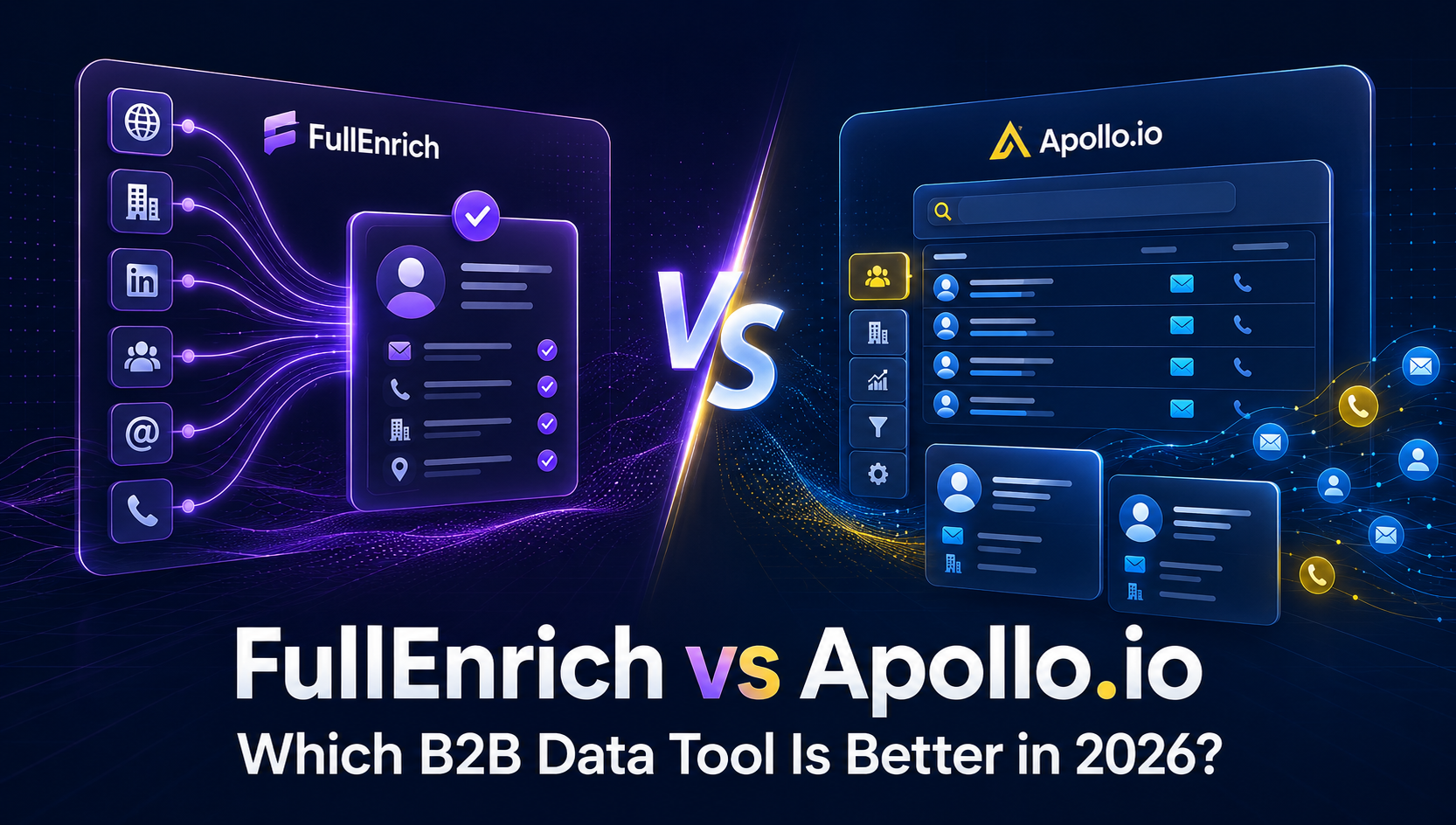
FullEnrich is primarily a B2B contact enrichment platform. It searches across multiple data providers to find and verify work emails, personal emails, and mobile phone numbers. Apollo is a much broader sales platform that combines a large searchable contact database with enrichment, prospecting, outbound sequences, workflow automation, pipeline tools, and other sales-engagement features.
That difference shapes almost every part of this comparison. A team that already has prospect lists and only needs better contact coverage may reach a different conclusion from a team that wants to build lists and run campaigns inside one application.
This FullEnrich vs Apollo comparison examines their data models, email and phone enrichment, verification, search capabilities, integrations, ease of use, credits, pricing, and ideal users. It also explains when using both tools may be more practical than treating them as complete substitutes.
1. Quick Verdict
Choose FullEnrich if your main priority is finding verified contact information for people you already know you want to reach. It is particularly attractive for teams that have a list from LinkedIn, a CRM, a spreadsheet, or another prospecting source and want to maximize the number of records with usable emails and mobile numbers. Its specialized waterfall model, success-based credit deductions, unlimited users, and support for work emails, personal emails, and mobiles make it easy to evaluate as a dedicated enrichment layer.
Choose Apollo if you need a broader sales platform. Apollo is better suited to users who want to search a large native B2B database, create targeted lead lists, access contact information, launch sequences, manage outreach, use buying-intent signals, enrich CRM records, and monitor sales activity from one system.
Neither platform wins every category. FullEnrich is the more focused enrichment product, while Apollo offers the more complete prospecting and sales-engagement environment.
Best for enrichment-first workflows: FullEnrich
Best all-in-one sales platform: Apollo.io
Best approach for some teams: Build lists in Apollo and run difficult or incomplete records through FullEnrich.
Want to test the difference with your own data? FullEnrich provides free starting credits without requiring a credit card. Upload a representative sample rather than your easiest contacts, then compare verified match rates and cost per usable record.
2. FullEnrich vs Apollo at a Glance
| Category | FullEnrich | Apollo.io |
|---|---|---|
| Primary purpose | Contact data enrichment | Prospecting, data enrichment, outreach, and sales execution |
| Core data approach | Waterfall enrichment across multiple sources | Large native B2B database plus enrichment and connected data sources |
| People and company search | Yes, with 30+ filters advertised | Yes, with 240M+ contacts and 65+ filters advertised |
| Work email enrichment | Yes | Yes |
| Personal email enrichment | Yes | Available according to account email settings and data availability |
| Mobile number enrichment | Yes | Yes |
| Bulk CSV enrichment | Yes | Yes |
| CRM enrichment | Yes | Yes |
| API | Yes | Yes; availability and limits vary by plan |
| Outbound email sequences | No | Yes |
| Dialer and call tools | No | Available on eligible plans |
| Buying-intent data | Not a core feature | Yes |
| Free option | 50 starting credits; no card required | Free plan with usage and feature limits |
| User pricing | Unlimited users advertised on all FullEnrich plans | Paid pricing is generally per seat |
| Best for | Teams focused on enrichment coverage | Teams wanting an integrated sales platform |
The table shows why a simple feature-count comparison can be misleading. Apollo naturally wins on total platform breadth. FullEnrich does not attempt to replace a sequencing platform, dialer, or sales workspace. Its value depends more heavily on whether its enrichment process finds accurate information your current source missed.
3. What Is FullEnrich?

FullEnrich is a B2B email and phone enrichment platform designed for sales teams, agencies, recruiters, GTM teams, RevOps professionals, AI agents, and products that need contact data through an API.
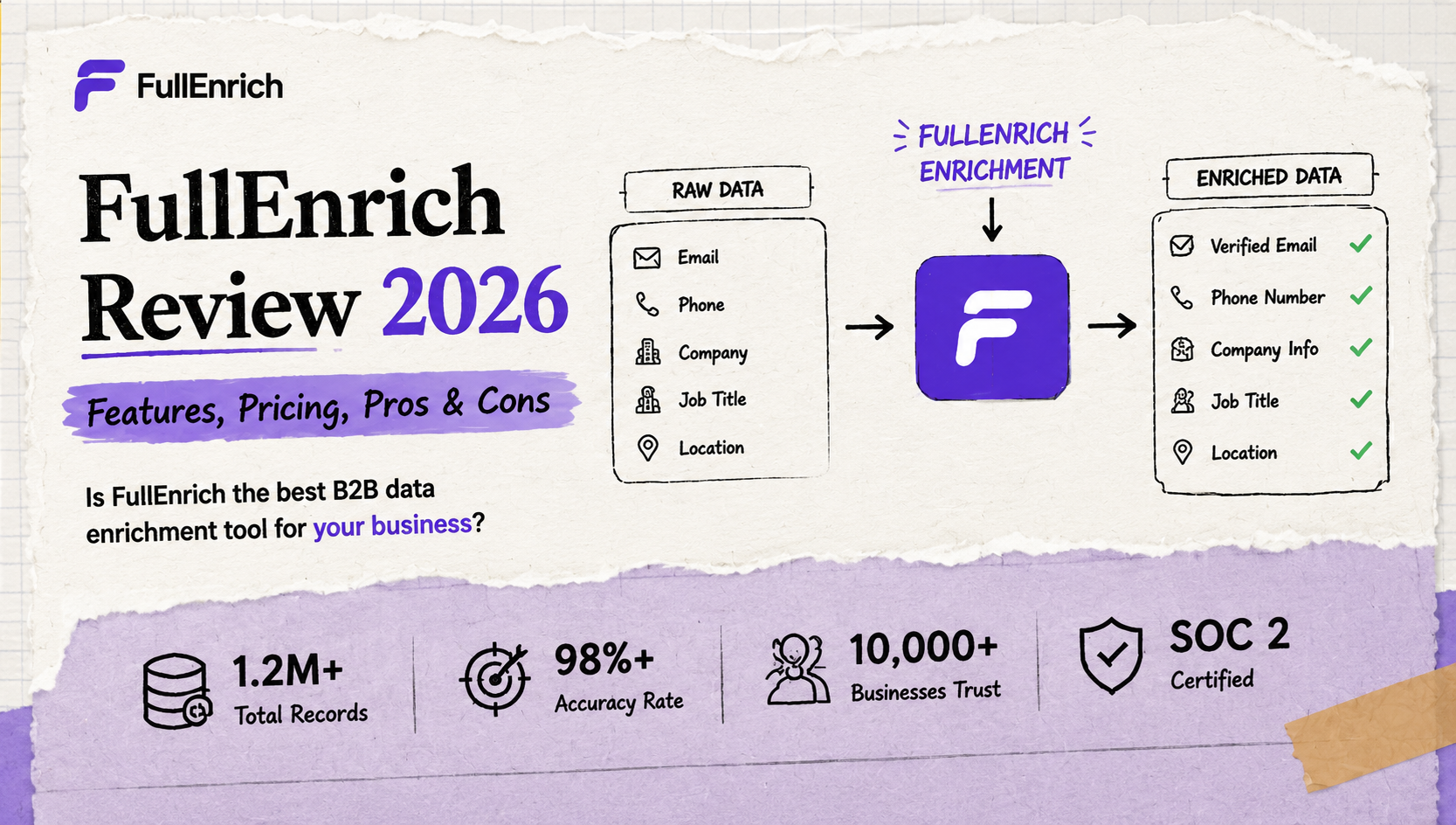
Its central feature is waterfall enrichment. Instead of relying on one source, FullEnrich sends a lookup through a sequence of data providers. If one source cannot find the requested information, the process continues to another. FullEnrich currently advertises access to more than 20 data sources on its homepage and describes 25+ sources on its pricing feature table.
Users can enrich records individually, upload CSV or Excel files, search for people and companies, synchronize data with supported CRMs, or connect through API and no-code integrations. FullEnrich also offers reverse email lookup and an MCP server for AI-oriented workflows.
The platform is not an outbound campaign manager. It gives you contact and profile data that can be exported or passed to the tools where your team already works.
For a deeper examination of its workflow, pricing, limitations, and ideal users, read our complete FullEnrich Review 2026.
4. What Is Apollo.io?
Apollo.io is an end-to-end B2B sales intelligence and engagement platform. Its product scope begins with a large searchable database, but it extends well beyond contact discovery.
Apollo says users can search more than 240 million verified contacts using more than 65 filters. Typical filters cover factors such as job title, seniority, location, industry, company size, technologies, and intent signals. Users can save prospects, organize them into lists, reveal contact information, export records, push data into a CRM, or enroll contacts into outreach sequences.
Apollo also includes or sells access to features such as email sequences, workflow automation, meeting scheduling, lead scoring, AI research, email deliverability tools, dialers, call recording, conversation intelligence, website visitor identification, and deal management. Exact availability depends on the plan and account configuration.
Apollo therefore appeals to teams trying to consolidate multiple sales tools. However, users who only need contact enrichment may not use much of the broader platform.
5. How Their Data Models Differ
The traditional comparison between these tools was straightforward: Apollo provided a large contact database, while FullEnrich searched several external sources in sequence. That description is no longer complete because Apollo now lists waterfall enrichment among its capabilities on eligible plans.
The more useful distinction in 2026 is their product orientation.
FullEnrich is built around enrichment as the main product. A user provides a person, company, domain, LinkedIn profile, email, or list, and FullEnrich attempts to return verified data. The workflow and pricing are structured around successfully found attributes. This makes FullEnrich easy to add on top of another lead source.
Apollo begins with a native prospecting database and surrounds that data with a wider sales workflow. Users can define an ideal customer profile, discover prospects, access contact details, initiate outreach, and manage subsequent activity without leaving Apollo. Enrichment is important, but it is one component of a much larger system.
This creates a practical decision:
- If you already know which people or accounts you want, FullEnrich may provide a cleaner enrichment-first workflow.
- If you need to discover those people before enriching them, Apollo offers stronger native prospecting.
- If Apollo finds most records but leaves gaps, FullEnrich can serve as a second enrichment layer for the unresolved portion.
Avoid judging either product solely by the size of a claimed database or number of sources. Coverage varies by job function, company size, industry, country, and the age of the records. The best evidence is a controlled test using the same representative list.
6. Email-Finding Comparison
Both platforms can find verified business email addresses, but the route to the result differs.
FullEnrich is designed to keep checking sources when an earlier provider does not return an acceptable result. It also applies multiple verification steps before delivering data. According to FullEnrich, approximately 30% of purchased raw data is rejected during verification. Its stated verification process includes syntax and formatting checks, SMTP checks, catch-all verification, confidence scoring, and three independent verification engines for email results.
FullEnrich charges one credit for a successfully found work email, three credits for a personal email, and one credit for reverse email lookup. The company states that failed searches do not consume credits. This model is understandable for teams that want to budget based on returned data.
Apollo provides verified emails while users prospect in its database, use the Chrome extension, enrich a CSV or CRM, or call supported API endpoints. Apollo’s current documentation states that a verified email costs one credit per contact. Depending on the team’s primary email settings, Apollo may return business emails, personal emails, or any verified email available. Apollo says it only charges once for the selected primary email result even if more than one email is returned for the contact.
Apollo also has a useful protection for certain outbound workflows: if an Apollo-verified email is requested and an email sent through Apollo bounces within the eligible period, Apollo says the credit is refunded in the following billing cycle. Check the current rules because the protection depends on how and when the message is sent.
Which one is better for emails?
FullEnrich has the clearer advantage when you already possess a defined list and want a specialized service to search multiple sources for missing emails. Apollo is more convenient when you are discovering prospects and plan to contact them inside the same platform.
The winner on actual coverage cannot be determined from vendor claims alone. Test at least 100–200 records from your real audience and track:
- Percentage of records receiving a verified work email
- Percentage receiving only a personal email
- Duplicate and generic inbox rates
- Bounce rate after a compliant campaign
- Total credits and subscription cost
- Cost per usable, non-duplicate email
7. Mobile-Number Comparison
Phone enrichment is often more expensive and less consistent than email enrichment, so it deserves a separate test.
FullEnrich charges ten credits for a successfully found verified mobile number. It says it checks line status, removes out-of-service numbers, distinguishes mobile numbers from landlines, and can verify ownership names in supported markets. FullEnrich also says that landlines do not consume credits when the user requested a mobile number.
Apollo currently lists phone access at eight credits in its pricing materials. When a user requests phone data, Apollo may search for mobile numbers, direct work numbers, office extensions, and other available phone types. Its documentation says the user is charged once per contact when at least one eligible phone number is found, even if multiple numbers are returned.
On nominal credit use, Apollo’s eight-credit phone lookup appears less expensive than FullEnrich’s ten-credit mobile lookup. However, credits from different platforms are not directly equivalent because the subscription price per credit, included features, returned phone types, verification methods, and match rates differ.
For a fair comparison, calculate the cost per usable mobile number, not the cost per lookup or raw result. Manually audit a small sample, separate mobile numbers from switchboards and landlines, and record wrong-party and out-of-service rates. Teams operating outside North America should include enough contacts from each priority region to reveal geographic differences.
8. Data Accuracy and Verification
FullEnrich places verification at the center of its positioning. Its process combines waterfall discovery with additional screening intended to prevent low-confidence information from reaching the customer. The platform provides email confidence and deliverability information and advertises phone checks for active status and, in certain regions, ownership matching.
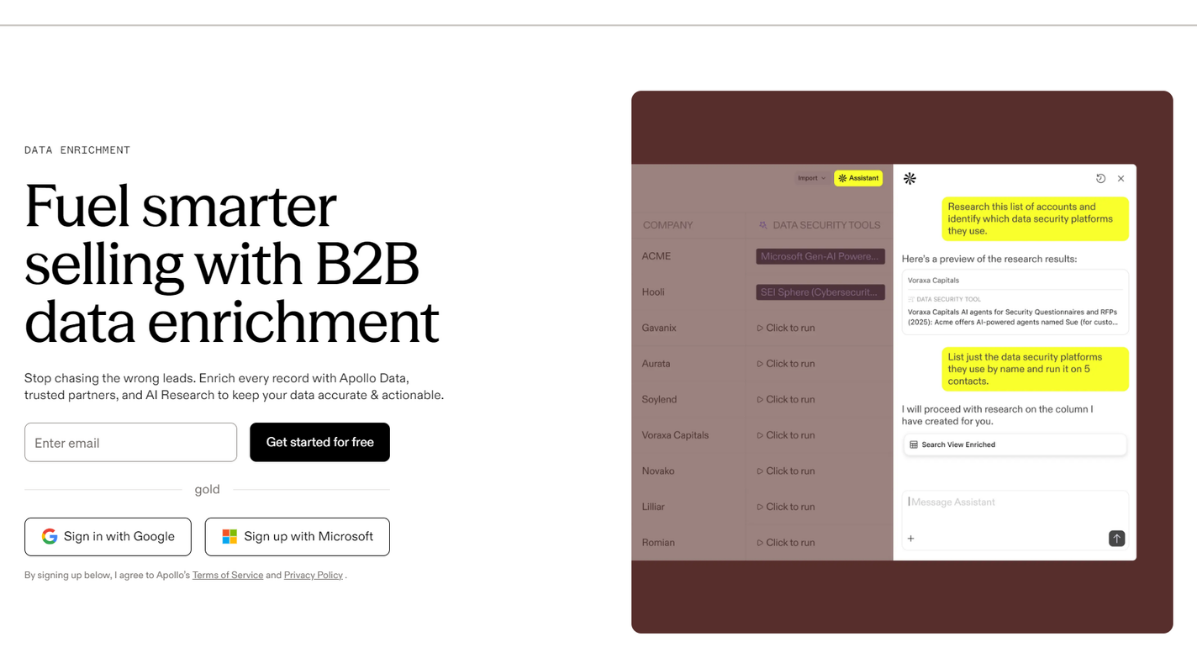
Apollo categorizes email and phone data by status so users can distinguish verified information from records with lower confidence. Apollo reports an email match rate of 84% and accuracy above 90% for its verified email category. These are Apollo’s own platform-level figures, not guaranteed performance for every audience.
Both approaches are useful, but neither eliminates the need for customer-side data hygiene. People change jobs, companies change domains, mailboxes close, and telephone numbers are reassigned. Even a correctly verified record can become stale after it is retrieved.
Your evaluation should separate four concepts that are frequently mixed together:
- Find rate: How many submitted records receive a result?
- Verification rate: How many results pass the platform’s checks?
- Accuracy: Does the email or number belong to the intended person?
- Usability: Can your team lawfully and practically use the result in its workflow?
A provider can have a high find rate but return information that is difficult to use. Another provider may return fewer records but produce a better cost per conversation. The only reliable decision metric is the outcome that matters to your team.
Test FullEnrich with your hardest records—not only your easiest prospects. Upload a balanced sample covering your important countries, industries, company sizes, and job functions, then compare verified coverage and accuracy with your current source.
9. Prospect Search and List Building
Apollo is the stronger prospecting platform.
Its native database and extensive filters allow users to move from a broad ideal customer profile to a targeted list without starting from an external spreadsheet. Teams can combine person-level criteria with company characteristics, intent information, job changes, technology data, and engagement signals. Lists can then feed directly into Apollo sequences, workflows, CRM integrations, or exports.
FullEnrich now offers people and company search, with more than 30 filters advertised. This makes it possible to identify contacts in addition to enriching existing records. Nevertheless, prospect discovery remains a supporting capability within a product primarily differentiated by enrichment.
If your workflow begins with “find 500 marketing leaders at SaaS companies matching these conditions,” Apollo is likely the more complete workspace. If it begins with “we already have 500 target profiles and need verified ways to reach them,” FullEnrich is likely the more natural starting point.
10. Integrations, CRM, and API
Both products support external workflows, but their integration strategies reflect their broader positioning.
FullEnrich supports bulk files, CRM connections, API access, no-code integrations, and an MCP server. Its pricing page currently references HubSpot and lists Salesforce-related workflows on the platform. The API is particularly relevant to agencies, GTM engineers, AI-agent builders, data products, and companies embedding enrichment into internal systems. Enterprise options include higher-volume arrangements, custom rate limits, dedicated support, reseller agreements, and agency-oriented features.
Apollo integrates with major sales and marketing tools and offers CRM, CSV, and API enrichment. Its official materials reference Salesforce, HubSpot, Outreach, Salesloft, Marketo, SendGrid, LinkedIn, and email providers. Apollo can also update stale CRM records, monitor job changes, merge duplicates, and enrich records on a schedule.
Apollo is stronger when enrichment must trigger downstream prospecting, sequencing, calling, and pipeline actions within one platform. FullEnrich is attractive when teams want a dedicated data layer that sends enriched fields into an existing stack.
Before subscribing, verify that the exact integration and API endpoint you need is included in your intended plan. “API access” can refer to different endpoints, limits, and permitted use cases. Reselling or embedding data in a customer-facing product may require an enterprise or separate agreement from either vendor.
11. Ease of Use
FullEnrich has a narrower workflow and is generally easier to understand. Users select an enrichment method, supply records, choose the data types they need, start the job, and export or synchronize the results. A team focused only on contact enrichment has fewer unrelated features to configure.
Apollo’s interface carries more complexity because the product does more. Search, lists, sequences, tasks, CRM records, workflows, meetings, calls, analytics, and AI features require additional setup and governance. That learning curve can be worthwhile when a team plans to use the integrated workflow.
The better experience therefore depends on scope. FullEnrich is simpler as an enrichment utility. Apollo can be more efficient as an end-to-end system after it is configured properly.
12. FullEnrich vs Apollo Pricing
Pricing is not an apples-to-apples comparison because FullEnrich primarily sells enrichment capacity, whereas Apollo bundles contact data with sales software.
FullEnrich pricing
FullEnrich currently offers:
- Free trial: $0, 50 starting credits, no credit card required
- Pro: Volume-based pricing; the displayed 1,000-credit option is $55 per month at the time of checking
- Enterprise: Custom pricing for higher-volume, agency, embedded API, reseller, security, and governance requirements
FullEnrich’s current credit costs are:
| Result | Credits |
|---|---|
| Verified work email | 1 |
| Verified personal email | 3 |
| Verified mobile number | 10 |
| Reverse email lookup | 1 |
| Standalone B2B profile/company data | 0.25 |
Profile and company information is included when another enrichment result is purchased. FullEnrich says credits roll over for three months on monthly subscriptions and twelve months on annual subscriptions. It also advertises unlimited users, which can materially reduce effective cost for larger teams.
Apollo pricing
Apollo currently lists the following annual-billing prices:
| Plan | Price | Annual credits per seat |
|---|---|---|
| Free | $0 | 900, granted monthly |
| Basic | $49 per user/month | 30,000, granted upfront |
| Professional | $79 per user/month | 48,000, granted upfront |
| Organization | $119 per user/month, minimum three users | 72,000, granted upfront |
Apollo’s pricing materials currently show one credit for a verified email, eight credits for a phone number, one to eight credits for enrichment depending on the requested data, and one credit for an AI research run. Features, credit rules, record-selection limits, and export behavior vary by plan and by whether an account uses Apollo’s current or legacy credit system.
Apollo may appear to provide more credits for the money, especially on annual plans, but those credits support a wider range of activities. Teams should account for phone requests, enrichment, AI research, exports where applicable, website visitor features, and email infrastructure actions rather than assuming all credits will be used only for emails.
Pricing takeaway: FullEnrich is easier to evaluate as a dedicated enrichment expense. Apollo may offer greater overall value when your team will actively use its prospecting, outreach, workflow, and pipeline features.
Not sure whether FullEnrich is worth adding to your stack? Use the free credits to measure its incremental verified matches and calculate your cost per usable contact before choosing a paid plan.
13. Cost per Usable Contact
Subscription price and credit quantity do not reveal the true economic result. The best metric is cost per contact your team can actually use.
Consider a hypothetical list of 1,000 target prospects. Provider A costs $50 and returns 700 records, but only 600 are verified, correctly matched, and non-duplicate. Provider B costs $80 and returns 850 records, of which 780 are usable. Provider A costs about $0.083 per usable result, while Provider B costs about $0.103. Provider A remains cheaper, but Provider B supplies 180 additional people who may create more pipeline.
That is why a proper test should report both unit economics and incremental coverage:
Cost per usable contact = total test cost ÷ verified, accurate, non-duplicate results
Also measure:
- Additional contacts found beyond your existing provider
- Cost per incremental contact
- Bounce rate for verified emails
- Valid mobile and right-party rate
- Connect, reply, and meeting rates
- Time saved on manual research and list cleaning
For FullEnrich, the business case is often not replacing every function inside Apollo. It may be recovering valuable records that remain unresolved after the first data source has been exhausted.
14. Pros and Cons
FullEnrich pros
- Specialized waterfall enrichment workflow
- Work email, personal email, and mobile enrichment
- Credits deducted only for successfully found verified data
- Multiple email and phone verification measures
- Unlimited users advertised across plans
- CSV, CRM, API, no-code, and MCP workflows
- Credit rollover
- Free starting credits without a card
FullEnrich cons
- Not a complete outbound sales-engagement platform
- No native email sequencing or dialer comparable to Apollo
- Ten-credit mobile lookup can consume allowance quickly
- Actual coverage varies by audience and geography
- Teams still need another tool for campaign execution
Apollo pros
- Large searchable B2B contact database
- Strong filters and native list building
- Combines data, enrichment, sequences, workflows, and pipeline tools
- Email, phone, CRM, CSV, Chrome extension, and API workflows
- Free plan available
- Can reduce the number of separate sales applications required
Apollo cons
- More complex than a dedicated enrichment tool
- Paid plans are generally priced per user
- Credits can be consumed by several kinds of actions
- Feature, export, and record-selection limits vary by plan
- Some teams may pay for a broad platform while using only a small portion of it
15. Choose FullEnrich If…
FullEnrich is the better choice when:
- You already have target accounts, LinkedIn profiles, or lead lists.
- Your current provider leaves too many emails or mobile numbers unresolved.
- You want a focused enrichment layer rather than a new sales workspace.
- You need work emails, personal emails, mobile numbers, or reverse email lookup.
- Several team members need access and per-seat pricing is undesirable.
- You want to enrich data through CSV, CRM, API, no-code, or AI workflows.
- You prefer to pay credits only when verified information is found.
If these conditions describe your workflow, test FullEnrich using a representative sample before committing to a larger plan.
16. Choose Apollo If…
Apollo is the better choice when:
- You need to discover prospects as well as enrich them.
- You want a large native database with advanced search filters.
- Your team plans to run outbound email sequences from the same platform.
- Buying intent, workflow automation, dialers, analytics, and pipeline tools matter.
- Consolidating multiple sales applications is a priority.
- You want prospect data and sales engagement under one subscription.
- Your organization has the time and resources to configure a broader platform.
Apollo is particularly compelling for founders, SDR teams, sales managers, and RevOps teams building a repeatable outbound operation from the beginning.
17. Should You Use FullEnrich and Apollo Together?
For some teams, this is the most practical option.
Apollo can function as the prospect discovery and campaign platform. A user defines the target audience, searches the database, creates lists, and retrieves the contact data Apollo can verify. Records that remain incomplete can then be exported or routed through FullEnrich, subject to each platform’s terms and the team’s compliance requirements.
A combined workflow might look like this:
- Define your ideal customer profile.
- Build the target list in Apollo.
- Access and verify available contact details.
- Remove duplicates and exclude existing customers or suppressed contacts.
- Send missing or difficult records to FullEnrich.
- Validate and merge the returned fields.
- Push the final list into the approved outreach workflow.
- Measure results by original data source.
Do not enrich every record twice by default. Start with unresolved or strategically valuable contacts. This keeps costs controlled and reveals the incremental contribution of FullEnrich.
18. Final Verdict
FullEnrich and Apollo overlap in contact data and enrichment, but they are designed around different centers of gravity.
FullEnrich is the better fit for an enrichment-first workflow. It is built for teams that already know whom they want to contact and need a specialized system to search across data sources, verify returned information, and fill missing work emails, personal emails, and mobile numbers. Its success-based credit model and unlimited-user policy make it especially interesting as an additional data layer.
Apollo is the better all-in-one platform. Its large database, filters, enrichment, sequences, workflows, CRM capabilities, sales intelligence, and execution tools make it suitable for teams that want to discover prospects and act on them in the same environment.
Our recommendation is simple: choose based on the missing part of your workflow. If you lack prospect discovery and campaign execution, start with Apollo. If you already have the people but lack reliable contact coverage, test FullEnrich. If Apollo supports your overall process but leaves valuable gaps, consider using FullEnrich selectively for the unresolved records.
Do not rely on advertised database size or find-rate claims alone. Test both products on the same representative sample and compare verified coverage, accuracy, incremental matches, and cost per usable contact.
Our recommendation for enrichment-focused teams: Start with FullEnrich’s free credits, submit a challenging sample of your real prospects, and measure the results before upgrading.
For a closer look at the platform itself, see our in-depth FullEnrich review.
19. Frequently Asked Questions
Is FullEnrich better than Apollo?
FullEnrich is better when your primary requirement is enriching an existing list with verified emails and mobile numbers. Apollo is better when you need a broader system for database search, list building, enrichment, email sequences, workflows, and sales execution. The better product depends on whether your workflow is enrichment-first or platform-first.
Is FullEnrich an Apollo alternative?
FullEnrich can replace Apollo for some contact-enrichment tasks, but it is not a complete replacement for Apollo’s sales-engagement platform. FullEnrich does not offer the same breadth of native sequencing, dialer, intent, pipeline, and sales-execution tools. It is more accurate to describe it as an Apollo data-enrichment alternative or complementary provider.
Which tool is better for finding work emails?
Both tools find verified work emails. FullEnrich searches multiple providers through a waterfall workflow and is well suited to enriching lists assembled elsewhere. Apollo is more convenient when the prospect was discovered in Apollo and will be contacted through Apollo. Use the same test list to determine which has better coverage for your market.
Which tool is better for mobile phone numbers?
FullEnrich focuses specifically on verified mobile enrichment and charges ten credits for a successfully found mobile number. Apollo currently charges eight credits for phone access and may return several phone types. Because their credits and outputs are not identical, compare cost per valid mobile number rather than credits alone.
Does Apollo offer waterfall enrichment?
Yes. Apollo now lists waterfall enrichment among the capabilities available in its current product and plan structure. Feature availability depends on the plan and account. This means the comparison should focus on implementation, coverage, pricing, integrations, and broader workflow—not the outdated assumption that Apollo relies on only one source.
Does FullEnrich have a contact database?
FullEnrich offers people and company search in addition to enrichment and advertises hundreds of millions of people and millions of companies in its search environment. However, Apollo remains the more comprehensive native prospecting platform because its database search connects directly to intent data, lists, sequences, workflows, and other sales tools.
Can I upload a CSV to both platforms?
Yes. FullEnrich supports bulk CSV and Excel enrichment. Apollo also supports CSV enrichment and provides a report showing how the uploaded data was updated. Review the required fields and credit rules before running a large file.
Does FullEnrich charge for failed searches?
FullEnrich says credits are deducted only when it successfully finds verified data. Failed lookups do not consume credits. Different attributes have different costs, so finding a work email, personal email, and mobile number for the same person may use more than one type of credit charge.
Does Apollo have a free plan?
Yes. Apollo offers a free plan with limited credits and usage. It is suitable for exploring the interface and testing basic workflows, although paid plans provide higher limits and additional functionality.
Does FullEnrich offer a free trial?
Yes. FullEnrich currently provides 50 starting credits without requiring a credit card. Those credits can be used to test its data quality on a sample before purchasing a paid plan.
Can I use FullEnrich and Apollo together?
Yes, provided your workflow complies with both vendors’ terms and applicable privacy and outreach rules. One common approach is to build and manage a list in Apollo, then use FullEnrich only for important records that still lack verified contact information.
Which tool is better for agencies?
It depends on the service. Lead-generation and enrichment agencies may prefer FullEnrich’s unlimited-user structure, API options, multi-source coverage, and enterprise agency features. Agencies that execute full outbound programs may benefit more from Apollo’s prospecting, sequencing, workflow, and reporting tools. Some agencies may use both.
Which tool is better for recruiters?
FullEnrich may suit recruiters who already source candidates through LinkedIn, an applicant-tracking system, or specialist databases and need personal or professional contact details. Apollo may be more useful for business-development prospecting and corporate recruiting searches where its native filters match the target audience. Recruiters should confirm that their use of personal data complies with applicable laws and platform rules.
Which platform is more affordable?
FullEnrich can be more economical for teams that only need enrichment, especially when several users require access. Apollo can deliver better total value for teams that would otherwise pay separately for prospecting data, sequences, workflows, and sales tools. Calculate cost per usable contact and the cost of the full required software stack rather than comparing entry prices alone.
How should I test FullEnrich against Apollo?
Create a sample of 100–200 real prospects representing your important geographies, industries, company sizes, and seniority levels. Submit the same normalized records to both tools. Compare verified email coverage, valid mobile coverage, duplicates, accuracy, bounce rate, credit use, total cost, and incremental matches. Keep the results separated by region and persona so a strong segment does not hide a weak one.
- FullEnrich Review 2026 → https://esapplication.com/fullenrich-review-2026/