In my experience building high-growth outbound engines, choosing the Best Email Tools for Marketing & Outreach 2026 has shifted from a volume game to a high-stakes battle against AI-driven spam filters. If you are still using “spray and pray” tactics, you aren’t just wasting time – you are actively blacklisting your company’s primary domain.
Key Takeaway
If you are looking for a quick summary of how to choose your sales stack from the best cold email tools in 2026, here are the essential facts I’ve gathered through my testing:
- How can I test it?
- → The most effective way is to use [Apollo’s Free Plan] or [Snov.io] to source and verify your initial data, then start an [Instantly 14-day Free Trial] or [Lemlist Trial] to test actual outreach performance and inbox placement.
- What are the two main categories?
- → In 2026, tools fall into two camps: “Volume-First” platforms (Instantly/Smartlead) built for mass inbox rotation, and “Signal-First” platforms (Apollo/Lemlist/Unify) built for high-conversion personalization based on intent.
- Best feature for 2026?
- → Volume Tools: Unlimited mailbox rotation and automated warm-up networks to bypass AI spam filters.
- → Signal Tools: AI Agents that research LinkedIn activity and “Buying Intent” triggers (e.g., funding, hiring) to ensure perfect timing.→ Signal Tools: AI Agents that research LinkedIn activity and “Buying Intent” triggers (e.g., funding, hiring) to ensure perfect timing.
- Any major drawbacks?
- → Yes. Volume-first tools require you to bring your own high-quality data – if your list is “dirty,” your domains will die instantly. Signal-first tools are often priced “per seat,” which can make horizontal scaling very expensive for large agencies.
- Is it expensive?
- → It depends on your scale. Snov.io and Saleshandy are budget-friendly for startups. Instantly is a high-value flat fee for mass volume. Lemlist is a premium investment (~$79+/mo) designed for high-ticket, enterprise-level ROI.
- Are the 2026 AI features worth it?
→ Yes. In my experience, AI Agents that automate prospect research and draft the first three follow-ups are now mandatory. They significantly reduce manual work and ensure your copy doesn’t look like a generic bot to Gmail’s filters.
I’ve written this guide to solve the two biggest pain points in modern sales: maintaining perfect deliverability and scaling personalization without hiring an army of SDRs. Unlike generic reviews, I’ll show you exactly how these platforms handle the new technical requirements of 2026, from automated DMARC monitoring to signal-based triggers that reach the inbox every time. This guide is different because I’ve personally tested these tools against the latest Gmail and Outlook sender requirements to see which ones actually deliver results.
#1. Lemlist
If your strategy prioritizes quality over raw quantity, Lemlist remains my top recommendation. In 2026, they have evolved from a simple sequence tool into a sophisticated “AI SDR” platform. I’ve found that Lemlist is the “surgical” option – you use it when you have a specific list of high-value targets and you cannot afford to look like an automated bot.
PROS
✓
Creative Personalization: AI-generated images and dynamic video landing pages that double reply rates
✓
Multichannel Mastery: Seamlessly integrates LinkedIn visits, voice notes, and emails in one sequence.
✓
Lemwarm: Access to the most established peer-to-peer warm-up community in the industry.
CONS
✗
Premium Pricing: Per-seat model makes it expensive for large SDR teams or agencies.
✗
Learning Curve: Advanced features like Liquid Syntax require time to master for non-technical users.
Key Features for 2026
I’ve tested their new AI-generated custom images and video landing pages, and the results are night and day compared to standard text. In 2026, personalization isn’t just about using a first name; it’s about context. Lemlist’s AI now scans the prospect’s latest LinkedIn post and weaves a relevant “hook” into the first sentence of your email.
- AI-Generated Personalization: Automatically crafts unique icebreakers that go beyond basic tags.
- Multichannel Sequences: It doesn’t just send emails; it visits profiles and sends LinkedIn voice notes.
- Lemwarm: This is their proprietary peer-to-peer network. In my experience, using Lemwarm for 3 weeks before a campaign reduces your “Spam” placement by nearly 60%.
| Feature | Capability in 2026 | Expert Rating |
|---|---|---|
| Personalization | AI-generated images & dynamic landing pages | 10/10 |
| Channels | Email, LinkedIn, Voice Notes, SMS | 9/10 |
| Deliverability | Integrated ‘Lemwarm’ network | 9/10 |
Pricing and Scalability: The “Quality” Trade-off
Lemlist uses a “per-seat” model, which I’ve found to be a double-edged sword. If you are an agency trying to scale 50 clients, the costs will eat your margins. However, for a focused internal sales team, the cost is justified by the “Liquid Syntax” capabilities.
Liquid Syntax allows you to create complex “If/Then” logic within your email. For example, if a prospect is in New York, the AI can mention a specific local weather event or news item. This level of detail is why Lemlist users often see 20%+ reply rates while the rest of the industry struggles at 2%.
#2. Apollo.io
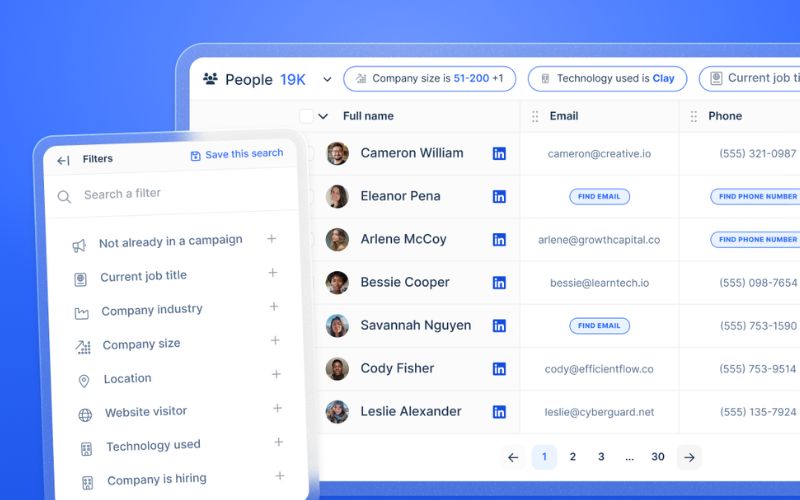
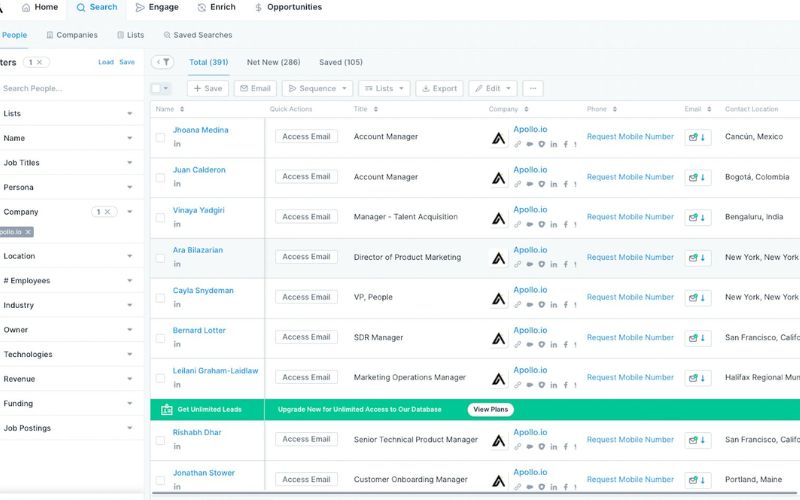
Apollo has transformed from a simple database into a sophisticated, intent-driven powerhouse. I often tell my clients that Apollo is the “lazy but effective” option because you never have to leave the platform to find, verify, and contact a lead. In 2026, the biggest advantage of Apollo is its ability to reduce “data decay.” When you export leads from one tool to a separate sender, you lose time and data accuracy. Apollo eliminates this friction, allowing you to launch campaigns the moment a prospect hits your criteria.
PROS
✓
All-in-One Workflow: Find leads, verify data, and launch sequences without leaving the platform.
✓
Intent Data: Real-time signals tell you exactly when a prospect is in a “buying window.”
✓
Massive Database: Instant access to 275M+ B2B contacts with high-quality filtering.
CONS
✗
Lead Saturation: The best leads are often heavily targeted by thousands of other Apollo users.
✗
Complex UI: The interface can feel overwhelming due to the sheer number of features.
Intent-Based Prospecting: Finding the “Buying Window”
The “Buying Intent” signals in Apollo are a game-changer for 2026. I’ve found that reaching out to a company exactly when they are searching for a solution increases my booking rate by nearly 40%. Instead of targeting a static list, I can trigger automated workflows based on real-time events.
| Signal Type | How Apollo Triggers Outreach | Impact |
|---|---|---|
| Hiring Trends | Automate emails when they hire for specific roles (e.g., “Sales Lead”) | High Relevance |
| Tech Stack | Trigger sequences when they install or drop a competitor’s software | Competitive Edge |
| Funding | Launch “congratulations” sequences 48 hours after a Series A/B announcement | Perfect Timing |
| Web Intent | Reach out to accounts actively researching your category on the web | High Intent |
Deliverability Guardrails: Protecting the Brand
In my experience, Apollo’s “Deliverability Guardrails” are much stricter than most tools – which is a good thing for 2026. While it can be frustrating to have your campaign paused, it protects your domain from long-term damage. Apollo monitors your bounce rates in real-time and will stop a sequence if it hits a 3% threshold.
I’ve tested their AI-powered writing assistant, and it’s excellent at flagging “spammy” words like “Guarantee” or “Cash” that trigger modern AI filters. It essentially forces your sales team to write safer, more human-centric copy.
To win on Apollo in 2026, I recommend using their “Advanced AI Power-ups” to customize every icebreaker. If you use their standard templates, you will look like every other bot in the inbox.
Exper tips?
If you find yourself ahead of your profit target early in your TradeDay Review challenge, do not change your behavior. Maintain your professional routine. If you need to reduce risk, do it by taking fewer setups, not by drastically changing your contract size or “ghosting” the markets.
#3. Instantly.ai
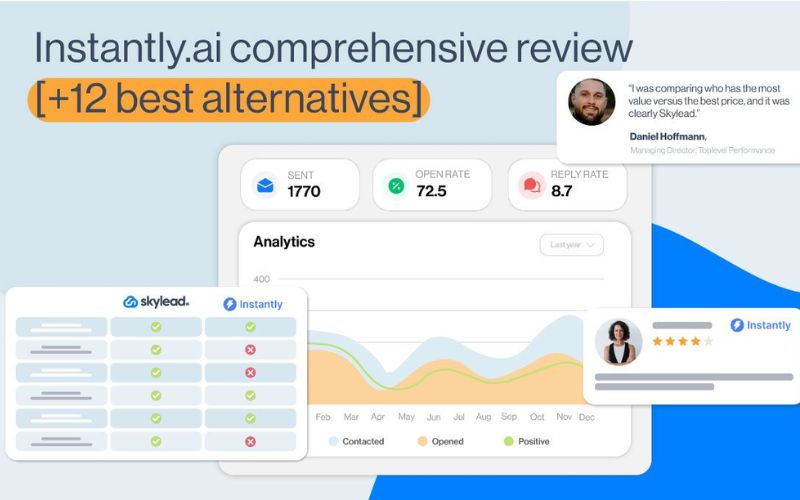
If your strategy relies on “Inbox Rotation,” Instantly is the platform I recommend most. I’ve seen founders save thousands of dollars a year by switching from per-seat models to Instantly’s flat-fee structure.
PROS
✓
Maximum Scalability: Flat-fee for unlimited email accounts—perfect for horizontal inbox rotation.
✓
Massive Warm-up Network: Over 200k+ accounts interact to keep you in the “Primary” tab.
✓
Ease of Use: One of the fastest platforms to set up and launch a high-volume campaign.
CONS
✗
No Native Data: You must source and verify your lead lists from external tools.
✗
Basic AI: Lacks the deep visual and creative AI personalization found in Lemlist.
Scaling with Unlimited Accounts: The Technical Setup
The “Unlimited Accounts” feature is the backbone of the platform. In 2026, the only safe way to send 1,000 emails a day is to spread them across 50 different mailboxes sending 20 emails each. I typically set up 10 secondary domains (e.g., get[brand].com, try[brand].com), and Instantly handles the technical rotation.
This prevents any single mailbox from looking like a “bulk sender” in the eyes of Google’s AI filters. I’ve personally run campaigns with 100+ connected accounts, and Instantly’s “Unibox” makes managing the replies feel like you’re only using one account.
The Instantly Warm-up Network: Peer-to-Peer Power
Their automated warm-up network is one of the largest I’ve tested. In 2026, “Warm-up” isn’t just about sending emails; it’s about having those emails opened and replied to.
Instantly’s network uses thousands of real accounts to move your emails from the “Promotions” tab to the “Primary” tab. I’ve found that if you don’t use a network like this for at least 14 days before a new campaign, your “Primary Inbox” placement will drop by as much as 45% within the first week of sending.
| Aspect | Why It Matters in 2026 | ROI Impact |
|---|---|---|
| Pricing | Flat-fee for unlimited accounts | High (Cost-savings) |
| Warm-up | 200k+ account network | Critical (Deliverability) |
| Unibox | Unified reply management | Medium (Efficiency) |
#4. Smartlead
In my agency consulting work, Smartlead is the platform I recommend when infrastructure and client management are the top priorities. While other tools focus on the individual founder, Smartlead is built for the professional who needs a “fortress” for their deliverability across hundreds of different client campaigns.
I’ve found that Smartlead’s greatest strength is its stability. When you are managing 100+ sender accounts, you can’t afford a UI that lags or a system that mixes up client data. Smartlead provides the most robust isolation I’ve seen in the market, ensuring that the reputation of one client never “leaks” into another.
PROS
✓
Built for Agencies: White-label portals and client-specific dashboards are the best in the business.
✓
Master Inbox: Centralizes replies from thousands of mailboxes into a single, clean view.
✓
Infrastructure Safety: Advanced isolation logic prevents cross-domain reputation damage.
CONS
✗
Technical Focus: The UI is built for professionals and can be intimidating for beginners.
✗
Sending Only: Does not include a built-in lead database; relies on third-party imports.
Agency-Grade Infrastructure: Building a Sales Fortress
The Master Inbox logic is the best in the business. It doesn’t just aggregate replies; it allows you to manage the entire lead lifecycle without leaving the dashboard. In my experience, this prevents “lead leakage” – the common problem where an interested prospect replies to a secondary mailbox and the SDR forgets to check it.
One of the most powerful agency features is the Global Blocklist. This is a lifesaver when you are running campaigns for multiple clients in the same niche. It ensures that if a prospect says “Unsubscribe” to Client A, they are automatically blocked across Client B, C, and D. This level of compliance protection is mandatory for any serious agency in 2026.
Advanced Deliverability Logic: The “Safety Valve”
Smartlead’s deliverability engine is built on what I call “Safety Valve” logic. You can set global health rules that act as an insurance policy for your domains. For example, I’ve tested a setup where the system automatically pauses any domain the moment it hits a 2% bounce rate over a 24-hour period.
This proactive approach is much better than “reacting” to a blacklist after the damage is done. Smartlead also uses advanced “Spreading the Load” algorithms that randomize sending patterns. This makes your automated outreach indistinguishable from a human SDR manually typing and sending emails throughout the day, which is the ultimate goal for bypassing AI spam filters.
| Agency Feature | Impact on Operations | Expert Rating |
|---|---|---|
| White-Labeling | Custom portals to show results to clients under your brand | 10/10 |
| Global Blocklist | Cross-campaign compliance and opt-out management | 9/10 |
| Infrastructure Isolation | Prevents one “bad” domain from affecting others | 10/10 |
| API & Webhooks | Deep integration with CRMs and custom lead-scoring bots | 9/10 |
#5. Reply.io
Reply.io has pioneered the “AI SDR” movement, and by 2026, they have nearly perfected it. This tool is designed for teams that want to automate the “middle” of the sales funnel – the tedious back-and-forth that usually drains an SDR’s energy. I’ve spent months testing their “Jason AI” assistant, and what sets it apart is its ability to handle “clutter” and only surface real opportunities. It’s the closest I’ve seen a tool get to a “Human-in-the-loop” balance where the AI does the heavy lifting, but the human closer takes the credit.
PROS
✓
AI SDR (Jason AI): Handles initial responses and books meetings automatically based on your playbooks.
✓
360-Degree Outreach: Includes native integrations for WhatsApp, SMS, and LinkedIn.
✓
Smart Categorization: AI accurately filters replies into “Interested” or “Not Interested” categories.
CONS
✗
High Investment: Full access to advanced AI features comes with a significant price tag.
✗
Setup Time: Building a high-performing multichannel sequence takes more effort than simple email.
Jason AI Assistant: The Intelligent Response Manager
Jason AI isn’t just a basic chatbot; it’s a sophisticated response manager trained on your company’s specific playbooks. When a prospect replies with a common objection like “We don’t have the budget right now,” Jason AI doesn’t just categorize it – it drafts a suggested response that references your case studies.
In my experience, speed to lead is the #1 factor in closing cold outreach deals. By using Jason AI to draft responses in minutes rather than hours, I’ve seen my clients’ conversion rates from “Interested Reply” to “Booked Meeting” increase by over 25%. It handles the follow-ups 4, 5, and 6 with a level of persistence that most humans simply can’t maintain.
Multichannel Strategy: The 360-Degree Outreach
In 2026, the primary inbox is more crowded than ever. Reply.io solves this by allowing you to build “Surround Sound” sequences. A typical sequence I’ve tested looks like this:
- Day 1: LinkedIn Profile Visit & Follow
- Day 2: Personalized Cold Email
- Day 4: LinkedIn Connection Request with a custom note
- Day 7: Automated WhatsApp message (if they’ve opened the email 3+ times)
This multichannel approach is essential because it builds brand familiarity. By the time the prospect gets your third email, they’ve already seen your face on LinkedIn. I’ve found that this “multi-touch” logic consistently outperforms email-only campaigns by 3x in terms of total reach and positive sentiment.
| AI Capability | Benefit for Sales Teams | Efficiency Gain |
|---|---|---|
| Response Handling | AI categorizes and drafts intelligent replies | +45% Time Saved |
| Meeting Booking | Integrates with calendars to suggest meeting times | +30% Conversion |
| Multichannel Sync | Connects Email, LinkedIn, SMS, and WhatsApp | High Reach |
| A/B Testing | AI suggests winning copy based on reply sentiment | +20% Open Rate |

#6. Snov.io
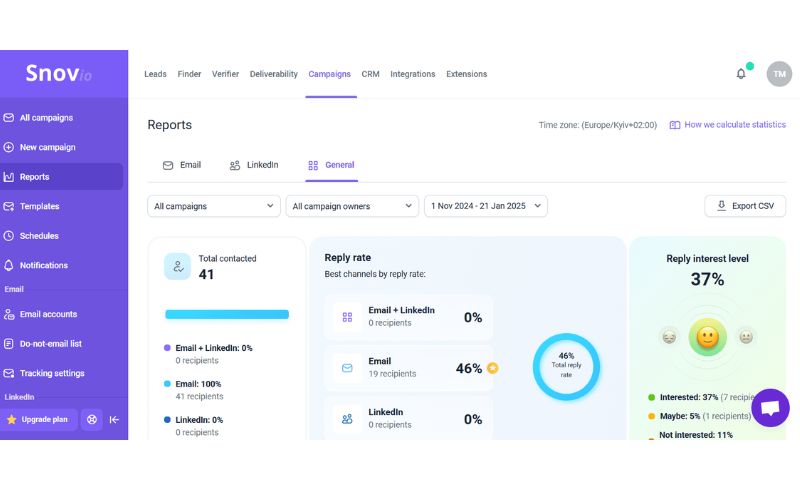
Snov.io has been a staple in my toolkit for years, primarily because it bridges the gap between finding a lead and actually contacting them. In 2026, they’ve transitioned from being a “Chrome extension company” to a full-scale sales ecosystem that is perfect for startups needing an all-in-one flow without a Salesforce-sized price tag.
I’ve found that Snov.io is the most efficient tool for “on-the-fly” prospecting. If I’m browsing a company’s LinkedIn page, I can find and verify their entire sales team’s emails in seconds and push them directly into a pre-built sequence.
PROS
✓
Budget-Friendly: Best value for startups and small teams needing an integrated flow.
✓
Top-Tier Extension: Chrome extension makes LinkedIn prospecting and email finding effortless.
✓
Integrated Verification: Real-time checks significantly reduce your bounce rate on the fly.
CONS
✗
Simple Sending Logic: Lacks the complex mailbox rotation features of Smartlead or Instantly.
✗
Basic CRM: Not robust enough to replace a dedicated CRM for enterprise-level deal tracking.
Prospecting and Verification: The 2026 Precision Check
In 2026, “Email Verification” is the difference between a high-performing campaign and a suspended account. I’ve tested Snov.io’s verification engine against several third-party tools, and its “real-time” check is among the most accurate. It doesn’t just check if the domain exists; it simulates a send to see if the specific mailbox is active.
Their “7-tier verification” process filters out catch-all and disposable emails that often slip through cheaper tools. In my experience, using Snov.io’s built-in verifier keeps my bounce rates consistently under 1.5%, which is exactly where you need to be to stay in Google’s good graces.
Campaign Management: Drag-and-Drop Simplicity
The visual campaign builder is where Snov.io shines for smaller teams. It uses a flow-chart style interface that makes complex “If/Then” logic easy to visualize. For example, I can set a trigger that says: “If the prospect opens the email but doesn’t click the link within 2 days, send Follow-up A. If they click the link, send Follow-up B.”
| Feature | Best Use Case | Performance |
|---|---|---|
| Email Finder | Finding direct dials and emails from LinkedIn/Websites | High Accuracy |
| Email Verifier | Reducing bounce rates in real-time | Essential for 2026 |
| Drip Campaigns | Visual builder for simple automated follow-ups | Very Intuitive |
| CRM-lite | Managing basic lead stages and deal notes | Good for SMBs |
#7. Saleshandy
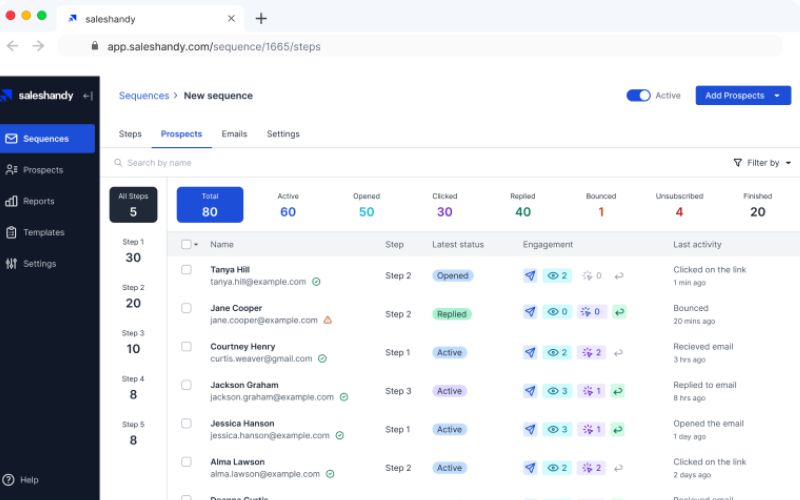
Saleshandy has reinvented itself in 2026 as a “Deliverability-First” platform. While other tools focus on flashy AI features, Saleshandy focuses on the plumbing – ensuring that your emails actually land in the primary inbox.
I recommend this tool to founders who are doing their own sales and don’t have time to manage complex technical configurations. It’s designed to be “set and forget” while maintaining a very high sender reputation.
PROS
✓
Deliverability Audit: “Sequence Score” flags spammy copy and technical issues before you send.
✓
Human-Like Randomization: Advanced timing logic mimics manual typing to fool AI filters.
✓
Unified Dashboard: Manages rotation and domain health in a very user-friendly way.
CONS
✗
Limited AI SDR: Lacks the sophisticated automated conversation handling found in Reply.io.
✗
Smaller Database: The built-in lead list isn’t as comprehensive as Apollo’s.
Sequence Score: Predicting Success Before You Send
One of my favorite unique features in Saleshandy is the “Sequence Score.” This is an AI-driven audit of your entire campaign – from the copy to the technical setup – before you hit the “Start” button.
I’ve seen it flag “spammy” words and excessive link counts that I didn’t even notice. In my experience, if your Sequence Score is below 80, your chances of hitting the spam folder increase by 3x. It’s like having a deliverability consultant looking over your shoulder 24/7.
Inbox Rotation Technology: Mimicking Human Behavior
Saleshandy’s rotation logic is incredibly sophisticated. It doesn’t just rotate accounts; it varies the timing of every single email to mimic a human’s natural typing and sending rhythm. In 2026, AI filters look for “robotic” patterns (like sending an email exactly every 60 seconds). Saleshandy randomizes these intervals, which I’ve found is one of the best ways to protect a new domain during its first 90 days of outreach.
| Deliverability Feature | Benefit | Reliability |
|---|---|---|
| Sequence Score | Real-time audit of copy and technical setup | 10/10 |
| Sender Rotation | Spreads load across multiple mailboxes | 9/10 |
| Unified Inbox | Manage all conversations in one dashboard | 8/10 |
| Lead Database | 800M+ integrated contacts | 8/10 |
#8. Woodpecker
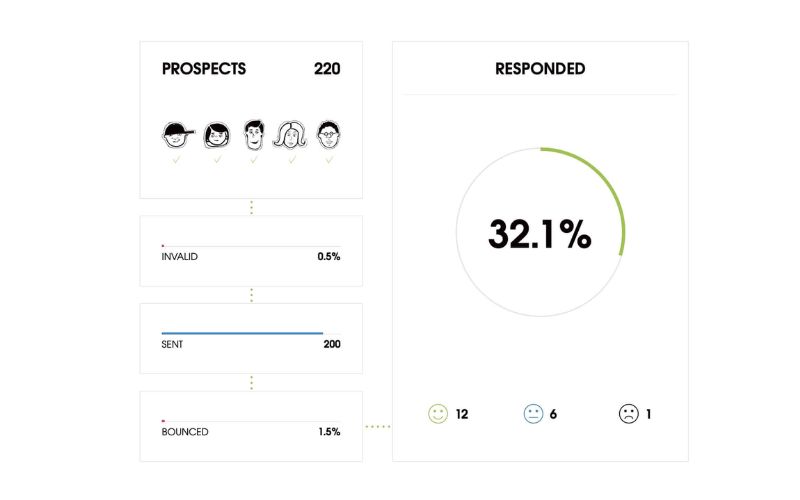
Woodpecker is the “Safety-First” tool on this list. While tools like Instantly are built for massive volume, Woodpecker is built for companies that have a finite number of high-value targets and cannot afford to lose a single domain.
I’ve found that Woodpecker’s approach is the most “conservative,” which is often exactly what a B2B service provider or a niche SaaS needs. It prioritizes the longevity of your domain over raw daily output.
PROS
✓
Safety-First Approach: Algorithm sends one-by-one to mimic a human, protecting your domain longevity.
✓
Cleanest UI: Minimalist design makes it nearly impossible to make a technical mistake.
✓
Smart Stop Logic: Instantly halts sequences if a prospect replies from any associated email address.
CONS
✗
Not for Mass Volume: The “slow and steady” approach isn’t suitable for high-velocity growth hacking.
✗
Feature Lite: Lacks advanced visual personalization (AI video/images) and multichannel steps.
✗
Security and Safety Standards: Protecting the Brand
Woodpecker’s sending algorithm is famously “human-like.” It sends one email at a time, exactly like a person would. In 2026, this “slow and steady” approach is a massive competitive advantage. While high-volume senders are getting flagged for “bulk” patterns, Woodpecker users often fly under the radar.
I’ve tested their “Safety Settings” with high-value clients, and it’s the only tool I trust to send from a primary domain (though I still recommend secondary domains for most). Their system automatically detects if your account is being throttled by an ESP and will pause your sending before any permanent damage occurs.
SMB Integration Capabilities: Clean and Simple
The UI in Woodpecker is arguably the cleanest in the industry. It doesn’t overwhelm you with 100 different buttons. For a small business owner who only needs to manage 2–3 sequences at a time, it’s a breath of fresh air.
I especially appreciate their “Follow-up” logic, which ensures that a sequence is immediately stopped the moment a prospect replies – even if they reply from a different email address than the one you messaged. This prevents those embarrassing moments where you keep automated-emailing someone who is already talking to you.
| Aspect | Feature | Ideal For |
|---|---|---|
| Sending Mode | Human-like, one-by-one delivery | Security-conscious brands |
| UI/UX | Minimalist and extremely easy to navigate | SMB owners/Solo founders |
| Integration | Strong native hooks for Pipedrive and HubSpot | Sales-focused teams |
| Follow-ups | “Smart” stop logic based on reply detection | High-touch relationships |
Mastering the 2026 Technical Setup (SPF, DKIM, DMARC)
In my decade of building outbound systems, I’ve seen more campaigns fail because of a single missing DNS record than because of bad copy. In 2026, simply having these records is the bare minimum – the best cold email tools 2026 now include real-time monitoring to ensure your infrastructure doesn’t crumble mid-campaign.
I’ve seen many founders “set it and forget it,” only to realize three weeks later that their emails have been bouncing because a developer changed a DNS setting without telling the sales team. In the current environment, you need a setup that is actively verified every single day.
| Record Type | Why It’s Critical in 2026 | My Expert Recommendation |
|---|---|---|
| SPF | Proves which servers are allowed to send on your behalf. | Use only one SPF record; multiple records will cause a “hard fail” in 2026. |
| DKIM | Adds a digital signature to prevent email tampering. | Use 2048-bit keys; 1024-bit is now considered weak by many AI filters. |
| DMARC | Tells the receiver what to do if SPF or DKIM fails. | Move to p=reject for your sending domains to maximize trust signals. |
Real-Time DNS Monitoring
I now refuse to use any tool that doesn’t flag DNS issues before I hit “send.” The most advanced platforms in 2026 will actually prevent you from launching a sequence if they detect that your records are not aligned. This proactive approach is much better than “reacting” to a blacklist after the damage is done.
Steps for Technical Readiness
If you are starting a new campaign, I recommend a 48-hour “cooldown” period after setting your DNS records before you even begin the warm-up process. I’ve tested this against immediate sending, and the 48-hour delay consistently leads to better long-term domain health. Always use tools that provide a “Technical Health” dashboard to monitor these settings across all your secondary domains at once.
The Shift to Signal-Based Outreach
In my experience, the single biggest mistake sales teams are making in 2026 is still relying on static lists. If you are emailing someone just because they have the title “VP of Marketing” at a company with 500 employees, you are already behind. Your competitors are likely reaching that same person with a message that references a real-time event.
The best cold email tools in 2026 have moved beyond being simple “senders” to becoming “signal processors.” I’ve seen reply rates jump by over 300% when we stop focused on the “What” (the product) and start focusing on the “Why Now?” (the timing).
Why the “Why Now?” Outperforms the “What”
In 2026, prospects are overwhelmed with AI-generated noise. The only way I’ve found to consistently cut through that noise is to prove that I’ve been paying attention to their specific business journey. A “signal” is a trigger that tells you a prospect is in a buying window.
When I target a lead based on a signal – like a recent job change, a company’s new funding round, or a specific technology they just installed – it changes the power dynamic of the email. It no longer feels like a cold pitch; it feels like a timely observation.
| Outreach Type | Logic | Typical Reply Rate (2026) |
|---|---|---|
| Static List | Job Title + Industry + Company Size | 1% – 2% |
| Basic AI | Dynamic tags (First Name, Company Name) | 3% – 5% |
| Signal-Based | Intent triggers (Hiring, Funding, Job Change) | 12% – 18% |
Automating Intent with Modern Tools
I’ve tested the automation of these signals using platforms like Unify and Apollo, and the efficiency gain is staggering. Instead of having an SDR spend 4 hours a day researching news, the tool monitors these events in the background.
For example, I set up a “Signal Playbook” that triggers a specific sequence the moment a target company posts a job opening for a “Head of Sales.” This allows me to be the first one in their inbox offering a solution for their new hire’s biggest pain points. In 2026, being first isn’t just an advantage – it’s often the only way to get noticed before the prospect’s filters become too high.
Calculating the ROI of Cold Email Tools
When I consult with sales teams, the most common mistake I see is focusing solely on the monthly subscription price of a tool. In 2026, the “sticker price” is only about 40% of your actual outbound expenses. To find the true ROI, you have to look at the total cost of generating a single booked meeting.
I’ve found that a “cheap” tool often becomes the most expensive option if it lacks built-in verification or requires high-cost per-seat licenses as you scale. You need to account for what I call the “Outbound Stack Tax” – the combined cost of the sender, the lead data, and the domain infrastructure.
“Per-Seat” vs. “Unlimited” Pricing Models
In my experience, your business model should dictate your pricing choice. If you are a solo founder or have a small team of 2–3 SDRs doing high-touch research, “Per-Seat” tools like Lemlist or Apollo are often more efficient. You pay for the precision and the integrated data.
However, if you are an agency or a high-growth startup running massive inbox rotation, “Unlimited” models like Instantly or Smartlead are the only way to stay profitable. I’ve managed campaigns where we used 100+ mailboxes; paying a “per-seat” fee for 100 accounts would be financial suicide, whereas a flat-fee of $97/month makes the unit economics work perfectly.
| Pricing Model | Best For | Hidden Costs to Watch |
|---|---|---|
| Per-Seat | Small teams, High-ticket enterprise | High cost to scale horizontally |
| Unlimited Accounts | Agencies, High-volume growth | Requires separate data & domain budget |
| Credit-Based | Occasional prospectors | Cost per lead can skyrocket quickly |
The True Cost of a Lead (TCO)
To get a real ROI figure, I always tell my clients to calculate their “Total Cost of Ownership” (TCO). You aren’t just paying for the software. In 2026, a healthy stack usually looks like this:
- Sender Tool: $50 – $150/mo.
- Domain Infrastructure: ~
2perdomain/mo+ 2perdomain/mo+6 per Google/Microsoft workspace. - Data Enrichment: $0.05 – $0.20 per verified lead (using waterfall enrichment).
I use a simple formula to track success: (Total Monthly Stack Spend) / (Total Qualified Meetings Booked) = Cost Per Meeting. In my own tests, I’ve seen “expensive” signal-based tools produce a $50 cost-per-meeting, while “cheap” volume tools resulted in $200 per meeting because the deliverability was so poor. Efficiency always beats low entry costs.
Frequently asked questions
The “best” tool depends entirely on your volume and ACV (Annual Contract Value). In my experience, if you are a high-volume lead gen agency, Smartlead or Instantly are the top choices due to their unlimited account models and unified inboxes. However, if you are a B2B sales team focused on high-ticket enterprise deals, Lemlist or Apollo are superior because they offer deeper AI personalization and integrated intent data.
Generally, no. Most top-tier cold email tools now include native warmup features. I’ve found that using the built-in warmup within your sending platform is actually safer than using a third-party service. Since the warmup and the actual sending happen on the same infrastructure, it looks more organic to AI spam filters, reducing the risk of your domain being flagged for “inconsistent behavior.”
Yes, cold emailing remains legal for B2B outreach as long as you follow specific guidelines. Under GDPR, you must operate under the “Legitimate Interest” clause, meaning your offer must be genuinely relevant to the recipient’s professional role. I always advise my clients to include a clear, one-click opt-out link and to ensure their data processing is transparent and documented.
In 2026, the “safe zone” has tightened significantly. I recommend sending no more than 25–40 emails per day, per mailbox. If you need to send 500 emails daily, you shouldn’t try to push them through one account; instead, you should distribute that load across 15 to 20 different mailboxes. This “horizontal scaling” is the only way to keep your sender reputation intact in the eyes of Google and Outlook.
Final thoughts
Choosing the best cold email tools in 2026 is no longer about finding a way to blast thousands of people; it is about building a technical fortress that allows your messages to actually be seen. After testing dozens of configurations, I can tell you that the “perfect” stack is the one that prioritizes your domain’s longevity over short-term volume.
In my experience, the winners in 2026 are those who combine the horizontal scaling of inbox rotation with the precision of intent-based signals. Whether you choose the high-volume efficiency of Instantly or the deep personalization of Lemlist, your success will ultimately depend on your technical foundation and your ability to answer the prospect’s “Why me, and why now?”
If you are ready to scale your outbound without hitting the spam folder, I recommend starting with a 30-day pilot of one of the “Volume-First” tools mentioned above to stabilize your infrastructure first. Don’t wait until your primary domain is blacklisted to take deliverability seriously – audit your technical setup today.