




Table of Contents
Lifetime software deals (LTDs) present one of the most compelling financial propositions for bootstrap founders, marketing agencies, and lean operators: pay a single upfront fee (typically $49–$299) and secure lifetime access to a cloud platform without recurring monthly subscriptions. Replacing multiple $99/month SaaS tools with one-time purchases delivers immediate cash flow relief.
However, the economics of cloud software require recurring revenue to finance servers, API tokens, and continuous development. Over 60% of lifetime deal products either pivot, restrict features, or shut down within 24 to 36 months.
This quantitative guide breaks down the true economics of LTDs, how to calculate amortization break-even windows, how to sandbox promotional software safely, and how to spot winning investments on platforms like AppSumo.
1. Why Do SaaS Founders Launch on AppSumo?
Understanding whether an AppSumo deal represents a genuine bargain or an impending bankruptcy begins with understanding why software founders launch lifetime campaigns in the first place.
Building a B2B SaaS platform requires substantial initial capital. Traditional venture-backed startups raise outside funding to finance years of negative cash flow while acquiring customers. Bootstrap founders, by contrast, lack institutional funding. For an unfunded software team, launching an LTD on AppSumo serves three distinct operational objectives:
First, it generates immediate non-dilutive capital. A successful campaign can generate $50,000 to $250,000 in upfront gross sales within 60 days, providing the developer runway to hire full-time engineers and build out core features without giving up equity to venture capitalists.
Second, it delivers immediate user acquisition. An AppSumo launch exposes a new product to over 1.5 million digital marketers, agency owners, and entrepreneurs. This flood of 1,000 to 5,000 active users stress-tests application infrastructure, surfaces edge-case bugs, and generates actionable feature feedback far faster than slow organic sales cycles.
Third, it generates social proof and initial organic reviews. Early user feedback creates case studies and word-of-mouth distribution that founders leverage to attract traditional monthly recurring subscribers.
However, the revenue distribution on promotional marketplaces is steep. On standard marketplace listings, platform operators retain between 50% and 70% of gross sales, while curated Select launches take 30% to 50%. On a $59 Tier 1 code, the software founder may receive only $18 to $30 in net cash. When a founder must maintain database storage, customer service, and server bandwidth for that user over a 5-year period on $25 of net revenue, the financial margin is paper-thin.
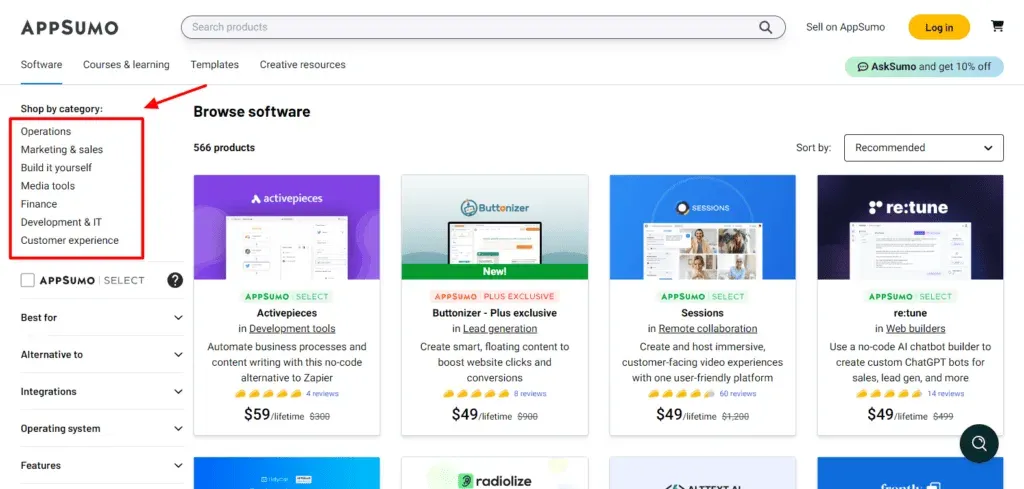 Figure 1: AppSumo Marketplace deal catalog interface showing license tier stacking and feature breakdowns.
2. What Are the Hidden Risks of Lifetime Deals?
When you purchase a traditional monthly SaaS subscription, your financial interests and the software vendor’s financial interests are aligned. If the software breaks, loses uptime, or stops updating, you cancel your subscription. To retain your monthly revenue, the vendor must invest in product stability, customer support, and continuous development.
With a lifetime deal, that economic alignment dissolves the moment the 60-day refund window expires. The vendor has already collected 100% of the lifetime revenue they will ever receive from you. Every customer support ticket you submit, every gigabyte of file storage you consume, and every database query you execute represents a direct operational cost that reduces the vendor’s remaining profit.
This dynamic drives three common failure modes in the lifetime software ecosystem:
The Recurring API Cost Trap
Many modern AI, scraping, and messaging tools rely on third-party APIs. If a tool offers lifetime access to audio transcription, OpenAI text generation, or automated email verification, the founder must pay third-party API providers on a per-token or per-minute basis. When power users run thousands of automated workflows, the founder’s monthly API bill quickly exceeds the original one-time purchase price. Within 6 to 12 months, the vendor is forced to drastically reduce monthly usage credits or require users to provide their own personal API keys.
The “Version 2.0” Rebrand Pivot
When founders exhaust their initial launch cash, they frequently discover that non-paying lifetime users consume 80% of their customer support capacity while contributing zero recurring revenue. To survive, the vendor announces a major architectural rewrite (often marketed as “Platform 2.0” or “Enterprise Suite”). The vendor maintains the original legacy platform in maintenance-only mode with zero new features, while migrating all active development to a new subscription-only application.
The Quiet Platform Sunset
The most common outcome for unviable tools is quiet abandonment. The developer stops answering roadmap requests, support response times extend from hours to weeks, security certificates expire, and the platform eventually disappears when cloud hosting bills go unpaid.
3. Calculating License Break-Even Points
A frequent point of confusion for software buyers is the “tier-stacking” pricing model used across modern deal platforms.
Rarely does a Single Code (Tier 1) provide a complete, scalable solution for an established business. Software vendors deliberately configure Tier 1 with restrictive usage limits, low storage ceilings, and single-user access. Tier 1 functions essentially as an extended paid trial. To unlock production-grade capabilities (such as custom CNAME domain mapping, white-label branding, webhook integrations, and multiple team seats), buyers must “stack” multiple codes, purchasing Tier 2, Tier 3, or Tier 5 licenses.
Evaluating a lifetime purchase requires calculating the fully stacked investment against equivalent market alternatives:
- Single Code (Tier 1): $49 to $69. Typically limited to 1 user, 1 workspace, and standard branding.
- Double Code (Tier 2): $99 to $149. Adds higher usage limits, additional team seats, and basic API access.
- Multi-Code (Tier 3 to Tier 5): $199 to $399. Unlocks full white-label capabilities, client management sub-accounts, custom domain mapping, and maximum monthly operational credits.
The Amortization Formula
To determine if a Tier 3 purchase at $249 is economically sound, calculate the Amortization Break-Even Window:
The Lifetime Deal Break-Even Formula:
Break-Even Period (Months) = Stacked LTD Purchase Price ÷ Monthly SaaS Alternative Cost
Example: If an LTD tier costs $149 and replaces a $49/month SaaS subscription, break-even occurs in exactly 3.04 months.
If a lifetime automation tool on Pabbly or AppSumo costs $249 and replaces an alternative costing $49/month, the investment breaks even in exactly 5.1 months. If your team uses the tool reliably for more than 6 months, every subsequent month represents 100% net financial savings.
Furthermore, factoring in the time value of money and opportunity cost:
- A $249 one-time expense amortized over 36 months represents a virtual cost of only $6.92 per month.
- Compared to a $49/month subscription totaling $1,764 over 3 years, the net cash savings equals $1,515 USD, which can be redeployed into customer acquisition and paid advertising.
- For agencies managing 15 client accounts, stacking Tier 5 white-label codes reduces software overhead from $735/month ($8,820/year) down to a single $399 one-time capital investment.
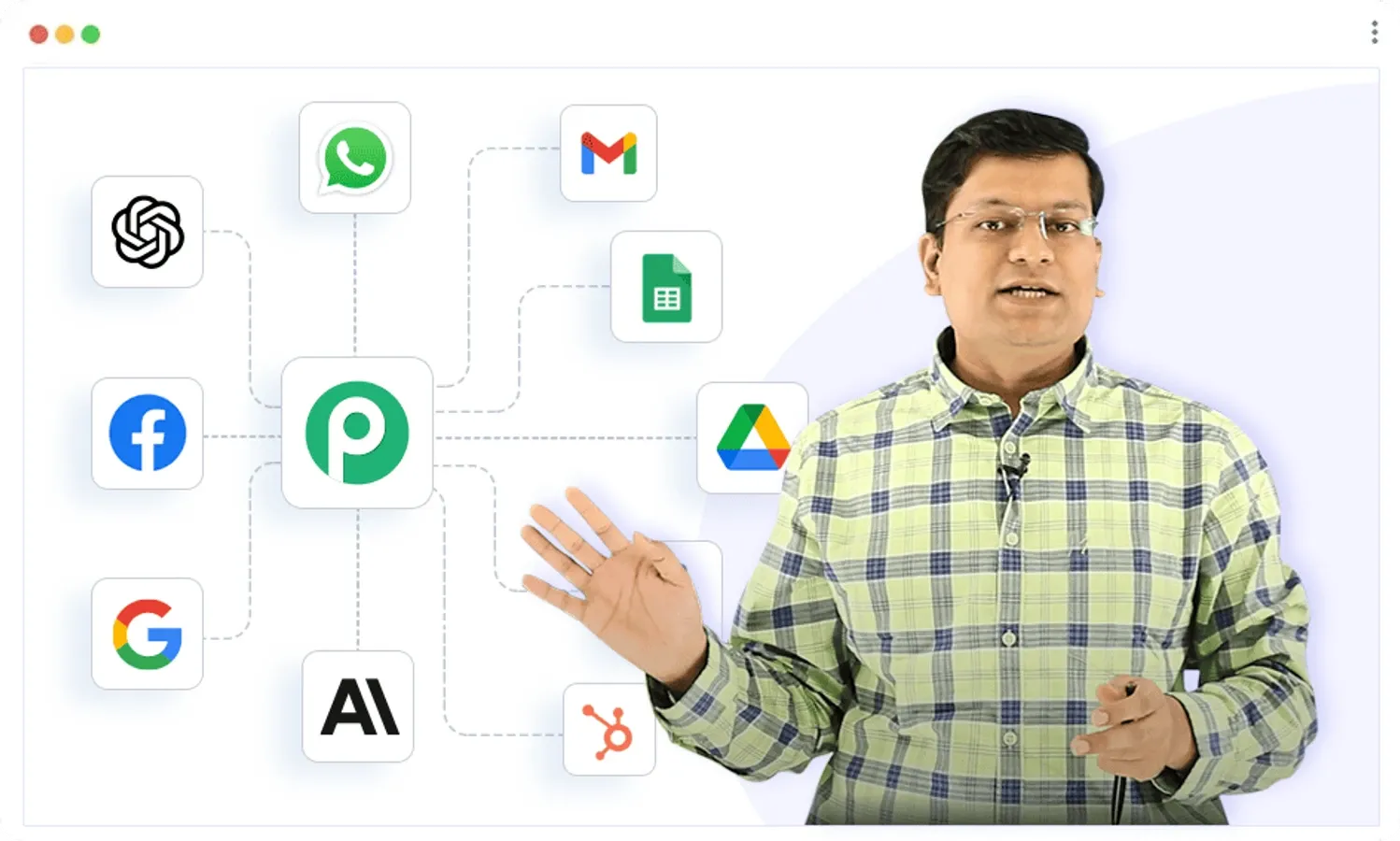 Figure 2: Pabbly Connect multi-step automation workflow engine providing lifetime webhook execution.
4. Lifetime Deals vs Monthly Subscriptions
To make objective procurement decisions, businesses must weigh the structural trade-offs between lifetime licenses and monthly SaaS subscriptions across total cost, support quality, and security posture.
| Evaluation Dimension | AppSumo Lifetime Deal (Stacked Tier) | Traditional B2B SaaS (Monthly / Annual) | Strategic Procurement Verdict |
|---|---|---|---|
| Upfront Capital Outlay | High ($149 – $399 one-time) | Low ($15 – $49 first month) | LTD requires immediate capital commitment |
| 3-Year Total Cost of Ownership | Fixed ($0 recurring fees) | Compounding ($1,200 – $3,600) | LTD delivers 70% to 85% net cost savings if tool survives |
| Feature Roadmap Velocity | Variable (Dependent on MRR conversion) | High (Continuous releases funded by steady cash flow) | Monthly SaaS provides superior long-term roadmap stability |
| Customer Support Priority | Moderate (Queues strained during launches) | Tiered Priority (SLA response time guarantees) | Mission-critical operations favor dedicated monthly SaaS |
| Data Security & Compliance | Basic (Self-certified GDPR, basic encryption) | Enterprise (SOC2 Type II, ISO 27001, HIPAA) | LTD tools rarely suit regulated enterprise compliance |
| Platform Longevity Risk | Moderate to High (30% to 40% survival over 3 yrs) | Low (Established market leaders backed by ARR) | LTD carries structural platform failure risk |
5. 5-Step Software Due Diligence Checklist
Before committing capital to a lifetime software deal, professional procurement teams apply a rigorous vetting process to filter out fragile tools and identify high-probability winners.
Step 1: Audit Founder Track Record and Team Architecture
Investigate the founding team on LinkedIn, GitHub, and Twitter. Is the company operated by a solo developer building on nights and weekends, or is it backed by a full-time engineering team with previous successful software exits? Solo-founder tools carry extreme key-person risk; if the founder experiences burnout, the application ceases to function.
Step 2: Evaluate Public Roadmap Activity and Commit Velocity
Review the company public roadmap (typically hosted on Canny, Trello, or Upvoty). Examine the ratio of “Planned” versus “Completed” features. Look at the date stamps on recent product updates. A roadmap with dozens of feature requests but zero shipped updates in the prior 60 days is a clear operational red flag.
Step 3: Analyze the Underlying Cost Structure
Examine the tool architecture. Does the platform provide static utility functions (such as graphic editing, form building, or site generation), or does it consume heavy variable third-party infrastructure (such as OpenAI GPT-4 tokens, mobile SMS gateways, or residential scraping proxies)? Tools with high variable cost structures carry significantly higher risk of future credit cuts.
Step 4: Inspect Community Engagement and Quality of Feedback
Examine the questions and reviews on the deal listing. Disregard generic 5-star reviews posted within 48 hours of launch. Focus on technical questions asked by experienced users regarding API endpoints, data backup formats, and concurrency limits. Pay close attention to how the founder responds: are answers specific and technically detailed, or evasive and defensive?
Step 5: Verify Data Portability and Open Export Capabilities
Never deploy an application that traps your company records. Ensure the software provides native, automated CSV/JSON data export, webhook triggers, and REST API access. If the platform experiences instability 18 months post-launch, your team must be able to export all database entries and migrate to a traditional SaaS alternative within 24 hours.
6. Which Software Categories Excel on AppSumo?
Not all software categories carry the same risk profile. The operational success of a lifetime deal depends heavily on the underlying server architecture of the specific software vertical.
Categories Where Lifetime Deals Excel
- Landing Page and Funnel Builders: Tools like Leadpages or standalone page builders generate static HTML/CSS assets. The hosting overhead for static files is negligible, making visual builders highly sustainable long-term assets.
- Workflow Automation & Webhook Routers: Platforms like Pabbly execute lightweight HTTP requests and JSON payload transformations. Because compute costs per webhook execution are fractions of a cent, automated routers operate stably on lifetime licenses.
- Internal Documentation & Resource Hubs: Portals for employee onboarding, standard operating procedures, and client knowledge bases require minimal real-time sync bandwidth, making them ideal lifetime purchases.
- Client Invoicing & Accounting Utilities: Basic invoice generators and billing portals that store structured transaction records without high-frequency streaming data.
Categories Where Lifetime Deals Carry Extreme Risk
- Core CRM & Transactional Email: Managing transactional deliverability, IP pools, and deep relational databases requires continuous server scaling. Relying on an early-stage LTD for primary sales pipeline data exposes your business to catastrophic downtime.
- Heavy AI Generation with Hosted GPU Models: Video rendering and voice synthesis consume substantial GPU compute. Unless the vendor requires your own API key, lifetime quotas are virtually guaranteed to shrink over time.
- Dropshipping & Supplier Catalogs: Ecommerce supplier directories (like Doba) require continuous product catalog updates, inventory syncing, and carrier API maintenance, which demand sustained engineering investment.
- Mission-Critical Cloud Storage: Storing multi-terabyte raw backups on early-stage lifetime cloud storage platforms carries significant risk if the vendor fails to maintain upstream datacenter contracts.
7. Sandboxing Early-Stage SaaS in Production
To capture the financial upside of lifetime deals without exposing your core operations to platform failure, implement a strict “Sandboxing” framework:
-
Layer 1 – Mission-Critical Infrastructure: Primary CRM, billing systems, and production databases $ ightarrow$ Stick with proven monthly SaaS market leaders.
-
Layer 2 – Utility & Operational Workflows: Landing page builders, internal form systems, and webhook automations $ ightarrow$ Deploy thoroughly vetted lifetime deals like AppSumo software.
-
Layer 3 – Experimental & Creative Labs: AI copywriters, web scrapers, and creative generators $ ightarrow$ Test Tier-1 lifetime deal pilots to reduce innovation costs.
-
Automated Nightly Backups: Configure webhooks or Zapier/Pabbly triggers to pipe all incoming form submissions and contact records into an independent Google Sheet or cloud database.
-
Isolate Client Deliverables: When deploying LTD tools for client projects, use white-label custom domains so that if a vendor rebrands, client-facing URLs remain under your ownership.
-
Maintain Fallback Templates: Keep pre-built templates ready in standard tools so your team can switch providers in under 2 hours if an LTD tool suffers prolonged downtime.
-
Zero Financial Dependency: Never base core annual revenue projections on the survival of an unproven early-stage tool; treat every LTD savings as a bonus margin booster rather than an irreplaceable structural dependency.
-
Establish SLA Benchmarks: Track tool uptime and API response times using automated uptime monitors. If an LTD tool records sub-99% monthly availability for two consecutive months, immediately re-route production traffic to a redundant backup service.
8. How to Maximize Lifetime Deal Returns?
Treat lifetime software procurement as venture investing: out of 10 purchased deals, expect 3 to shut down, 4 to remain mediocre utilities, and 3 to become powerhouse workhorses that generate 10x ROI over several years.
The 60-Day Testing Protocol
The moment you purchase a deal on AppSumo:
- Day 1–7: Deploy the tool on an active, non-critical test project. Stress-test maximum file upload sizes, webhook payloads, and export speeds.
- Day 8–30: Submit a technical ticket to customer support. Measure response latency and the technical depth of their reply.
- Day 31–50: Evaluate whether the tool genuinely saved team hours or replaced an existing recurring bill.
- Day 55: If the tool exhibited instabilit-, buggy exports, or sluggish support, request an unconditional refund before the 60-day window -loses.
Managing Exit and Migration Scenarios
When an LTD tool inevitably signals end-of-life-characterized by unannounced feature cuts, unresponsive founders, or frequent database downtime-execute an immediate exit protocol:
- Export all contacts, transaction logs, and workspace assets in JSON/CSV formats immediately.
- Update DNS CNAME records to redirect traffic to your backup landing pages or forms.
- Disconnect active OAuth tokens and API access keys to protect internal network security.
- Re-audit your team’s workflow stack to determine whether a replacement LTD tool or a mature monthly subscription is appropriate for long-term scalability.
Conclusion & Final Procurement Verdict
In conclusion, lifetime software deals on platforms like AppSumo represent powerful leverage for lean startups, bootstrappers, and digital marketing agencies when approached with rigorous due diligence. By focusing strictly on low-variable-cost tools such as Pabbly and Leadpages, avoiding mission-critical database dependencies, calculating strict amortization break-even timelines, and maintaining automated external backups, savvy operators can build a comprehensive enterprise-grade software stack at an 80% discount compared to traditional recurring subscriptions.