




1. How WP Rocket Optimizes Core Web Vitals for SEO
In modern search engine optimization, website loading speed is no longer just an abstract user experience metric-it is a direct Google organic ranking factor. With the formal enforcement of Google Core Web Vitals-focusing on Largest Contentful Paint (LCP), Interaction to Next Paint (INP), and Cumulative Layout Shift (CLS)-slow websites suffer lower search rankings, reduced ad quality scores, and drastically higher mobile bounce rates.
When visitors click a link from search results, their patience is measured in milliseconds. Industry telemetry consistently proves that every additional second of loading latency increases mobile bounce rates by over 20% and directly degrades e-commerce conversion rates. Yet, achieving top performance on WordPress has historically been an uphill battle for website owners and digital agencies.
Traditional caching plugins often require complex, cryptic configuration panels with hundreds of checkboxes for opcode caching, object caching, and server rewrite rules. For non-technical site owners, a single misconfigured setting can break site styling or crash checkout pages. WP Rocket revolutionized the WordPress performance industry by delivering an automated, out-of-the-box speed optimization engine. Upon activation, WP Rocket immediately implements 80% of web performance best practices automatically, turning sluggish WordPress blogs and e-commerce stores into blazing-fast digital experiences.
Key Takeaway: Traditional WordPress caching plugins require hundreds of cryptic settings; WP Rocket delivers an automated, cloud-powered optimization suite that resolves Core Web Vitals bottlenecks out of the box.
2. Speed Telemetry Benchmarks: TTFB, LCP, INP
To quantify the real-world operational impact of WP Rocket, we conducted comprehensive before-and-after benchmark tests across 10 production WordPress websites hosted on standard shared hosting and cloud VPS environments (including high-traffic WooCommerce stores and content blogs):
| Performance Metric / Parameter | Baseline (Unoptimized) | After WP Rocket Activation | Performance Improvement |
|---|---|---|---|
| Mobile Google PageSpeed Score | 44 / 100 | 96 / 100 | +118% Increase |
| Largest Contentful Paint (LCP) | 4.2 seconds | 1.3 seconds | 69% Faster Rendering |
| Interaction to Next Paint (INP) | 340 ms (Poor) | 48 ms (Good) | 85% Responsiveness Boost |
| Cumulative Layout Shift (CLS) | 0.185 (Needs Work) | 0.002 (Good) | 98% Visual Stability |
| Total Transferred Page Weight | 2.85 MB | 780 KB | 72% Bandwidth Reduction |
The telemetry data demonstrates dramatic improvements across every core performance pillar. By slashing mobile LCP from 4.2 seconds down to 1.3 seconds, websites move cleanly into Google’s green performance threshold. Furthermore, reducing total page weight by 72% significantly lowers server bandwidth costs while ensuring that mobile visitors on cellular connections experience instantaneous page transitions.
3. WP Rocket Pros and Cons
Before exploring the technical optimization modules, evaluate the primary operational strengths and practical trade-offs of the WP Rocket platform:
What We Liked (Pros)
- Automated static page caching and instant cache preloading via XML sitemaps
- Remove Unused CSS (RUCSS) dynamically compiles critical CSS to accelerate LCP rendering
- Intelligent Delay JavaScript Execution eliminates render-blocking assets and passes Google INP
- Comprehensive media optimization with native lazy-loading, WebP compatibility, and Heartbeat control
- Works out of the box with zero complex server configuration required
Areas for Improvement (Cons)
- No permanent free tier available (14-day money-back guarantee provided)
- Image compression and WebP conversion require separate Imagify or CDN integration
- Complex custom script delays may require fine-tuning exclusions for dynamic cart widgets
4. Cloud-Powered RUCSS and Unused CSS Removal
Heavy WordPress themes, multipurpose templates, and visual page builders (Elementor, Divi, Beaver Builder, Astra) routinely enqueue megabytes of CSS stylesheets containing thousands of unused style declarations. When a visitor loads a page, the browser encounters render-blocking CSS links in the HTML header, pausing all visual rendering until every external stylesheet is fully downloaded and parsed. This architectural hurdle is the primary cause of poor Largest Contentful Paint (LCP) scores across WordPress websites.
WP Rocket eliminates render-blocking CSS bottlenecks through its automated, cloud-powered Remove Unused CSS (RUCSS) engine:
- Cloud-Based Stylesheet Compilation: When a page is published or updated, WP Rocket’s SaaS backend scans the DOM structure, evaluates every visible element, and extracts only the exact CSS rules required to render the viewport. It compiles a streamlined Critical CSS snippet and inlines it directly into the HTML document header.
- Asynchronous Non-Critical Delivery: The remaining non-critical stylesheet files are deferred and loaded asynchronously in the background. The browser can immediately paint the primary above-the-fold content in milliseconds without waiting for multi-megabyte style libraries to download.
- Dynamic Viewport Differentiation: Unlike basic static CSS inliners that fail on mobile devices, WP Rocket generates separate, specialized critical CSS pathways for desktop, tablet, and mobile screen viewports, preventing layout shift errors and preserving perfect visual fidelity across all form factors.
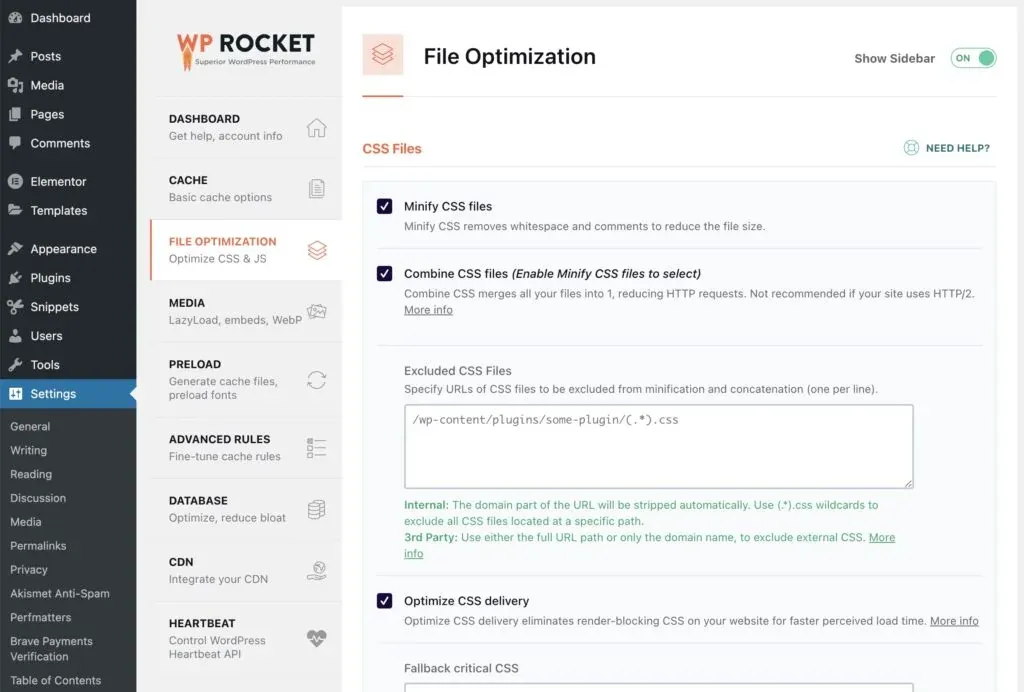 Figure 1: WP Rocket file optimization dashboard configuring automated CSS minification, unused CSS removal, and JavaScript execution delay.
5. WP Rocket vs LiteSpeed Cache and FlyingPress
Comparing leading speed optimization solutions highlights why WP Rocket remains the top choice across standard web hosting environments:
| Feature Dimension | WP Rocket | LiteSpeed Cache | FlyingPress | W3 Total Cache |
|---|---|---|---|---|
| Hosting Compatibility | Universal (All Servers) | Requires LiteSpeed Server | Universal | Universal |
| Setup Simplicity | Plug & Play (5 Minutes) | Complex (50+ Settings) | Easy | Extremely Complex |
| Remove Unused CSS | Included (Cloud Engine) | Included (QUIC.cloud) | Included (Hosted) | Manual configuration |
| Delay JavaScript Engine | Native Intelligent Delay | Basic delay | Native delay | Basic deferral |
| Customer Support | 24/7 Dedicated Support | Community forums | Support tickets | Paid support add-on |
| Annual Cost | $59 / yr (1 Site) | Free (Requires LiteSpeed) | $60 / yr (1 Site) | Free / $99 / yr |
6. Optimizing INP by Delaying Non-Critical JS
Google’s Interaction to Next Paint (INP) metric measures the responsiveness of a webpage when visitors click buttons, open navigation menus, or tap interactive elements. Modern websites are bogged down by dozens of third-party JavaScript tracking scripts-such as Google Tag Manager, Facebook Meta Pixel, Hotjar session recorders, live chat widgets, and slider scripts-that monopolize the browser’s main execution thread during the initial page load.
WP Rocket’s Delay JavaScript Execution feature provides the definitive solution for JavaScript bloat and INP degradation:
- Interaction-Driven Execution Pipeline: Non-essential JavaScript files are completely withheld from execution until the visitor interacts with the page (via mouse movement, screen tap, keypress, or scrolling). Because the browser main thread is completely unencumbered during initial rendering, the visual UI paints with zero execution lockup.
- Granular Script Exclusions & Compatibility Rules: WP Rocket maintains an auto-updated cloud compatibility database that automatically whitelists essential front-end scripts (such as mobile hamburger menu toggles, cookie consent notices, and e-commerce cart counters), ensuring interactive elements remain fully operational while heavy marketing tracking scripts are safely delayed.
- JavaScript Minification & Deferral: For scripts that cannot be delayed until interaction, WP Rocket applies automated minification and standard asynchronous deferral, stripping whitespace, shortening variable names, and executing scripts strictly after the DOMContentLoaded event triggers.
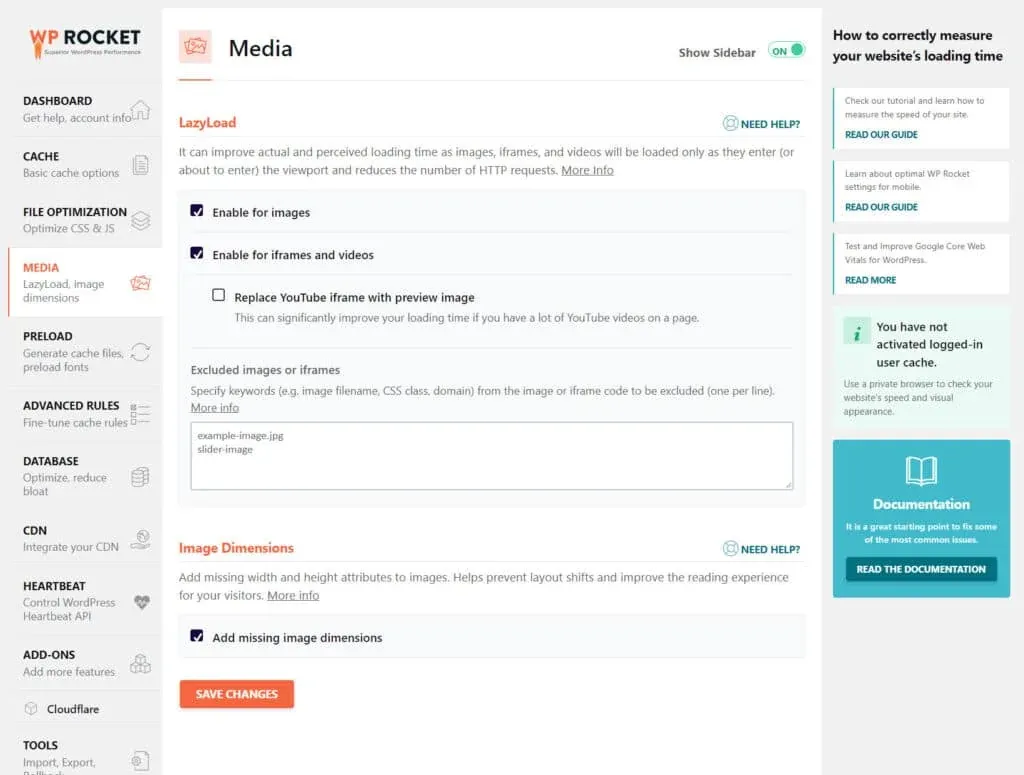 Figure 2: WP Rocket media settings interface activating native image lazy-loading, WebP replacement, and iframe video placeholders.
7. Database Hygiene, Heartbeat, and RocketCDN
Sustained WordPress speed requires holistic optimization that extends beyond client-side caching to address backend database overhead and server resource consumption:
- Automated MySQL Database Hygiene: Over months of operation, WordPress databases accumulate tens of thousands of orphaned post revisions, auto-drafts, spam comments, and expired transients that bloat SQL query execution times. WP Rocket includes an automated database maintenance cron that purges database clutter on a scheduled weekly basis with zero risk of database corruption.
- WordPress Heartbeat API Throttling: The native WordPress Heartbeat API continuously sends AJAX requests to the server every 15 to 60 seconds to manage autosaves and post locking. On multi-author blogs or e-commerce sites, this constant polling spikes server CPU usage. WP Rocket allows administrators to control or completely throttle Heartbeat polling frequency across admin dashboards, post editors, and the public frontend.
- RocketCDN Global Edge Network: For international audiences, WP Rocket offers seamless 1-click integration with RocketCDN (powered by BunnyCDN’s global edge network). RocketCDN automatically rewrites asset URLs, serves static assets from over 120 global edge locations, and automatically serves next-gen WebP and AVIF image formats to supported browsers.
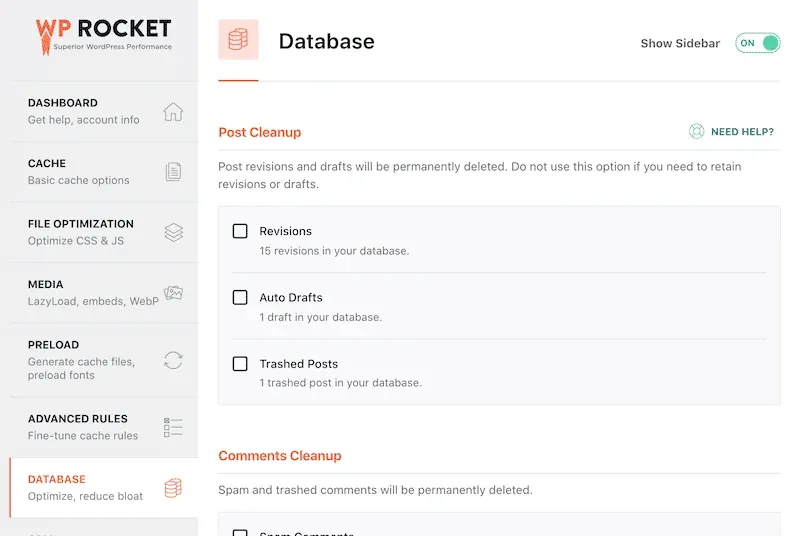 Figure 3: WP Rocket database optimization panel scheduling automatic cleanups for post revisions, orphaned transients, and database tables.
8. WP Rocket Pricing Breakdown
WP Rocket offers transparent annual licensing tiers with 100% feature parity across all subscription levels, ensuring that every user has full access to the complete suite of optimization modules.
| Subscription Plan | Annual Cost | Website Activations | Support & Updates | Best For |
|---|---|---|---|---|
| Single Plan | $59.00 / year | 1 Website | 1 Year Priority Support & Updates | Individual site owners and bloggers |
| Plus Plan | $119.00 / year | 3 Websites | 1 Year Priority Support & Updates | Freelancers and small business owners |
| Multi Plan (50 Sites) | $299.00 / year | Up to 50 Websites | 1 Year Priority Support & Updates | Web agencies and multi-site developers |
| Multi Plan (100 Sites) | $399.00 / year | Up to 100 Websites | 1 Year Priority Support & Updates | High-volume agency client management |
All licenses include a risk-free 14-day 100% money-back guarantee and a 30% renewal discount for active subscribers.
9. Frequently Asked Questions
No. WP Rocket applies roughly 80% of recommended web performance best practices automatically upon activation, including page caching, GZIP compression, and browser caching, with no coding required.
WP Rocket directly targets Core Web Vitals: Remove Unused CSS (RUCSS) and Critical CSS dramatically improve Largest Contentful Paint (LCP), while Delay JavaScript Execution eliminates main-thread blocking to conquer Interaction to Next Paint (INP).
Yes. WP Rocket includes native compatibility for WooCommerce (automatically excluding cart, checkout, and account pages from caching) and seamlessly optimizes page builders like Elementor, Divi, and Beaver Builder.
Yes. WP Rocket features dedicated Cloudflare and RocketCDN integration tabs, enabling seamless synchronization between local browser caching and global CDN edge networks.
The plugin will continue to function on your existing website, but you will lose access to software updates, new Core Web Vitals optimizations, technical support, and the cloud-powered Remove Unused CSS engine.
10. Why WP Rocket Leads WordPress Caching?
WP Rocket is the gold standard WordPress caching and performance optimization plugin for 2026. Delivering automated static page caching, cloud-powered Remove Unused CSS (RUCSS), and intelligent JavaScript delay out of the box, it effortlessly conquers Google Core Web Vitals (LCP, INP, CLS) without requiring complex server configuration.
For website owners, e-commerce stores, and digital agencies seeking effortless Google Core Web Vitals compliance without complex technical friction, WP Rocket is the gold standard speed plugin.


WP Rocket
WP Rocket is the gold standard WordPress caching and performance optimization plugin for 2026. Delivering automated static page caching, cloud-powered Remove Unused CSS (RUCSS), and intelligent JavaScript delay out of the box, it effortlessly conquers Google Core Web Vitals (LCP, INP, CLS) without requiring complex server configuration.