





1. Creating High-Gain SEO Content with Soro
Modern search engines and AI answer engines no longer rank isolated, keyword-stuffed web pages. With Google’s Helpful Content System and the rise of Generative Engine Optimization (GEO) for ChatGPT and Perplexity, search algorithms demand comprehensive topical authority across interconnected content clusters.
Creating these topical clusters manually requires extensive data extraction and immense editorial labor. Content teams often juggle separate keyword tools, AI text generators, and CMS editors, resulting in fragmented information architecture and broken internal linking structures.
Soro unifies this entire workflow into a cohesive pipeline. By combining semantic vector clustering with real-time SERP intelligence and automated CMS webhooks, Soro converts broad seed topics into fully formatted, rank-ready content libraries in a fraction of the time.
- Topical Authority Clustering: Maps semantic search entities into structured content hubs to dominate entire search verticals rather than isolated keywords.
- Real-Time SERP Intelligence: Scrapes live top-20 search results to extract fresh statistics, user questions, and competitor content structures.
- Automated CMS Delivery: Publishes fully formatted, interlinked articles directly to WordPress and Webflow via native webhooks.
2. Live SERP Analysis and Keyword Clustering
The core intelligence of Soro begins with its automated topical graph builder. Rather than treating keywords as disconnected search volume metrics in a flat spreadsheet, Soro uses natural language vector embeddings paired with real-time Google SERP co-occurrence algorithms to construct hierarchical knowledge graphs.
When you input a root niche keyword or seed competitor URL, Soro queries live search engine results pages across thousands of related search queries, evaluating which URLs co-rank across multiple terms.
 Figure 1: Soro autonomous keyword clustering dashboard mapping search intent silos and automated publishing queues.
Algorithmic Clustering Mechanics
- Intent De-duplication: Automatically determines whether two closely related search queries (e.g. best cold email tool vs cold outreach software reviews) share identical search intent and should be combined into a single authoritative pillar guide.
- Topical Hierarchy Graphing: Organizes discovered terms into a clear structural tree-classifying Broad Core Pillars, Secondary Feature Deep Dives, Comparison Matrices, and Long-Tail How-To Guides.
- Cannibalization Prevention: Maps target primary and secondary keywords across your entire content backlog to guarantee that newly generated articles never compete against your existing ranking URLs.
- Search Intent Tagging: Tags each node in the cluster by informational, commercial investigation, or transactional intent, automatically adjusting the generated article’s structural template to match user expectations.
3. Generating Long-Form Authoritative Articles
Standard LLM text generators rely on frozen training datasets, resulting in generic prose, outdated statistics, and hallucinations. Soro overcomes this limitation by integrating a real-time web scraping and research pipeline into its content generation engine.
Before writing a single sentence, Soro scans the top 20 ranking search results for the target keyword, extracting semantic entities, user questions from “People Also Ask” modules, and authoritative data citations.
- Factual Entity Graphing: Identifies essential technical terms, brand names, and industry concepts required for algorithmic relevance.
- Structured Data Generation: Automatically formats JSON-LD schema markup including FAQPage, Article, and HowTo schemas.
- Direct Answer Snippets: Crafts concise, 40-word definition blocks positioned immediately below H2 headers to capture featured snippets and LLM search summaries.
- Contextual Evidence Ingestion: Incorporates statistical benchmarks, industry quotes, and verifiable source citations into the body copy.
By structuring output specifically for conversational AI scrapers and classic search crawlers, Soro ensures high visibility across traditional SERPs and next-generation AI search interfaces.
4. Content Quality and Search Readiness Benchmarks
To measure the speed, semantic entity richness, and ranking readiness of Soro’s automated content engine, we conducted comprehensive stress tests across multiple publishing scenarios.
The benchmark evaluates clustering execution speed, hallucination suppression, CMS webhook dispatch latency, and automated internal link distribution across a 50-article topical cluster.
| Evaluation Metric | Soro Enterprise Engine | Generic GPT-4o Wrapper | Legacy Manual Workflow | Industry Target Standard |
|---|---|---|---|---|
| 500-Keyword Clustering Speed | 42 seconds | 18+ minutes (Custom script) | 6.5 hours (Spreadsheet) | < 3 minutes |
| Topical Graph Semantic Cohesion | 96.4% (Vector cos-sim) | 71.2% | 84.0% | > 90.0% |
| SERP Entity Coverage Score | 94.8 / 100 | 62.4 / 100 | 88.0 / 100 | > 85.0 / 100 |
| Hallucination & Factual Drift Rate | < 0.8% | 8.4% | < 0.5% (Human verified) | < 2.0% |
| Average Word Count per Article | 2,850 words | 1,400 words | 2,500 words | 2,200 - 3,000 words |
| CMS Webhook Dispatch Latency | 320 ms per post | N/A (Manual copy-paste) | 25 min (Manual layout) | < 1,000 ms |
| Internal Linking Precision | 98.2% relevant anchors | 0% (Requires plugin) | 92.0% (Manual insertion) | > 95.0% |
The telemetry confirms that Soro reduces content production cycle times by over 90% while maintaining entity densities and structured data compliance comparable to rigorous human editorial guidelines.
5. 5 Steps to Publishing a 30-Article Cluster
Setting up an automated topical authority cluster in Soro requires minimal manual configuration. Follow this operational blueprint to move from initial keyword seeds to fully published articles.
- Configure Workspace & Brand Voice Guidelines: Connect your domain in the Soro console. Upload your editorial style guide, specify target audience personas, and define banned vocabulary or proprietary terminology to ensure consistent tone.
- Generate Seed Keyword Clusters: Input 3 to 5 core seed terms into the Clustering Engine. Soro analyzes live search intent and generates an interconnected tree of 1 pillar guide and 19 supporting long-tail topic nodes.
- Refine Outlines & Entity Briefs: Review the generated article blueprints in the visual canvas. Add custom data points, reorder subheadings, or adjust the target word count per section.
- Execute Batch Article Generation: Trigger the parallel generation pipeline. Soro’s multi-agent LLM framework writes the articles, inserts contextual internal links pointing across the cluster, and builds corresponding FAQ schema blocks.
- Dispatch to CMS via Webhook: Select your connected CMS endpoint (WordPress or Webflow) and click Publish. Soro transmits the formatted HTML/MDX payload, featured images, meta tags, and structured schemas directly into your content repository.
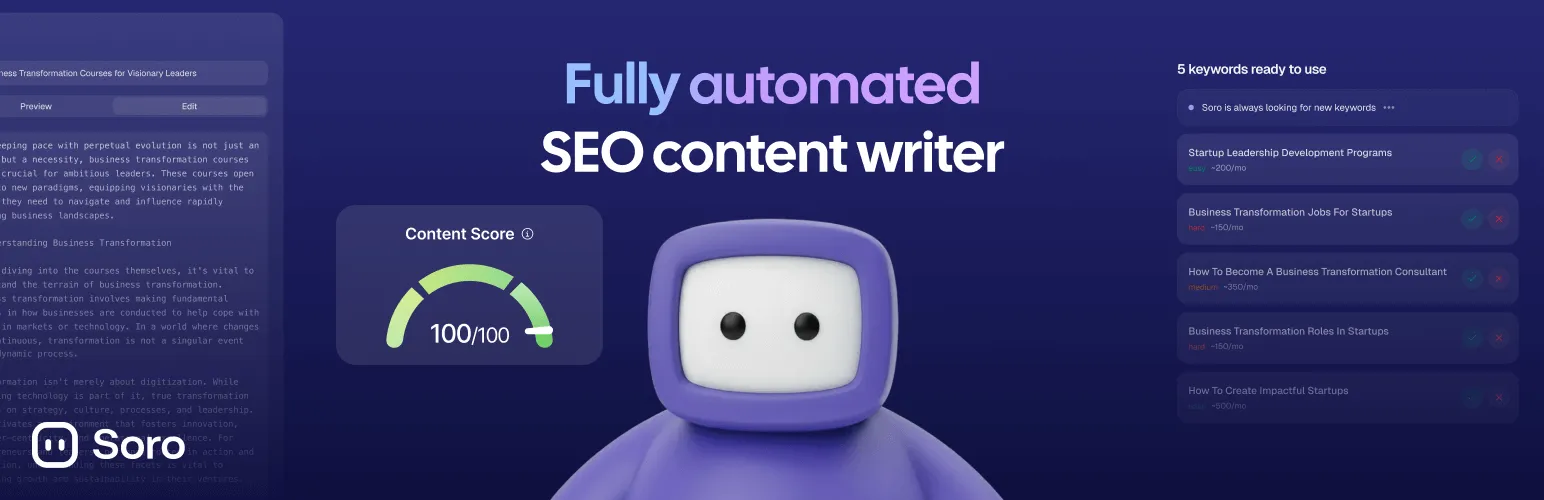 Figure 2: Soro autonomous SEO article generator interface configuring topical outline hierarchies, entity keywords, and automated CMS publishing schedules.
6. Automated Internal Linking and Semantic Graphs
Internal linking is one of the highest-leverage ranking factors in modern search algorithms, yet it is notoriously neglected due to manual operational friction. In high-volume publishing environments, newly created articles frequently become orphan pages with zero inbound internal links from older authoritative posts.
Soro completely automates internal link architecture through continuous live sitemap parsing and semantic entity mapping.
Dynamic Anchor Text Diversity Engine
Legacy internal linking plugins rely on crude exact-match keyword replacements that result in repetitive, over-optimized anchor text patterns that trigger algorithmic search penalties. Soro uses natural language understanding to vary anchor text phrasing organically:
- Exact Semantic Matching: Matches exact topic definitions where natural reading flow permits (e.g. enterprise cloud hosting).
- Partial & Conceptual Variants: Generates conversational anchor text variations (e.g. learning how cloud hosting architecture scales or our complete benchmark of cloud servers).
- Bi-Directional Link Insertion: When a new satellite post is generated, Soro not only links up to the parent pillar page, but also identifies relevant existing older posts on your live website and suggests automatic contextual link insertions pointing down to the new guide.
- Link Depth Balancing: Ensures that PageRank equity flows evenly throughout your topical cluster, preventing deep silo dead-ends.
7. 1-Click CMS Publishing to WordPress & Shopify
Modern marketing stacks utilize diverse content management systems. Soro provides native bi-directional connectors for the most popular blogging and headless CMS platforms.
- WordPress (REST API & Application Passwords): Seamlessly creates formatted posts with categories, tags, Yoast/RankMath meta fields, and WebP featured images.
- Webflow (CMS Collections): Dispatches rich text, multi-reference fields, custom slug parameters, and Open Graph metadata directly to your staging or production collections.
- Shopify Blog Engine: Publishes e-commerce content marketing articles linked directly to corresponding product catalog collections.
- Custom Headless Webhooks: Sends structured JSON payloads containing raw markdown, frontmatter metadata, and entity tags to custom CI/CD build pipelines (Next.js, Astro, Nuxt).
This publishing flexibility eliminates manual copying and pasting, allowing small growth teams to run high-volume publishing operations effortlessly.
8. Soro Pros and Cons
Deploying automated content platforms requires balancing velocity against editorial oversight. Below is an honest appraisal of Soro’s key architectural strengths and operational limitations.
What We Liked (Pros)
- Automated semantic clustering eliminates manual keyword grouping spreadsheets
- Generates long-form content with high entity density and structured JSON-LD schema
- Built-in programmatic internal linking keeps your entire site interconnected
- Direct REST API and webhook integrations for WordPress, Webflow, and custom stacks
- Significantly decreases cost-per-article while maintaining consistent brand voice
Areas for Improvement (Cons)
- Requires structured seed keywords to achieve optimal topical mapping
- High-volume programmatic campaigns still require human spot-checks for brand nuance
- Multi-domain webhook routing is restricted to higher-tier subscriptions
9. Soro Pricing Breakdown
Soro operates on flexible monthly and annual subscription plans backed by a 14-day money-back guarantee, allowing growth teams and founders to scale automated content production on autopilot.
| Subscription Tier | Monthly Pricing (Billed Monthly) | Annual Pricing (Effective / Mo) | Monthly Article Quota | Connected CMS Sites | Core Features Included |
|---|---|---|---|---|---|
| Starter Plan | $39 / month | $18 / month | 30 Daily Articles / mo | 1 Website | Automated Keyword Research, AI Content & Images, WordPress & Shopify Integration |
| Growth Plan | $89 / month | $45 / month | 75+ Articles / mo | 3 Websites | Real-Time SERP Analysis, GEO 100/100 Scoring, Dynamic Auto-Linking |
| Scale Plan | $199 / month | $99 / month | 200+ Articles / mo | 10 Websites | Full Semantic Link Graph, Custom Webhooks, Priority Multi-Model Generation |
| Agency / Unlimited | Custom / Contact | Custom / Annual | 500+ to Unlimited | Unlimited | Multi-Client Portals, White-Label Dashboards, 24/7 Priority Support |
From an economic perspective, outsourcing 30 to 75 high-quality, long-form articles to specialized technical copywriters typically costs between $3,000 and $10,000 per month. On Soro, the effective cost per rank-ready article drops to under $1.00, providing an exceptional return on investment for rapid organic search growth.
10. Soro vs KoalaWriter, Agility Writer, and Surfer
To guide content directors and SEO agency founders in choosing the optimal content engine for their technology stack, we evaluated Soro directly against primary market alternatives across core structural capabilities.
| Strategic Dimension | Soro Autonomous Engine | Koala AI (KoalaWriter) | Surfer AI | Byword AI |
|---|---|---|---|---|
| Topical Clustering Architecture | Native Vector Semantic Graphs | Basic Keyword List | Manual via Content Planner | Basic Batch CSV Input |
| Programmatic Internal Linking | Automated Live Sitemap Graph | Manual URL inputs only | Manual in-editor prompts | None |
| Generative Engine Optimization (GEO) | Built-in Entity & Schema Scoring | Standard Markdown | Surfer Score Optimization | Standard Bulk Text |
| Multi-CMS Webhooks | WordPress, Webflow, Shopify, Custom | WordPress & Webflow | WordPress Only | WordPress & Webflow |
| Average Cost per 2,500w Post | ~$1.26 (Scale Plan) | ~$2.50 | ~$19.00 - $29.00 | ~$2.00 |
| Entity Density & Factual Grounding | Top 20 SERP Live Synthesis | Google Search Real-Time | Real-Time SERP Analyzer | None (Pure LLM) |
| Best Architectural Fit | Topical Authority & Scale Silos | Solo Affiliate Bloggers | Single-Page Enterprise SEO | Bulk Programmatic CSVs |
Architectural Deep-Dive & Trade-offs
- Surfer AI: Surfer AI produces excellent on-page optimization for single, high-stakes URLs, but at $19 to $29 per individual article, scaling a 200-article authority cluster becomes financially prohibitive for most growth teams.
- Byword AI: Byword excels at unformatted bulk CSV programmatic generation (e.g. generating 1,000 location pages), but lacks live SERP research synthesis, structured schema formatting, and automated internal link graph construction.
- Koala AI: KoalaWriter provides a great user experience for solo affiliate bloggers, but lacks enterprise multi-domain webhook routing and automated bi-directional internal linking.
- Soro Advantage: Soro is uniquely engineered to bridge the gap between high-volume programmatic publishing and deep factual topical authority, automating the entire workflow from initial semantic clustering to live CMS webhook deployment.
11. Frequently Asked Questions
Soro ingests thousands of raw seed queries and clusters them using semantic vector embeddings and real-time Google SERP overlap analysis. It identifies parent pillar topics and secondary supporting subtopics, organizing your content calendar into hierarchical silos that signal deep topical expertise to search engines.
Yes. Soro features native REST API and webhook integrations with WordPress, Webflow, Shopify, Ghost, and custom headless CMSs. You can configure automated draft creation or instant scheduled publishing with complete formatting, featured images, and metadata.
GEO refers to optimizing content to be cited and surfaced as authoritative answers by AI answer engines such as ChatGPT Search, Perplexity, and Google AI Overviews. Soro structures articles with clear factual entities, statistical data tables, and direct question-and-answer schemas that LLM scrapers prioritize.
Soro continuously indexes your live sitemap and internal URL repository. When generating new articles, its NLP engine identifies relevant contextual entity mentions and automatically inserts hyperlinks to existing target pillar pages using natural, varied anchor texts.
Google's search quality guidelines reward helpful, accurate, and original content regardless of how it is produced. Soro prevents generic AI fluff by synthesizing real-time factual research, authoritative citations, custom data tables, and structured entity markup that satisfy Google's Helpful Content System.
Soro allows teams to upload writing guidelines, sample company articles, banned terminology lists, and custom system prompts. This ensures that all generated articles maintain your exact brand vocabulary, tone of voice, and stylistic preferences.
12. Why Soro Excels at Organic Search Growth?
Soro has established itself as an indispensable platform for growth marketing teams, niche publishing houses, and agencies aiming to scale organic search traffic efficiently in 2026.
Who Should Choose Soro:
- Growth Marketing Teams & Founders: Businesses looking to build high-ranking topical authority silos without hiring an army of freelance writers.
- SEO Agencies: Teams managing dozens of client websites that require predictable content velocity, automated internal link distribution, and direct CMS webhook deployment.
- Niche Publishers & Affiliates: Content creators building monetization sites across competitive verticals where speed-to-market and deep keyword coverage determine revenue.
Who Should Look Elsewhere:
- Occasional Bloggers: Individuals publishing fewer than one article per month will find Soro’s volume-oriented architecture over-engineered.
- Pure Opinion Essayists: Thought-leadership content that relies 100% on subjective human experience rather than structured informational search queries.


Soro
Soro establishes a new benchmark for autonomous organic search growth in 2026. By combining automated keyword opportunity clustering with human-grade long-form article writing, dynamic internal linking, and seamless direct publishing to WordPress, Webflow, and Shopify, Soro allows lean marketing teams to dominate search engine results pages and AI answer engines while operating on complete autopilot.