




Table of Contents
The artificial intelligence boom has fundamentally reshaped the economics of cloud computing. For over two decades, the “Big Three” hyperscalers-Amazon Web Services (AWS), Microsoft Azure, and Google Cloud Platform (GCP)-enjoyed near-monopolistic pricing power over compute, storage, and networking. Enterprise engineering teams defaulted to these giants without questioning the bill.
In 2026, the meteoric rise of generative AI, large language models (LLMs), diffusion pipelines, and computer vision models has broken that consensus. AI workloads are defined by raw floating-point operations per second (FLOPS) and high-bandwidth memory (HBM). On traditional hyperscalers, spinning up clusters of NVIDIA H100, A100, or L40S GPUs carries astronomical hourly rates, rigid annual lock-in contracts, and punishing data egress fees.
A new breed of specialized, GPU-first cloud infrastructure providers-led by RunPod-has emerged to disrupt this legacy paradigm. By stripping away bloated enterprise software layers and focusing exclusively on containerized GPU performance, these specialized platforms deliver identical hardware at 60% to 80% lower total cost of ownership (TCO).
This technical analysis explores the architectural, economic, and operational shifts driving modern engineering teams toward specialized AI clouds.
1. Why Are AI Teams Leaving Legacy Clouds?
To understand why AI engineering teams are migrating workloads away from legacy hyperscalers, one must analyze where hyperscaler pricing premiums actually originate.
When you rent an NVIDIA A100 (80GB SXM4) on a legacy cloud, you are not merely paying for silicon and electricity. You are subsidizing:
- Proprietary Ecosystem Software: Thousands of closed-source governance, IAM, compliance reporting, and enterprise billing tools bundled into the platform overhead.
- Punitive Data Egress Pricing: Charges ranging from $0.05 to $0.09 per gigabyte to transfer your own model checkpoints, embeddings, and training datasets out of their cloud ecosystem.
- Rigid Reserved Instance Commitments: Forcing startups to sign 1-year to 3-year contracts to achieve acceptable pricing discounts, destroying financial liquidity and operational agility.
- Massive Sales and Administrative Overhead: Legacy cloud giants maintain thousands of enterprise account executives, legal teams, and bureaucratic approval channels whose salaries are factored into hourly instance margins.
By contrast, specialized GPU clouds like RunPod operate as lean, performance-first utility providers. They procure enterprise GPUs at scale, deploy them into Tier 3/4 high-efficiency data centers, and expose raw compute through standardized Docker containers and serverless REST APIs. The result is pure computing power without the corporate bloat.
Furthermore, procurement velocity is vastly superior on specialized clouds. On legacy hyperscalers, requesting quota increases for 8x H100 GPU clusters often requires weeks of enterprise sales negotiations, credit checks, and minimum monthly spend guarantees. On RunPod, engineers can launch production-grade clusters via API in under 60 seconds with on-demand credit card billing or prepaid crypto balances.
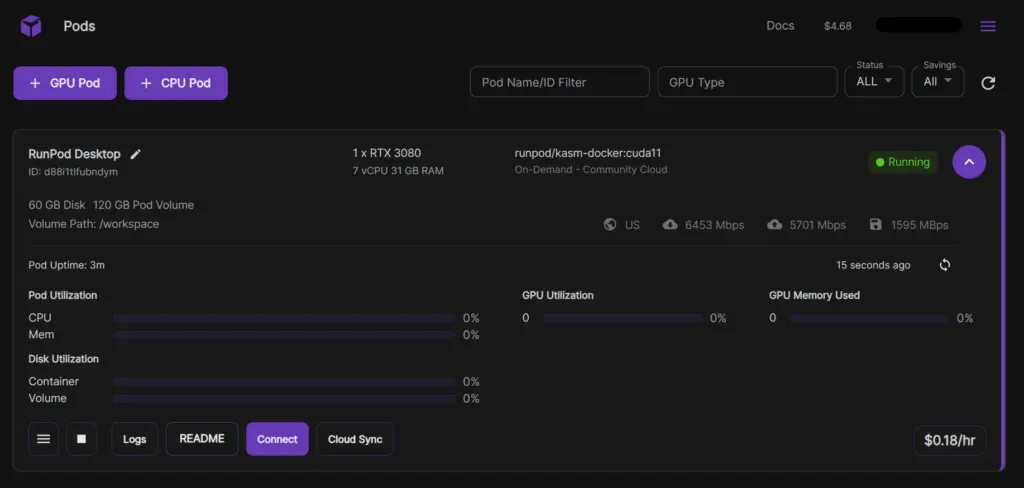 Figure 1: RunPod cloud console deploying high-performance NVIDIA GPU pods for distributed AI training.
2. Serverless vs Dedicated GPU Compute
Modern AI workloads split into two distinct operational categories: continuous training/fine-tuning and intermittent API inference. Deploying the wrong infrastructure model for your workload creates massive financial waste.
- Continuous Training & Fine-Tuning: Dedicated GPU Pods with static 24/7 allocation, high VRAM (A100/H100), and NVMe scratch storage.
- Intermittent API Inference: Serverless GPU Workers with autoscale-to-zero capabilities, pay-per-millisecond billing, and sub-second cold starts.
Dedicated GPU Pods
For model training, large-scale batch embeddings, or persistent multi-tenant applications, Dedicated GPU Pods provide uninterrupted access to hardware. You receive dedicated PCIe or SXM interfaces, guaranteed VRAM, and direct SSH access. Pricing is billed strictly by the minute or hour.
When training a 70B parameter model across multiple nodes, dedicated pods ensure stable GPU-to-GPU interconnectivity via NVLink (delivering up to 900 GB/s bidirectional bandwidth), preventing communication bottlenecks that slow down gradient synchronization during distributed backpropagation passes.
Serverless GPU Inference
Most consumer-facing AI applications experience volatile, spiky traffic patterns. Running dedicated $3.00/hour GPUs that sit idle at 3:00 AM burns venture capital rapidly.
Serverless GPU endpoints solve this by scaling worker containers automatically from zero to dozens of concurrent replicas within milliseconds. You pay strictly for execution time measured down to the millisecond, completely eliminating idle server waste.
When an incoming inference request hits the REST endpoint, the orchestrator routes the payload to a warm worker container. If traffic surges, new worker containers spin up in parallel across the global pool, handling thousands of concurrent user queries before automatically scaling back down to zero when the traffic burst concludes.
3. GPU Cloud Benchmark and Cost Breakdown
To demonstrate the concrete financial disparity, we benchmarked the hourly and monthly costs of running enterprise NVIDIA GPU instances across major cloud providers.
| GPU Hardware Spec | RunPod Community Cloud | RunPod Secure Cloud | AWS EC2 (On-Demand) | GCP Compute Engine | 30-Day TCO Savings with RunPod |
|---|---|---|---|---|---|
| NVIDIA RTX 4090 (24GB VRAM) | $0.34 / hour | $0.44 / hour | Not Available | Not Available | 70%–80% vs equivalent compute |
| NVIDIA A100 (80GB SXM4) | $1.19 / hour | $1.69 / hour | $4.10 / hour (p4d.24xl) | $3.67 / hour (a2-ultragpu) | 58%–71% Cost Reduction |
| NVIDIA H100 (80GB SXM5) | $2.39 / hour | $2.99 / hour | $6.98 / hour (p5.48xl) | $6.52 / hour (a3-highgpu) | 54%–65% Cost Reduction |
| Data Egress (Per Terabyte) | $0.00 / TB (Free) | $0.00 / TB (Free) | $90.00 / TB | $80.00 / TB | 100% Free Bandwidth Arbitrage |
The data reveals a dramatic efficiency gap. For a generative AI company running a modest cluster of 4x NVIDIA A100 GPUs for continuous model inference:
- Legacy Hyperscaler Annual Spend: $4.10 × 4 × 24 × 365 = $143,664 USD / year (excluding storage & egress).
- RunPod Secure Cloud Annual Spend: $1.69 × 4 × 24 × 365 = $59,217 USD / year.
- Net Annual Capital Savings: $84,447 USD (a 58.8% direct bottom-line reduction).
This capital difference frequently represents an extra 12 to 18 months of financial runway for early-stage AI engineering teams. For bootstrapped businesses and venture-backed startups alike, reinvesting $84,000 into engineering talent or customer acquisition delivers vastly superior growth outcomes compared to paying legacy cloud markups.
4. Deploying Serverless AI Inference
Deploying a custom PyTorch or HuggingFace model on RunPod Serverless takes under 10 minutes using standardized Docker containers.
- Pre-loaded Model Weights: Initialize model weights (such as Mistral-7B or LLaMA-3) into GPU VRAM during container startup to minimize execution latency.
- Standardized Handler Schema: The serverless worker processes an input payload containing the prompt, maximum tokens, and temperature parameters.
- CUDA Tensor Execution: Perform GPU inference using half-precision (
torch.float16) on isolated tensor cores without CPU bottlenecks. - Structured Response Delivery: Return decoded completion text, token metrics, and execution status directly to client APIs via webhooks.
Once packaged into a container and pushed to Docker Hub, you link the image to a RunPod Serverless endpoint. The platform automatically provisions GPU workers on demand, tracks execution telemetry, and scales down to zero when traffic subsides.
To optimize cold-start performance in production:
- Lightweight Container Base: Keep the base container image under 10GB by leveraging lightweight CUDA runtime base images (e.g.,
nvidia/cuda:12.1.1-runtime-ubuntu22.04). - Network Volume Checkpoints: Mount model checkpoints from persistent high-speed network storage volumes rather than downloading 15GB weights over public networks during every pod initialization.
- Worker Concurrency Tuning: Configure active worker concurrency thresholds to handle sudden traffic spikes without dropping incoming client requests.
- FlashAttention-2 Optimization: Compile FlashAttention kernels during container image build time to achieve up to 3x higher token generation throughput on Ampere and Hopper architectures.
5. S3 Object Storage and NVMe Data Volumes
AI model weights, training checkpoints, and multi-gigabyte embeddings require massive disk throughput. Slow storage chokes GPU compute pipelines, causing expensive silicon to sit idle waiting for I/O operations.
- Tier 1 (Ephemeral High-Speed NVMe): Local
/workspacevolume inside the GPU Pod with over 3,000 MB/s read speeds for live tensor caching. - Tier 2 (Persistent Network Volumes): RunPod Network Volume shared across distributed pods (500 MB/s) for shared model artifacts.
- Tier 3 (Cold Archive & Checkpoints): Backblaze B2 S3-compatible object storage at $0.006/GB/mo for training checkpoints and multi-TB dataset backups.
| Storage Parameter | Backblaze B2 Cloud Storage | Amazon S3 Standard | Strategic AI Advantage |
|---|---|---|---|
| Storage Cost / GB / Month | $0.006 / GB | $0.023 / GB | 74% Cheaper Archive Storage |
| Data Egress Fee / GB | $0.00 / GB (Bandwidth Alliance) | $0.09 / GB | Free multi-cloud checkpoint transfer |
| API Protocol Support | Native S3-Compatible REST API | Native S3 REST API | Drop-in SDK compatibility |
| Upload / Download Handshake | Global Edge PoPs | AWS Region Specific | Low latency distributed ingestion |
By pairing RunPod compute with Backblaze B2 for model checkpoint storage, engineering teams eliminate the massive storage markup and egress penalties imposed by AWS S3.
When training runs generate 50GB checkpoint files every 500 steps, storing 10TB of historical model iterations on AWS S3 costs $230/month plus hundreds in download egress fees. Storing the identical 10TB dataset on Backblaze B2 costs just $60/month with zero egress charges when transferring to compute workers.
6. Low-Cost VPS for Headless Microservices
While GPU instances handle heavy tensor math, running standard Node.js, Python, or Go backend APIs on $2.00/hour GPU instances is a gross architectural error.
A cost-efficient production architecture decouples the GPU worker cluster from standard backend web services:
- GPU Inference Cluster: Hosted on RunPod Serverless.
- Backend API & Database Servers: Hosted on dedicated Linux KVM VPS instances via RackNerd or enterprise web hosting on BanaHosting.
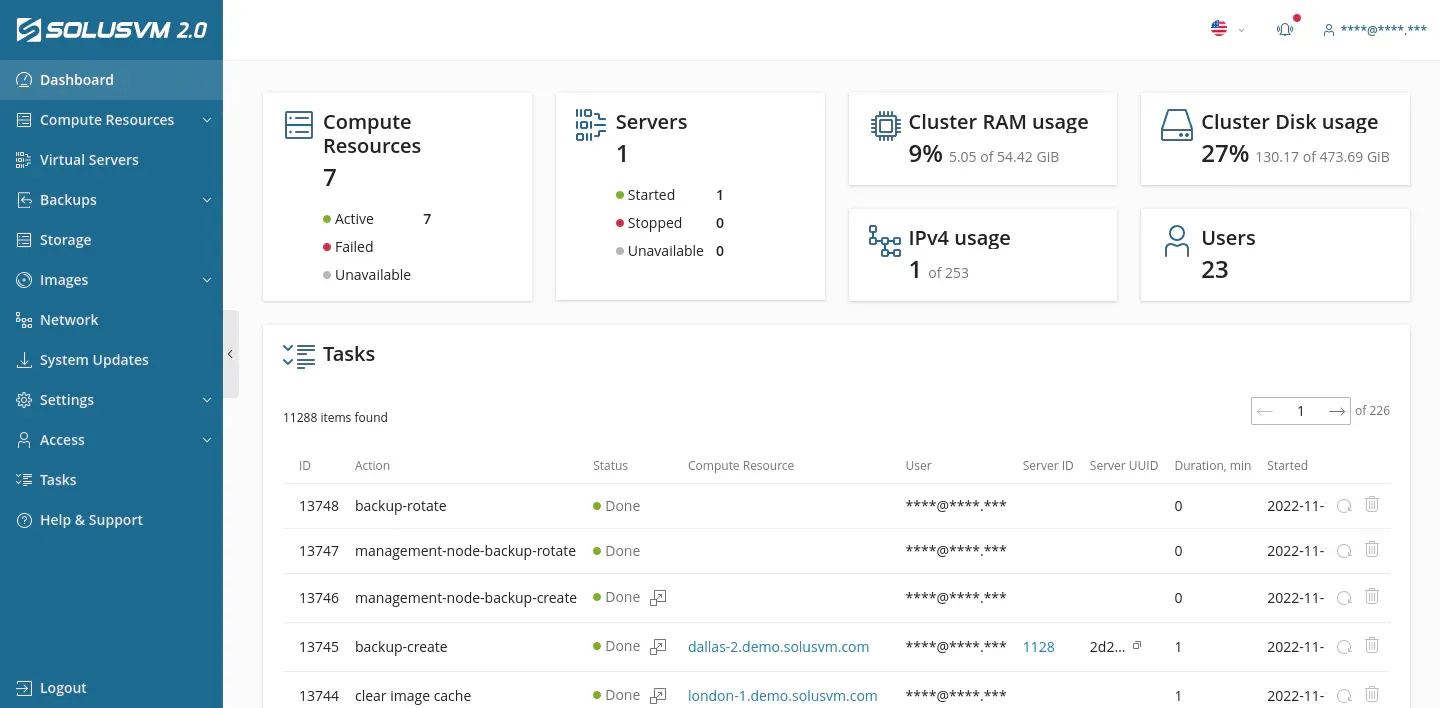 Figure 2: RackNerd KVM VPS management interface monitoring NVMe disk I/O and low-latency network bandwidth.
Deploying backend microservices on RackNerd gives developers dedicated IPv4 addresses, full root access, unmetered bandwidth, and high-speed NVMe disk I/O for under $30 to $50 per year, slashing auxiliary infrastructure overhead to near zero.
Backend API instances on RackNerd handle user authentication, rate limiting, stripe webhook processing, and PostgreSQL database queries, dispatching only heavy tensor generation requests to the RunPod serverless worker pool via secure API tokens.
This architectural separation ensures that when your web application receives thousands of non-compute API hits (such as user logins, dashboard page views, or billing receipts), those requests are processed on budget VPS nodes costing pennies a day rather than consuming expensive GPU memory.
7. Cloud Server Control Panels and WebOps
Managing distributed multi-cloud servers without dedicated DevOps engineers can introduce configuration drift and security vulnerabilities.
Utilizing modern server management control panels like Plesk Obsidian bridges the gap:
- Automated Docker Management: Run microservices, Redis queues, and reverse proxies through visual interfaces.
- SSL Certificate Automation: Automated Let’s Encrypt renewal across custom API subdomains.
- Security Hardening: Built-in fail2ban, firewall policies, and real-time resource telemetry.
- Nginx Reverse Proxy Configuration: Seamlessly proxy incoming client traffic to internal application ports with automated gzip/brotli compression.
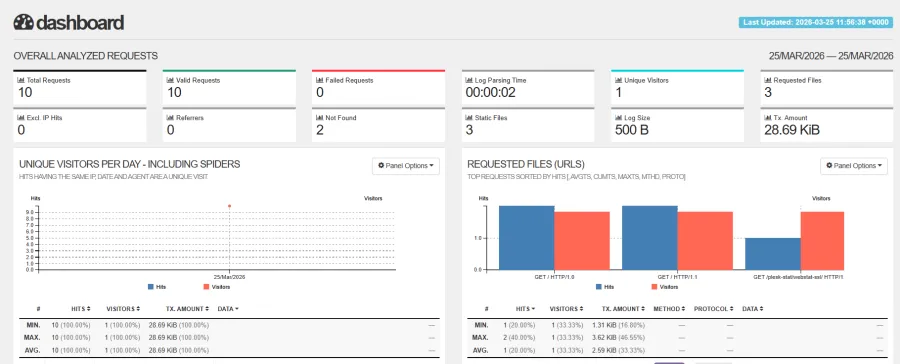 Figure 3: Plesk Obsidian server management interface orchestrating Docker containers and PHP-FPM web environments.
Deploying Plesk on cloud compute environments allows engineering teams to maintain enterprise-grade security and automated deployments without hiring dedicated full-time site reliability engineers. Developers can spin up staging subdomains, configure automated Git push-to-deploy pipelines, and monitor server CPU/RAM load in real time through an intuitive web console.
8. Network Latency and Global Edge Routing
In production AI systems, end-to-end response time is the sum of network transit latency plus GPU compute inference time. If your GPU cluster resides in a remote datacenter with poor peering, user perceived latency suffers.
To optimize global network performance:
- Deploy GPU Pods Close to Target Users: Select RunPod data centers located in primary internet exchange hubs (North America East/West, Europe Central) to keep TCP handshake latency under 35ms.
- Utilize Dedicated Proxy Infrastructure: Use residential and datacenter proxy routing via IPBurger when training scrapers, testing geolocated AI outputs, or harvesting localized training corpora across regional firewalls.
- Leverage Free Cloud Egress: Distribute inference outputs across edge CDN caches without incurring punitive egress bandwidth bills.
- Implement WebSocket Streaming: Stream generated LLM tokens to the client browser chunk-by-chunk over persistent WebSockets, reducing Time to First Token (TTFT) perceived latency below 350ms.
- Connection Keep-Alive & HTTP/2 Multiplexing: Maintain open TCP connections between your backend API gateway and GPU worker pods to eliminate repetitive TLS handshake negotiation latency on high-frequency request streams.
9. Enterprise Compliance and GPU Isolation
A common objection from enterprise security officers when evaluating specialized clouds is data privacy and hardware isolation.
To ensure enterprise-grade security on platforms like RunPod:
- Choose Secure Cloud Over Community Cloud: Secure Cloud pods run exclusively in ISO 27001, SOC2 Type II, and PCI-DSS certified Tier 3/4 facilities with strict biometric physical access controls.
- Enforce Container Encryption: Encrypt model weights in transit using TLS 1.3 and at rest using AES-256 encrypted network volumes.
- Ephemeral Storage Purging: Configure automated container teardown scripts that zero-out local
/tmpand/workspaceNVMe directories immediately upon session termination. - Private Networking & VPC Peering: Isolate GPU worker clusters behind private virtual networks, restricting inbound public access exclusively through authenticated reverse proxy gateways.
- Strict Role-Based Access Control (RBAC): Enforce granular API key permissions across development, staging, and production environments so engineering team members cannot accidentally modify live inference pods.
10. Multi-Cloud AI Stack Architecture
The optimal infrastructure blueprint for high-growth AI companies in 2026 is inherently modular and multi-cloud:
- Inference Layer: RunPod Serverless GPU for on-demand API inference and autoscaling workloads.
- Core Training Layer: RunPod Secure Cloud Pods for continuous fine-tuning and model evaluation.
- Web & API Gateway: RackNerd Dedicated Linux VPS or BanaHosting NVMe servers for frontend APIs and client databases.
- Object Storage Layer: Backblaze B2 for model checkpoints, training datasets, and cold media storage.
- Proxy & Scraping Layer: IPBurger Dedicated Proxies for distributed data collection and web intelligence.
- Management & Security: Plesk Obsidian server control panel paired with edge CDN protection.
Strategic Implementation Takeaways
By abandoning legacy hyperscaler monopolies and adopting a specialized multi-cloud architecture:
- Compute costs drop by 60% to 75% using RunPod dedicated and serverless pods.
- Storage and checkpoint backup expenses drop by 74% using Backblaze B2 with zero egress fees.
- Web API hosting overhead is minimized using high-performance budget VPS compute via RackNerd and BanaHosting.
- DevOps operational complexity is managed effortlessly through Plesk control panels.
Future Outlook: The Decentralized Compute Ecosystem
As open-source models (such as Llama 3, Mistral Large, and Stable Diffusion 3.5) continue to close the capability gap with closed-source proprietary APIs, the competitive moat in artificial intelligence shifts decisively toward inference unit economics. Companies that engineer multi-cloud, egress-free compute pipelines today will enjoy a durable margin advantage, allowing them to deliver faster, cheaper, and more reliable AI services to end users worldwide.