





1. Why DoorLoop Is Redefining Modern Property Management in 2026
Property management software has long forced operators into an uncomfortable trade-off. Legacy platforms like AppFolio, Yardi, and RealPage provide deep capabilities but remain cumbersome, slow, and complex. Their interfaces resemble early desktop databases, often requiring weeks of training. Conversely, entry-level rent collection tools lack real double-entry accounting, forcing property teams onto fragile spreadsheets.
DoorLoop entered the real estate technology industry to break this historic divide. Founded by software entrepreneurs Ori Tamuz, David Bitton, and Matt Cave, DoorLoop set out to build an all-in-one cloud platform pairing consumer-grade interface speed with rigorous enterprise bookkeeping. The software is designed from the ground up for modern property managers, asset owners, and regional management firms who refuse to navigate convoluted legacy menus.
Prospective buyers researching DoorLoop will quickly notice outdated pricing figures across independent review sites. Many articles still reference deprecated Starter and Pro tiers ranging from $49 to $149 per month. In reality, DoorLoop restructured its architecture around three modern plans: DoorLoop One, Connect, and Multiply. Crucially, the platform introduced native autonomous AI agents that field tenant calls, triage repairs, and execute lease renewals around the clock.
This operational upgrade establishes a modern entry price floor of $199 per month when billed annually ($239 per month on monthly billing). In this in-depth review, we analyze whether DoorLoop’s unified accounting infrastructure, multi-asset versatility, and autonomous agent capabilities justify that baseline investment for growing real estate portfolios in 2026.
2. Multi-Asset Architecture Across Residential, Commercial, and HOA Portfolios
A persistent operational headache in property management is portfolio fragmentation. Managing multifamily complexes, retail storefronts, and associations across separate systems creates administrative chaos, disjointed reporting, and steep licensing expenses. DoorLoop eliminates this friction by unifying diverse property asset classes inside a single relational database.
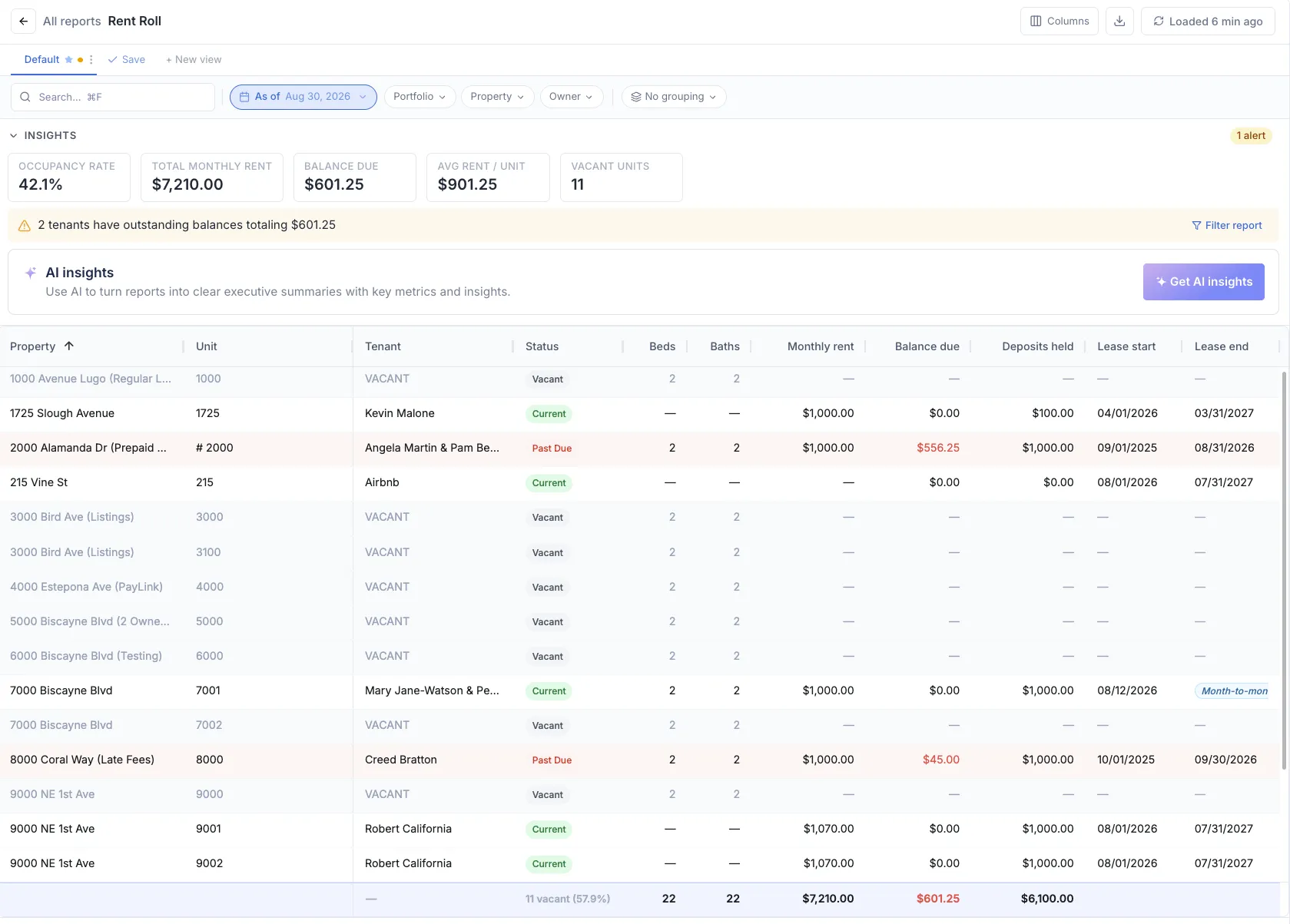 Figure 1: DoorLoop 2.0 centralized portfolio overview displaying multi-unit properties, occupancy status, and customizable table views.
Residential Portfolios
Residential management forms DoorLoop’s primary foundation. The system oversees the residential tenant journey: publishing vacant listings across leading rental portals, processing applications, running TransUnion background checks, managing security deposits in compliant trust accounts, and automating recurring rent billing. Staff can track single-family homes, student housing, and multi-unit complexes with custom tags and flexible lease addendums.
Commercial Leases and CAM Reconciliations
For commercial portfolios, DoorLoop accommodates gross, modified gross, and triple net (NNN) lease contracts. Property managers can establish shared expense pools for Common Area Maintenance (CAM), municipal property taxes, structural insurance, and utility services. The platform calculates individual tenant allocations based on occupied square footage formulas, producing transparent reconciliation audit statements that eliminate manual spreadsheet calculations during annual adjustments.
Community Associations, HOAs, and Specialized Portfolios
For homeowners associations and condo boards, DoorLoop handles recurring dues collection, architectural review applications, meeting minute distribution, and rule violation tracking with photographic evidence. Furthermore, the platform natively accommodates specialized real estate categories, including self-storage facilities with automated gate lockout notices, mobile home parks with sub-metered utility splits, and commercial flex-office spaces with shared conference room reservations.
3. Financial Infrastructure: Built-in Accounting and QuickBooks Sync
The single biggest technological difference between lightweight rent collection apps and enterprise property management software lies in the accounting architecture. Basic apps merely function as payment gateways and digital check registers. In contrast, DoorLoop embeds a complete double-entry bookkeeping engine that upholds strict GAAP financial reporting standards.
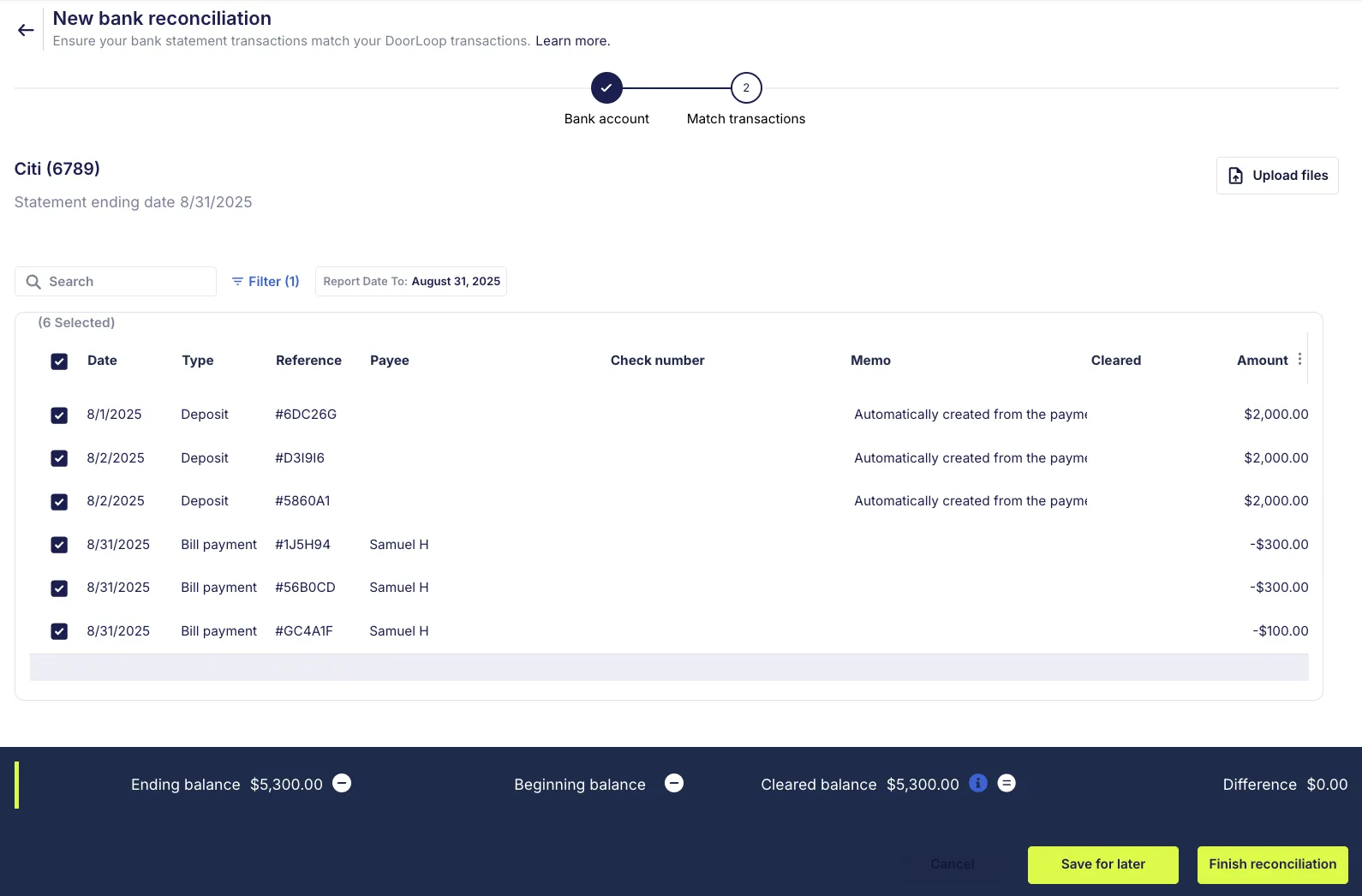 Figure 2: Real-time bank reconciliation inside DoorLoop matching cleared bank deposits and payments with double-entry ledger accounts.
Native Double-Entry Chart of Accounts
DoorLoop includes a pre-configured real estate Chart of Accounts that covers property operating expenses, capital reserves, tenant liabilities, and owner distributions. Every financial transaction automatically triggers balanced debit and credit entries. For licensed managers, the software enforces strict separation between operating accounts and security deposit trust funds, preventing commingling and maintaining state compliance.
Automated Bank Feeds and Two-Way QuickBooks Sync
Through secure Plaid connections, DoorLoop links directly with thousands of financial institutions. Property managers and bookkeepers can reconcile cleared checks, wire transfers, and incoming merchant deposits against open ledger line items with rapid one-click verification.
For property management firms that work alongside external CPAs who rely on QuickBooks, DoorLoop provides an industry-leading two-way synchronization engine with QuickBooks Online. Customer invoices, vendor bills, bank accounts, and class allocations synchronize automatically in real time. Transactions entered in DoorLoop update QuickBooks instantly, and adjustments recorded by outside accountants mirror back into DoorLoop without redundant double data entry.
Accounts Payable and Year-End Tax Reporting
Managing vendor payables is streamlined from initial quote to final settlement. Managers can review submitted invoices, match them to open work orders, and issue electronic disbursements directly from property accounts. At tax season, DoorLoop aggregates vendor payouts into IRS-compliant 1099-MISC and 1099-NEC reports for direct electronic filing.
4. Tenant Lifecycle: Screening, Applications, and Digital Leasing
Unoccupied rental units represent permanent revenue loss that can never be recovered. DoorLoop accelerates vacancy turnaround times by transforming fragmented leasing chores into a connected, mobile-responsive digital funnel.
Listing Syndication and Custom Portals
With a single click inside the listing manager, vacant rental units are syndicated across high-traffic rental directories including Zillow, Trulia, HotPads, and Rent.com. Every subscription includes a personalized, search-optimized website where prospective renters can browse portfolio vacancies, view photo galleries, review amenities, and submit applications directly from their smartphones.
Integrated TransUnion Screening and E-Signatures
DoorLoop embeds institutional-grade background screening directly into the application process through TransUnion. Tenant reports generate within minutes and include comprehensive credit profiles with VantageScore ratings, nationwide criminal database checks, 50-state eviction filings, and identity verification. Property managers can configure the application workflow to collect non-refundable application fees ($45 to $49.90) directly from applicants, eliminating out-of-pocket screening expenses.
Once an applicant is approved, property managers can generate customized residential or commercial leases using DoorLoop’s built-in document builder. Existing PDF leases can be uploaded and populated with dynamic merge tags that pull tenant names, unit numbers, rental amounts, and deposit terms automatically. The software distributes secure signing links to all tenants, co-signers, and guarantors, providing legally binding, ESIGN-compliant digital signatures without requiring third-party signature subscriptions.
5. Rent Collection Workflows and Payment Processing Systems
Predictable cash flow is the operational lifeblood of every portfolio. DoorLoop replaces physical paper checks, lockbox trips, and manual collections with a comprehensive digital payment infrastructure.
Flexible Digital Payment Channels
Tenants manage their financial obligations through a dedicated web portal or mobile application, with access to diverse payment options:
- Automated Clearing House (ACH) direct bank transfers
- Debit and credit card payments (standard 3.25% merchant processing fee passed to cardholders)
- Cash payments at nationwide retail partner locations via PayNearMe and Western Union
The cash payment partnership is especially valuable for operators managing workforce housing. Renters can generate a secure digital barcode on their smartphones, visit participating retail locations like Walgreens or 7-Eleven, and pay cash at the register. Funds credit the tenant’s ledger and property operating account instantly, eliminating cash handling risks.
Automated Late Fees and Owner Disbursements
Property managers can configure custom rent rules with specific grace periods and automated late fee penalties, supporting flat rates, percentage-based fees, or compounding daily charges. In the event of formal eviction proceedings, property staff can block partial payments with a single toggle, preserving statutory eviction notices and protecting legal timelines.
For third-party property management companies, DoorLoop calculates accurate net rental proceeds by automatically deducting management fees, utility chargebacks, and approved maintenance expenses. Available balances can be disbursed to property owners via bulk electronic transfers alongside branded monthly financial statements.
6. Maintenance Dispatch and Vendor Management Pipelines
Maintenance coordination is frequently cited as the single most demanding aspect of daily property operations. DoorLoop organizes disjointed maintenance phone calls, texts, and emails into a structured, trackable work order pipeline.
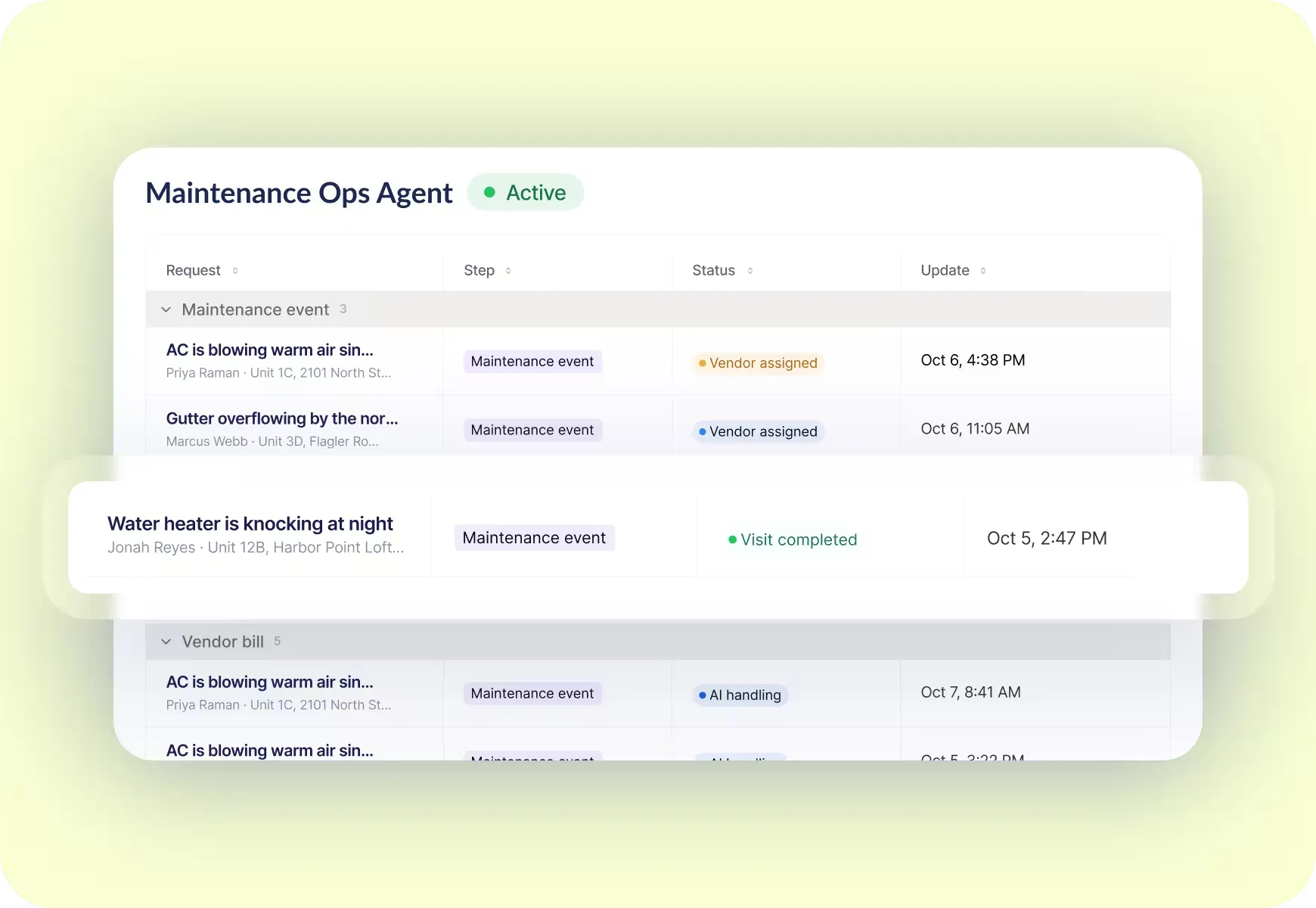 Figure 3: DoorLoop 2.0 maintenance dispatch pipeline tracking tenant repair requests, vendor assignments, and invoice status.
Work Order Submission with Media Attachments
Tenants can log maintenance tickets at any time through the tenant mobile app. The submission form guides tenants to select specific issue categories, designate pet safety information, authorize entry permissions, and attach high-resolution photos or video clips of the problem. Visual documentation allows property managers to diagnose issues accurately, determine responsibility, and avoid unnecessary technician call-out charges.
Vendor Dispatch and Direct Invoicing
Once a work order is reviewed, managers can assign the job to internal maintenance employees or external third-party contractors via automated email or text message. External contractors do not need to purchase user accounts: they receive a secure mobile link where they can view property access instructions, record job completion notes, attach before-and-after photos, and submit their final invoice.
Approved invoices convert directly into Accounts Payable entries with one click, posting to the property ledger and maintaining an unbroken audit trail from initial complaint to final payment.
7. Autonomous AI Suite: Receptionist, Maintenance, and Lease Renewal Agents
While many software companies add superficial AI chat widgets, DoorLoop engineered native autonomous AI agents that interact directly with your live portfolio database to execute operational workflows.
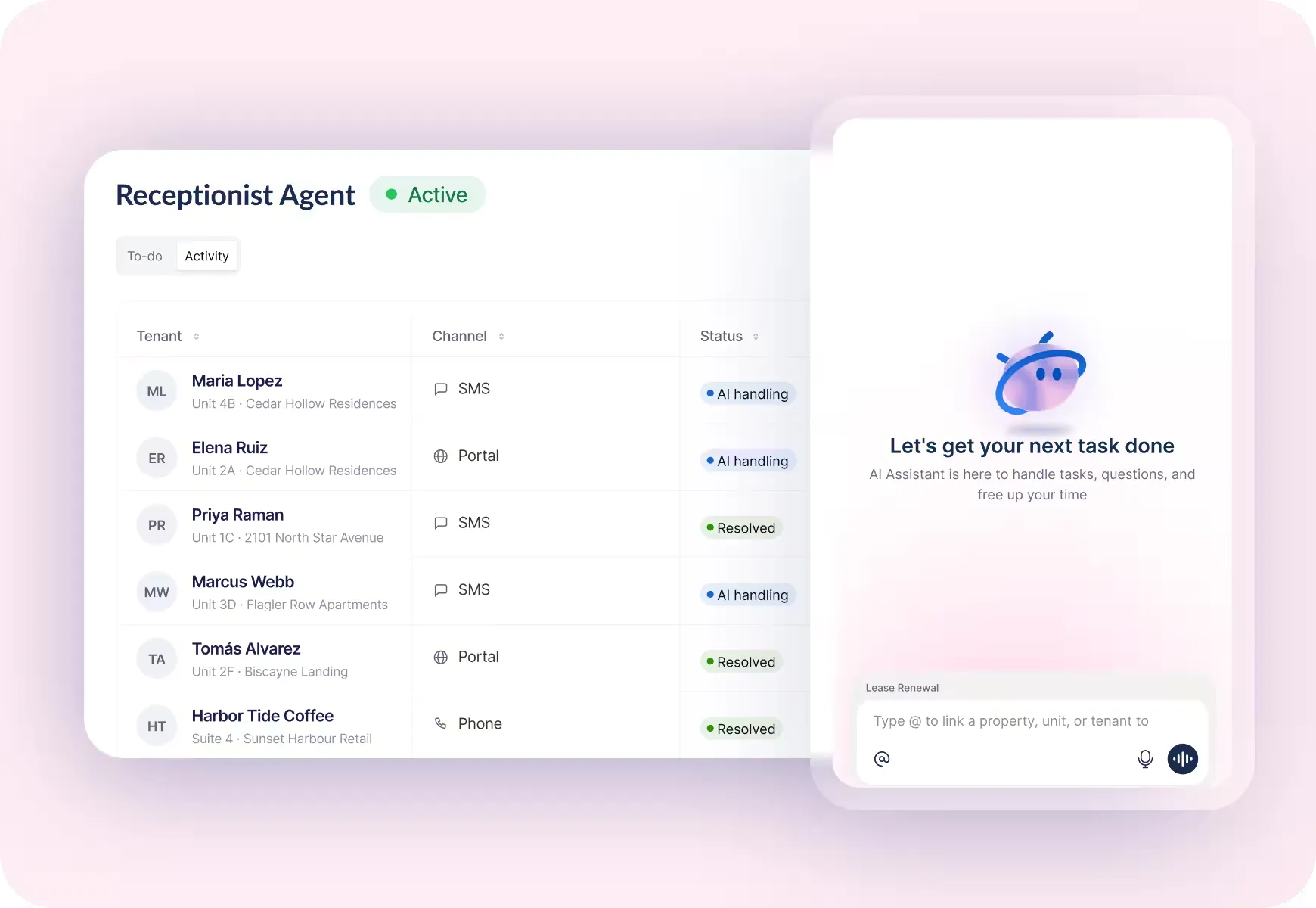 Figure 4: DoorLoop AI Receptionist and conversational assistant resolving tenant inquiries, checking lease rules, and logging tickets.
AI Assistant on DoorLoop One
On the entry-level DoorLoop One tier, the AI Assistant acts as a dependable administrative co-pilot. It drafts compelling rental property listings based on selected amenities, summarizes lengthy tenant communication threads, and condenses detailed move-out inspection checklists into structured executive summaries.
Round-the-Clock Receptionist Agent on DoorLoop Connect
Available on the Connect tier, the AI Receptionist operates as a tireless 24/7 digital front desk coordinator across incoming telephone calls, SMS messages, and tenant portal inquiries. Connected directly to the portfolio database, the agent verifies caller identities, consults lease terms, and answers balance or property policy questions without human intervention. Crucially, when an emergency arises, such as a major water pipe rupture or heating failure during freezing temperatures, the agent recognizes urgency and escalates the ticket directly to on-call staff following custom routing rules.
Maintenance Ops and Lease Renewal Agents on DoorLoop Multiply
On the top-tier Multiply plan, DoorLoop introduces comprehensive autonomous operational agents:
- Maintenance Ops Agent: Takes tenant repair descriptions, requests additional diagnostic photos if details are lacking, contacts approved preferred contractors for availability, gathers competitive price quotes, and queues invoices for managerial review.
- Lease Renewal Agent: Continuously monitors lease expiration timelines, benchmarks current market rental rates, and generates automated renewal offers at 90, 60, and 30-day milestones. It coordinates digital signature collection and logs every interaction in plain-language audit journals, ensuring human managers retain complete supervision.
8. Transparent Pricing Structure and Real-World Portfolio Economics
DoorLoop structures pricing on a per-unit basis, offering substantial savings for property managers who commit to annual billing. Understanding tier thresholds is essential for determining your exact monthly investment.
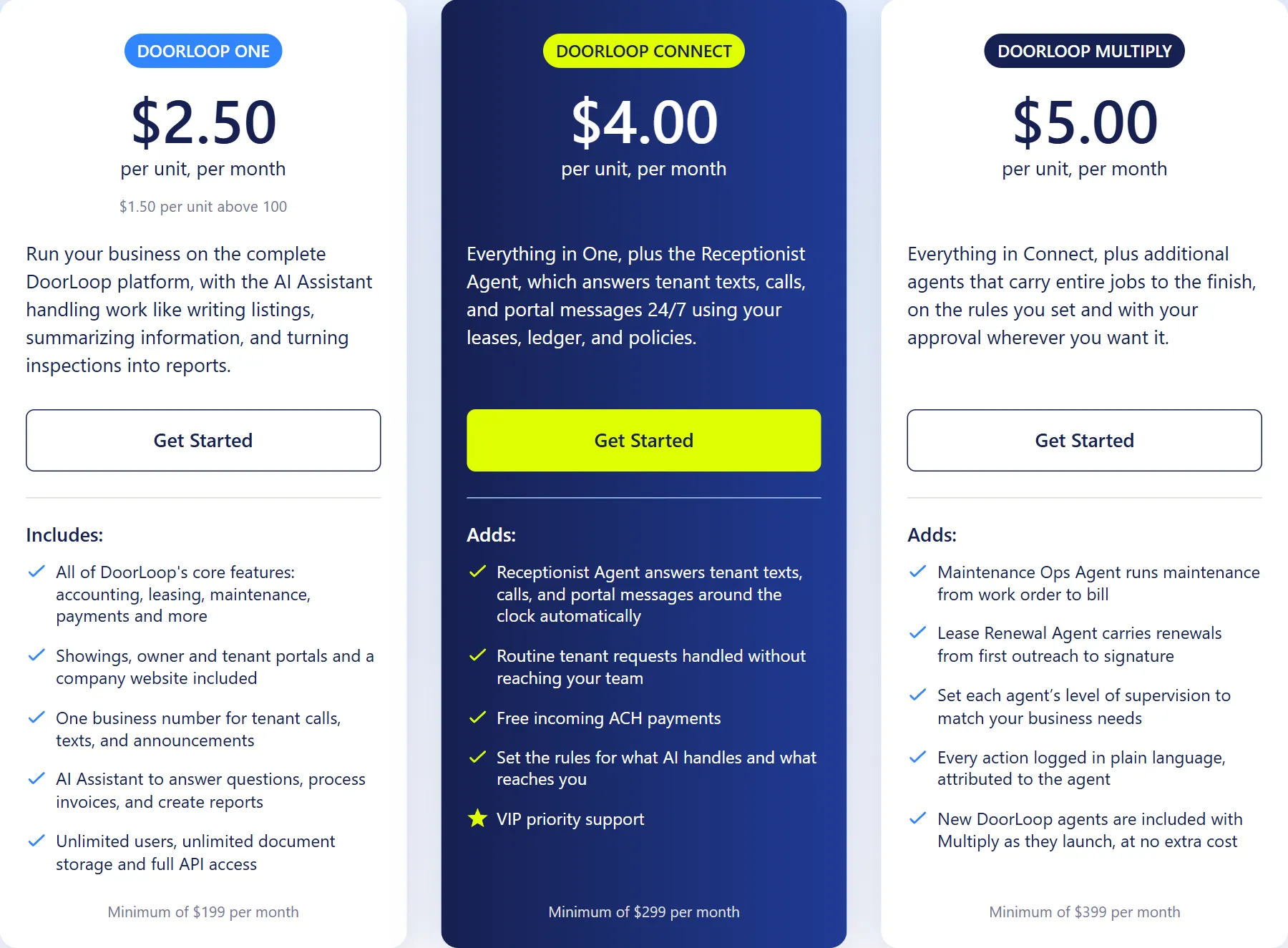 Figure 5: Official DoorLoop 2026 subscription tiers displaying DoorLoop One ($199/mo minimum), Connect ($299/mo minimum), and Multiply ($399/mo minimum) with per-unit rates and feature inclusions.
| Plan Tier | Annual Billing Minimum | Monthly Billing Minimum | Per-Unit Cost (Annual / Monthly) | Key Included Features | Best Operational Fit |
|---|---|---|---|---|---|
| DoorLoop One | $199 / month | $239 / month | $2.50 / unit ($1.50 above 100) / $3.00 / unit ($1.80 above 100) | Full core platform, double-entry accounting, tenant and owner portals, online payments, website, 1 business phone number, unlimited users, unlimited storage, open REST API, standard AI Assistant | Mid-sized operators (20-100 units) wanting modern UI, unlimited seats, and unified accounting |
| DoorLoop Connect | $299 / month | $359 / month | $4.00 / unit / $4.80 / unit | Everything in One plus 24/7 AI Receptionist Agent (phone, SMS, portal), free incoming ACH payments, custom AI rules & permissions, VIP priority support | Growing teams needing 24/7 tenant answering without hiring additional front desk staff |
| DoorLoop Multiply | $399 / month | $479 / month | $5.00 / unit / $6.00 / unit | Everything in Connect plus Maintenance Ops Agent, Lease Renewal Agent, custom supervision controls, plain-language action logs, and upcoming agents | Scaled property management companies seeking full automation of maintenance and renewal cycles |
Unlimited Seats and Core Inclusions
A major financial advantage of DoorLoop is its transparent fee model. DoorLoop includes unlimited administrative seats, unlimited document storage, a dedicated tenant portal, a public website, a business phone line, and open REST API access on every plan without per-seat licensing penalties. Credit and debit card payments carry a standard 3.25% fee paid by cardholders, incoming ACH payments are free on Connect and Multiply tiers (standard transaction fees apply on One), and outgoing ACH disbursements to vendors and owners are free across all subscription plans.
Real-World Portfolio Cost Calculations
- Small Residential Portfolio (20 Units on DoorLoop One): At 20 units ($50 calculated under the $2.50 annual per-unit rate), the account hits the $199 monthly plan minimum, resulting in an effective rate of $9.95 per unit monthly.
- Mid-Sized Multi-Family Operator (80 Units on DoorLoop One): At 80 units ($200 calculated), the portfolio exceeds the minimum threshold, achieving an economical rate of $2.50 per unit monthly.
- Large Scaled Management Firm (200 Units on DoorLoop Connect): At 200 units on the Connect tier ($800 monthly on annual billing), the software completely eliminates the need for third-party telephone answering services and after-hours call centers, generating substantial net operational savings.
9. DoorLoop Pros and Cons
What We Liked (Pros)
- Sleek, modern user interface with virtually zero onboarding friction compared to legacy enterprise platforms
- Autonomous AI agents handle routine tenant calls, maintenance triage, and lease renewals around the clock
- Native double-entry accounting engine eliminates the mandatory requirement for external bookkeeping software
- Seamless bi-directional QuickBooks Online synchronization keeps external accountants and CPAs perfectly aligned
- Unlimited user seats and open REST API access included in the base plan without per-user pricing penalties
Areas for Improvement (Cons)
- Steep entry price floor of $199/month makes it uneconomical for DIY landlords managing fewer than 15 units
- Advanced AI agents like the 24/7 Receptionist and Maintenance Ops require higher tiers starting at $299 to $399 per month
- Customization for complex commercial financial statements is less flexible than legacy enterprise ERP systems
- Standard customer support availability is primarily focused on North American business hours
Key Operational Advantages
DoorLoop’s standout strength is modern software engineering. Every screen is responsive, navigation is straightforward, and team members can achieve proficiency within hours instead of weeks. Unifying tenant messaging, maintenance work orders, digital leasing, and double-entry accounting inside one shared database completely eliminates double data entry and administrative oversights.
Practical Limitations
The platform’s primary drawback is the $199 monthly entry minimum, which makes DoorLoop impractical for casual DIY landlords with small unit counts. Additionally, institutional investment funds managing complex real estate syndications with tens of thousands of units may find DoorLoop’s financial reporting less customizable than legacy enterprise systems like Yardi Voyager or MRI Software.
10. Head-to-Head Comparison: DoorLoop vs Industry Alternatives
Selecting the right property management platform requires evaluating portfolio size, asset types, internal staff expertise, and automation requirements.
| Software Platform | Overall Rating | Starting Price Floor | Unit Focus | AI Automation Level | Best Operational Fit |
|---|---|---|---|---|---|
| DoorLoop | 4.8 / 5.0 | $199 / month | 20 to 500+ Units | High (Autonomous AI Agents) | Mid-sized operators wanting modern UI, accounting, and 24/7 AI answering |
| AppFolio | 4.6 / 5.0 | ~$280 / month (50-unit minimum) | 50 to 1,000+ Units | Moderate (Smart Workflows) | Large established residential property management companies |
| Buildium | 4.5 / 5.0 | ~$55 / month | 20 to 500+ Units | Low to Moderate | Traditional property managers seeking reliable legacy accounting |
| TurboTenant | 4.4 / 5.0 | Free / $149 per year | 1 to 15 Units | Low (Basic Automation) | DIY landlords managing small personal portfolios on a budget |
DoorLoop vs AppFolio
AppFolio enforces strict hurdles, requiring a 50-unit minimum starting at $280 monthly for Core and up to $1,500 monthly for Plus. AppFolio also restricts open API integrations to top tiers. DoorLoop includes open REST API access and unlimited users on all plans, providing a significantly faster, more responsive experience.
DoorLoop vs Buildium
Buildium provides an accessible entry price of $55 monthly, but charges a la carte add-on fees for incoming ACH transactions ($1.25 per transfer), electronic lease signatures, and implementation packages. Once an operator grows past 50 units, Buildium’s total effective cost closely tracks DoorLoop, yet Buildium lacks DoorLoop’s 24/7 autonomous conversational AI agents.
DoorLoop vs TurboTenant
TurboTenant serves 1 to 10 unit landlords through a freemium model funded by tenant applicant screening fees. However, TurboTenant lacks native double-entry accounting, commercial lease tools, and HOA management features. Expanding property management businesses outgrow DIY tools the moment they require compliant trust accounting and multi-user permissions.
Strategic Selection Framework
- Choose DoorLoop if: You manage 20 to 500+ units across residential, commercial, or HOA portfolios and want modern UI, built-in accounting, and 24/7 autonomous AI answering.
- Choose AppFolio if: You operate an established residential enterprise with 500+ units that requires complex corporate workflow configurations.
- Choose TurboTenant if: You are an independent landlord managing under 15 units seeking zero software licensing costs.
11. Frequently Asked Questions
DoorLoop provides personalized 1-on-1 walkthrough demos and sandbox test accounts with product specialists rather than an instant self-serve trial.
Yes. DoorLoop contains a full double-entry accounting engine with chart of accounts, bank feeds, accounts payable, and P&L reports, alongside a two-way QuickBooks sync.
Operating 24/7 on the Connect tier, the Receptionist Agent takes tenant calls, texts, and portal messages, resolving inquiries directly from your lease rules.
Yes. DoorLoop natively supports commercial NNN leases with CAM reconciliations, as well as HOA dues billing, violation tracking, and architectural reviews.
On DoorLoop One ($2.50/unit/month billed annually), 50 units equals $125, but defaults to the $199/month plan minimum.
Yes. Through partnerships with PayNearMe and Western Union, tenants can pay cash at thousands of local retail locations, instantly updating their ledger.
No. Standard DoorLoop subscriptions include assisted data migration and training without mandatory multi-thousand-dollar implementation charges.
12. Does DoorLoop Deliver Real Operational Value in 2026?
DoorLoop represents the modern evolution of property management technology. By unifying double-entry accounting, multi-asset leasing, maintenance dispatch pipelines, and autonomous AI agents into a single platform, it solves software fragmentation for real estate operators.
Its value proposition depends on portfolio scale. For small landlords managing under 15 units, the $199 monthly baseline is disproportionately high.
However, for growing property managers overseeing 20 to 500+ units, DoorLoop is an outstanding investment. The hours saved by its 24/7 AI Receptionist Agent, automated maintenance dispatch, and bi-directional QuickBooks sync easily outweigh the subscription price, giving modern teams a decisive operational advantage.
Who Should Buy DoorLoop:
- Growing Property Management Firms (20-500+ Units): Companies seeking a modern operating system with unlimited user seats, open APIs, and rapid onboarding.
- Mixed-Asset Portfolio Owners: Investors managing residential apartments, commercial storefronts, and community associations inside a single ledger.
- Teams Needing Front Desk Automation: Operations wanting 24/7 automated telephone and messaging triage through native AI agents without adding headcount.
Who Should Look Beyond DoorLoop:
- Micro-Landlords (Under 15 Units): Part-time landlords who only need basic rent collection should choose tools like TurboTenant or TenantCloud.
- Institutional Real Estate Funds (2,000+ Units): Mega-enterprises requiring hyper-customized ERP database schemas where Yardi Voyager remains standard.


DoorLoop
DoorLoop is one of the most intuitive, technologically advanced property management platforms available in 2026. By pairing complete double-entry accounting with 24/7 autonomous AI agents for tenant communications and maintenance, it eliminates administrative drag for mid-sized portfolios. While its $199/month minimum price floor is too steep for micro-landlords with fewer than 15 units, growing property managers with 20 to 500+ units will find it delivers exceptional operational ROI.