




1. What Is Dun & Bradstreet?
Business decisions become harder when each department has a different view of the same company. Sales needs account information, finance needs credit context, and procurement needs visibility into suppliers. Disconnected records make those decisions difficult to reconcile, particularly when a business operates through several entities or locations.
Dun & Bradstreet, commonly known as D&B, brings business identity, commercial data, and analytics into these workflows. The D-U-N-S Number provides the identity reference, while individual products add credit information, risk analysis, prospecting tools, or data enrichment.
D&B’s strongest appeal is the connection between company identity and operational decisions. Credit Insights helps owners understand their own business credit profile. Finance Analytics supports customer credit management. Hoovers handles sales research, while Connect and Direct+ address the information flowing through business systems.
That breadth makes D&B more relevant to organizations with recurring credit, supplier, or account-data requirements. A small business owner can start with a focused credit product; a larger organization can use different parts of the portfolio across departments. The trade-off is commercial and operational complexity: products have separate prices, access rights, and implementation requirements.
2. D-U-N-S Numbers and Business Identity
The D-U-N-S Number is a nine-digit identifier for a business. It gives company information a consistent reference beyond a name or web domain, which is useful when records contain abbreviations, address changes, or different naming conventions.
D-U-N-S registration is free through the U.S. application process. Businesses can also look up an existing number, and eligible U.S. companies can request updates to their basic information. Registration and paid credit services are separate: obtaining an identifier does not purchase a monitoring subscription or access to every D&B report.
For business owners, accurate company details matter because partners may use the profile when researching the organization. For enterprise data teams, a shared identifier provides a foundation for connecting account records across sales, finance, and procurement.
The distinction between identity and creditworthiness remains essential. A D-U-N-S Number identifies a business; lenders and commercial partners still apply their own approval criteria. The value comes from connecting the correct company to the information used in a decision.
3. Business Credit and Finance Analytics
Credit Insights and Finance Analytics address different sides of business credit. Credit Insights focuses on understanding and managing your own company’s profile. Finance Analytics supports teams making credit decisions about customers and monitoring portfolio exposure.
Credit Insights Free includes risk-range indicators for four scores and ratings: PAYDEX, Delinquency Score, Failure Score, and Supplier Evaluation Risk Rating. Those ranges provide an accessible starting point for credit awareness, but they offer less detail than the numerical scores available in paid tiers.
Basic expands access to six scores and ratings, payment information, alerts, and dark-web monitoring for up to three business email addresses. It is the more focused paid option for an owner who wants ongoing visibility into the company’s credit profile without the broader submission and comparison allowances of higher tiers.
Plus adds comparisons with up to five U.S. businesses, monitoring for five email addresses, and up to 12 regular-term payment or financial-statement submissions. Premium increases comparisons to 25 U.S. businesses, includes unlimited submissions, and provides Business Information Reports on ten other companies. Those allowances should not be treated as monthly entitlements without confirmation of the applicable allowance period. Submitted information remains subject to review and possible acceptance; purchasing a plan does not guarantee a better score.
Finance Analytics moves the emphasis from a single company’s profile to credit operations. Decision Maker supports credit applications and decision workflows, Portfolio Insights organizes exposure across accounts, and Account Manager helps identify accounts that need attention. This combination is more relevant to a credit department managing many customer relationships than an owner monitoring one business.
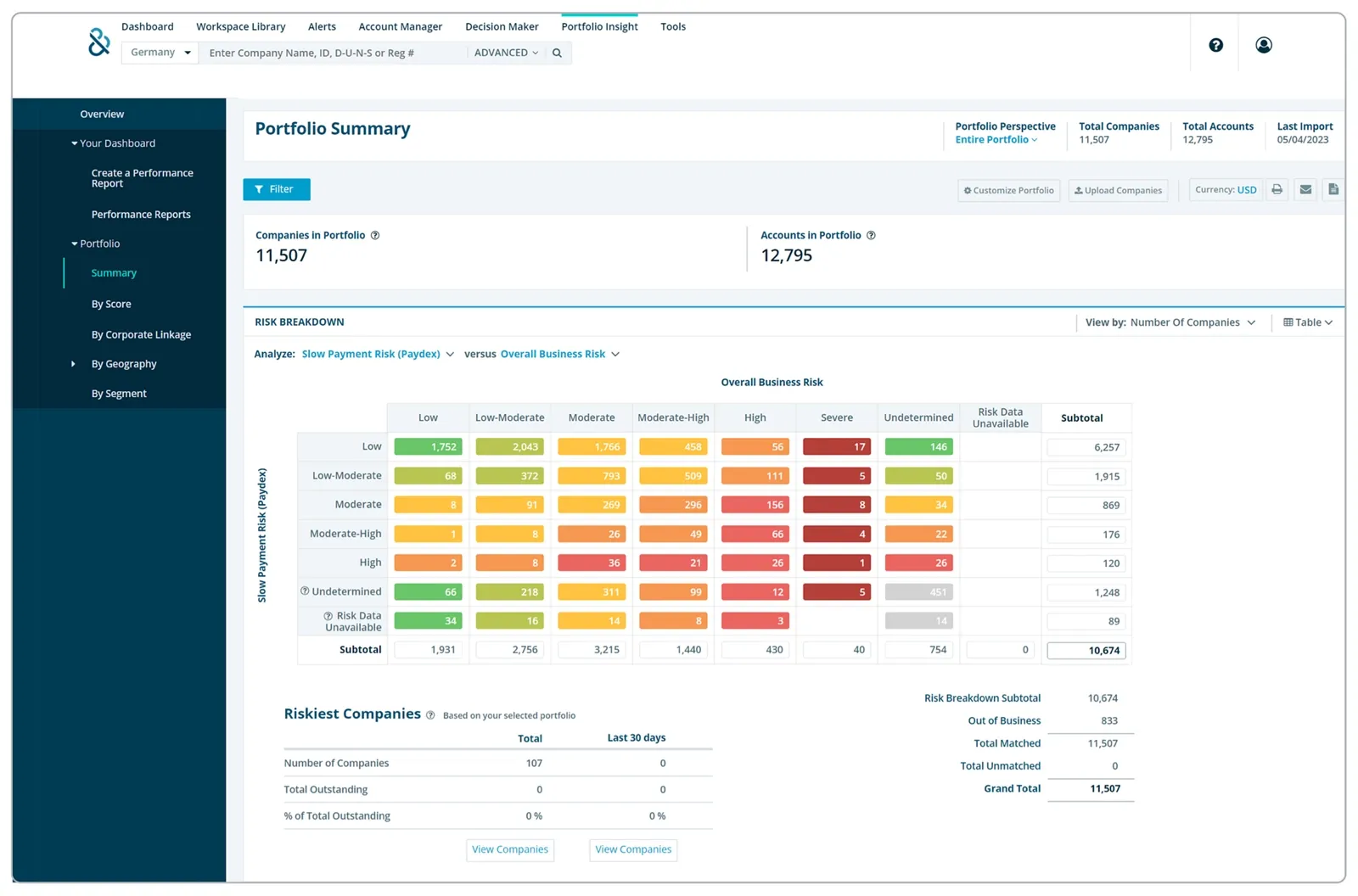 Figure 1: D&B Finance Analytics Portfolio Summary compares Slow Payment Risk (PAYDEX) with Overall Business Risk.
4. Supplier Risk and Compliance Intelligence
D&B’s supplier-risk services extend company intelligence into procurement. Supplier identification, onboarding, screening, and monitoring help teams organize the information behind vendor relationships, including the businesses connected to a supplier network.
Risk Analytics (Compliance Intelligence) adds business-partner verification, beneficial-owner screening, due diligence, monitoring, and third-party surveys. These capabilities serve a different purpose from a prospecting database: the concern is understanding the counterparty and maintaining oversight as its circumstances change.
The practical benefit is continuity between onboarding and ongoing monitoring. An initial company check establishes the starting position; subsequent changes can bring a relationship back into review. That matters when supplier records and review history are otherwise spread across spreadsheets, email, and separate systems.
The operational commitment is substantial enough to consider alongside the license. Alerts need an owner, uncertain matches need review, and internal policies need to define the next action. D&B supplies information and workflow capabilities, while the organization remains responsible for its approval process. Teams with recurring supplier reviews have a clearer use case than businesses needing only an occasional company lookup.
5. Sales, Marketing, and D&B Hoovers
D&B Hoovers is the sales intelligence part of the portfolio. It combines company and contact research with buying signals, business events, account context, and prioritization tools. The goal is to help sellers identify suitable businesses and understand the circumstances behind an outreach opportunity.
Its value is strongest where account research matters to the sale. Company information helps establish fit, while buying signals and business changes provide context for timing and messaging. That gives a sales team more to work with than an isolated contact record.
Hoovers Essentials offers a smaller-business entry point with separate company and contact credits. The full Hoovers product has its own scope and commercial terms. D&B also offers marketing solutions for audience-related workflows, so sales access should not be assumed to cover every marketing service.
Hoovers does not make Finance Analytics, compliance screening, or enterprise data feeds part of the same subscription. For a revenue team, the decision is whether its account information and prospecting workflow justify the cost. For a broader D&B deployment, sales intelligence is one module within a larger business-data strategy.
6. D&B Connect and Data Management
D&B Connect addresses the quality and consistency of business records. Its core functions cover matching, cleansing, enrichment, and stewardship, making it relevant when account information is fragmented across business applications.
Connect Discover’s data-health dashboard brings field completeness, geographic distribution, company match confidence, and duplicate records into one view.
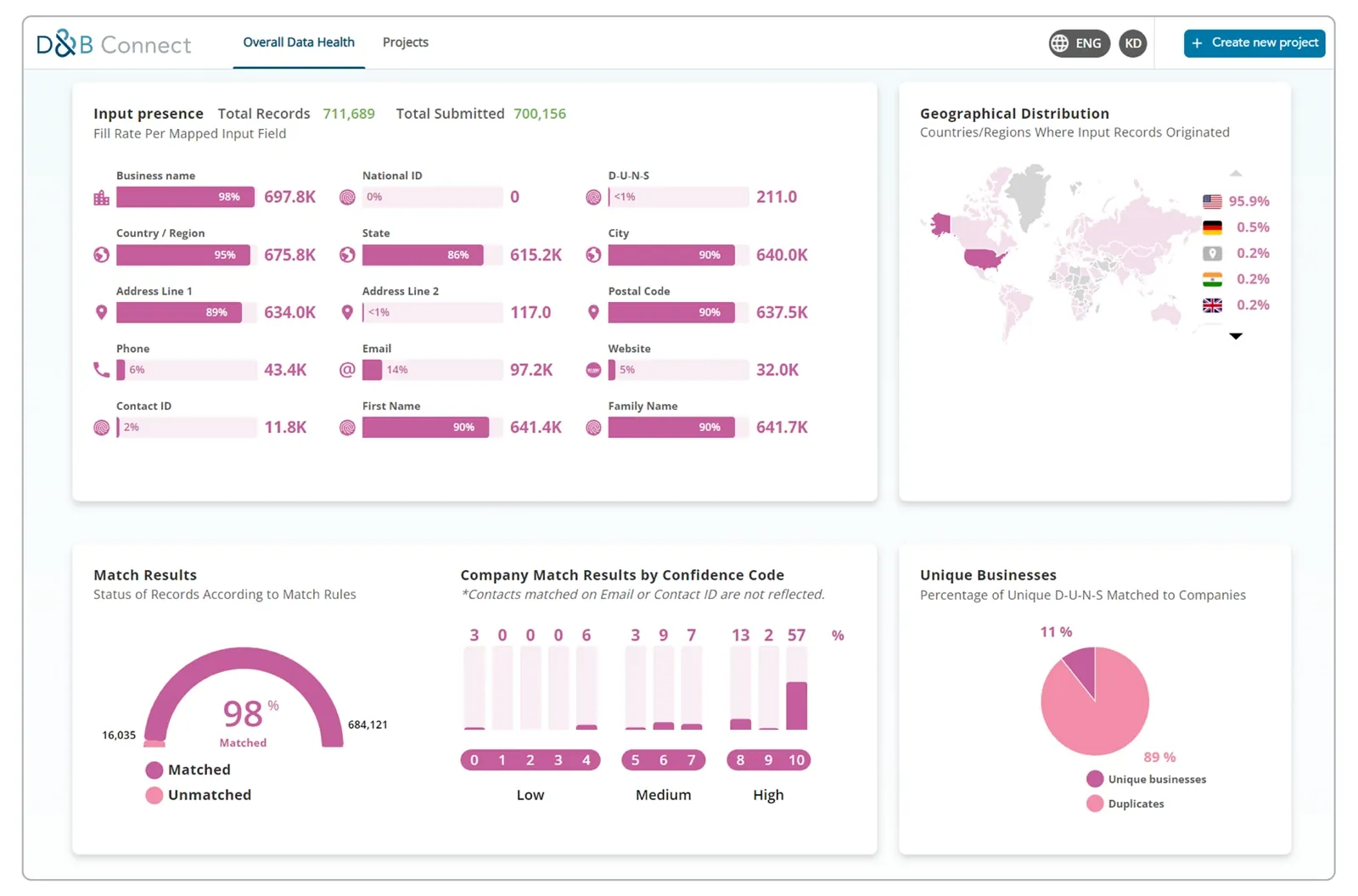 Figure 2: Connect Discover displays field completeness, geographic distribution, match confidence, and unique versus duplicate businesses.
Matching connects an existing record to a business identity. Cleansing and enrichment then help standardize information and add useful attributes. Stewardship provides the organizational discipline around maintaining that information over time. Together, these functions address a persistent problem: the same customer or supplier appearing in several systems with different names, missing fields, or conflicting details.
The useful outcome is a more consistent account record across departments. Sales can work with company information that relates to the records used by finance and procurement, rather than maintaining an entirely separate interpretation of the business.
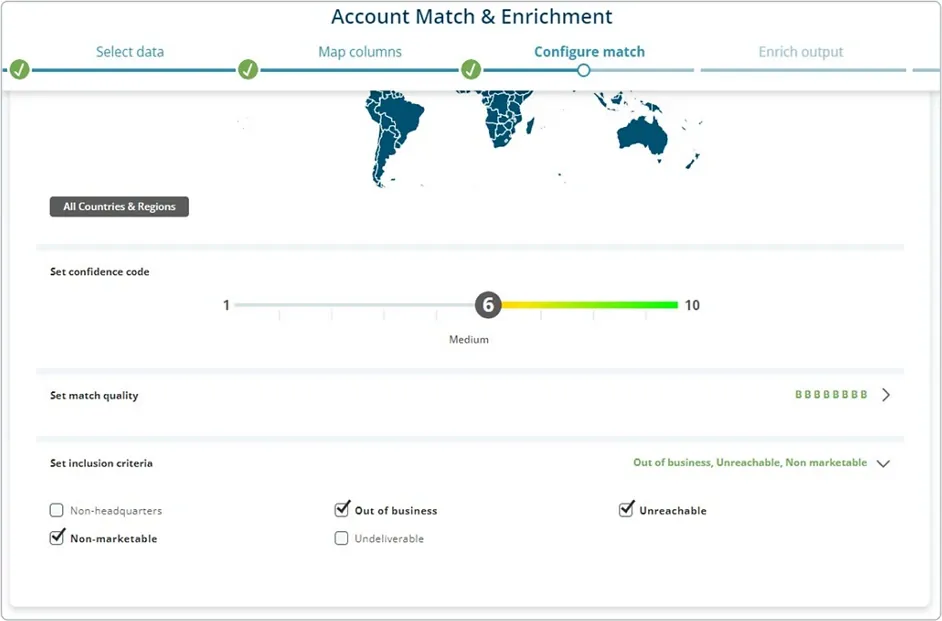 Figure 3: D&B Connect Discover’s Account Match & Enrichment settings let users configure match confidence, match quality, and record inclusion criteria.
Data management still requires decisions about which records may be merged, which fields take precedence, and how uncertain matches are resolved. That work is part of the investment. Connect is a better fit for an organization maintaining a substantial account dataset than for someone seeking a handful of contact details. Its value depends on the usefulness of the enriched records and the reduction in repeated data work across systems.
7. Direct+, APIs, and AI Connectors
D&B Direct+ delivers business identity and contextual information into existing applications and workflows. Available information includes firmographics, hierarchies, relationships, and risk indicators, with access governed by the licensed data scope.
API, batch, and data-warehouse delivery provide different ways to incorporate company information into a business-data environment. API access suits interactive lookups and application workflows; recurring enrichment jobs and warehouse feeds serve a different operating pattern. The delivery method affects integration effort, usage planning, and how information stays current in the receiving system.
MCP and partner connectors extend access into compatible AI environments. These connectors make licensed business information available within an agent workflow, where company identity and context can support account research or other business tasks.
Connector access and data access are separate purchasing considerations. A compatible connection does not establish permission to retrieve every D&B field or reuse the information in every setting. Licensed data blocks, usage limits, storage rights, and permitted downstream use belong in the commercial scope. Direct+ is most relevant when the information needs to operate inside an existing application, rather than only in a standalone dashboard.
8. Dun & Bradstreet Pricing: Plans, Credits, and Billing
D&B prices its products separately. Credit Insights has public U.S. subscription prices in USD, with a Free plan and three paid tiers:
| Credit Insights plan | Monthly billing (USD) | Annual billing (USD) |
|---|---|---|
| Free | $0/month | Free |
| Basic | $49/month | $499/year |
| Plus | $149/month | $1,499/year |
| Premium | $199/month | $1,999/year |
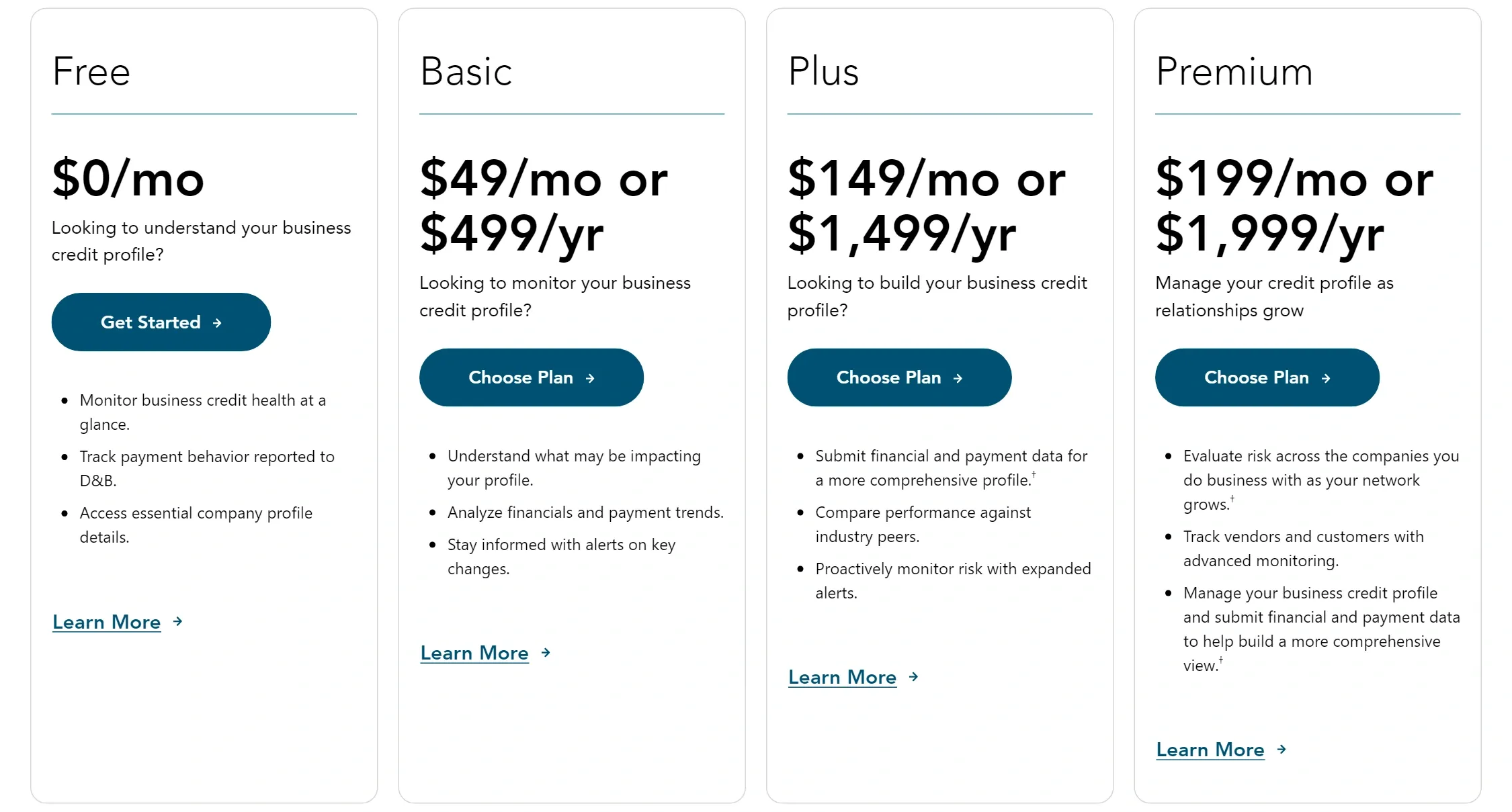 Figure 4: D&B Credit Insights plans with monthly and annual pricing in USD.
The annual amounts are billed annually. Against twelve monthly payments, annual billing saves $89 on Basic, $289 on Plus, and $389 on Premium. These savings belong to the annual payment option. Taxes and availability outside the U.S. depend on the purchase location and checkout terms.
Basic is the focused option for detailed monitoring of your own profile. Plus adds document submissions and selected-business comparisons. Premium expands those allowances and includes reports on other companies. The higher price makes sense when those additional functions will be used; a business that only needs high-level indicators can start with Free.
Other services follow different pricing and access arrangements:
| Product or service | Price or access | Included scope or billing consideration |
|---|---|---|
| D-U-N-S registration | Free through the U.S. application process | Business identifier; paid reports and subscriptions are separate |
| Hoovers Essentials, monthly | $49/month | 150 Company Credits and 150 Contact Credits |
| Hoovers Essentials, annual | $529/year | 1,800 Company Credits and 1,800 Contact Credits |
| Finance Analytics Tier 1 Starter | $1,200/year on the small-business list-price schedule | Other tiers have separate prices; report and seat allowances require confirmation |
| Finance Analytics, full Hoovers, and Connect | Free trials available by request | Trial duration, data access, exports, and paid terms vary by product |
| Risk Analytics | Personalized demo | Product scope and commercial terms depend on the required service |
| Direct+ and AI connectors | Product-specific data licensing | Data blocks, usage, storage, and downstream-use rights affect the scope |
Hoovers Essentials advertises a first month free. Eligibility and application to the selected billing option need confirmation in the cart. The offer is separate from the Credit Insights Free plan and does not establish unrestricted free access to Hoovers.
Credit Insights and Hoovers Essentials automatically renew at the list price in effect at renewal, which can exceed the initial purchase price. Renewal must be canceled through the applicable account process before the current term ends to prevent another charge. Refund eligibility follows the SMB cancellation policy and the purchase terms; canceling renewal does not itself promise a refund for the current term.
For a wider deployment, the subscription is only part of the cost. Integrations, data preparation, ongoing matching rules, and staff time affect the operating budget. Public subscription prices also should not be treated as proof of a particular seat count or API entitlement.
9. Dun & Bradstreet Pros and Cons
D&B’s main strength is the breadth of business information available around a shared identity reference. The portfolio covers several distinct business functions, which is useful when the same company needs to be understood by sales, finance, procurement, and data teams.
What We Liked (Pros)
- D-U-N-S business identity connects account information across departments and systems
- Dedicated products address credit, supplier risk, compliance, sales, and data management
- Credit Insights offers a Free plan alongside monthly and annual paid subscriptions
- Software, APIs, and licensed connectors support different ways of using business data
Areas for Improvement (Cons)
- Separate product licenses make a broad deployment more complex to budget
- Credit Insights Free shows risk ranges rather than full numerical scores
- Record matching and integrations require ongoing data management
- Coverage and data entitlements vary across products and target markets
The clearest limitation is the separation between products. A business can use Credit Insights without needing an enterprise data integration, while a finance or procurement team may require a different product entirely. That flexibility creates choices, but it also makes a single headline subscription price a poor guide to the cost of a broad deployment.
For smaller businesses, Credit Insights provides a more focused entry point. For larger organizations, D&B’s value increases when consistent company information can support several recurring workflows. In both cases, the useful measure is the information available for the businesses that matter to the organization.
10. Dun & Bradstreet vs Experian, Creditsafe, and Apollo
D&B spans several categories, so the closest alternative depends on the job. Business credit reporting, supplier monitoring, prospecting, and record enrichment require different comparisons.
| Provider | Main comparison area | Relevant buyer requirement |
|---|---|---|
| Dun & Bradstreet | Business identity, credit, risk, sales, and data management | Connecting company information to several business functions |
| Experian | Business credit reports | Researching business credit information |
| Creditsafe | Business reports and company monitoring | Tracking changes relevant to commercial credit risk |
| Apollo | Sales prospecting | Finding and researching B2B prospects |
Experian and Creditsafe are relevant to a credit-focused shortlist. The comparison should center on the entities covered, useful report information, monitoring scope, and total subscription cost. A provider’s overall database size is less helpful when the records needed for a particular customer or supplier group are incomplete.
Apollo is a more relevant comparison for the sales side of D&B. A team choosing a prospecting tool should compare Apollo with Hoovers on account discovery and the sales workflow, rather than treating Apollo as a replacement for business credit management or supplier screening.
Our Cold Email & Lead Gen reviews cover more sales-focused options. Businesses with several departmental needs should consider the individual D&B modules and the work required to connect them, rather than choosing on the assumption that every capability sits inside one subscription.
11. Frequently Asked Questions
Dun & Bradstreet provides business identity, commercial data, and analytics for credit monitoring, customer and supplier risk, compliance, sales research, and data management. Its D-U-N-S Number connects business information across these services.
Dun & Bradstreet is the company behind the wider D&B portfolio. Hoovers is its sales intelligence product for account and contact research. Credit Insights, Finance Analytics, Connect, Direct+, and Risk Analytics serve other business functions.
D-U-N-S registration is free through the U.S. application process. Credit reports, monitoring subscriptions, and optional commercial services are separate purchases. The registration process and available services depend on the country.
No. A D-U-N-S Number identifies a business. Lenders, customers, and other partners make their own approval decisions using their eligibility requirements and the information available about the company.
U.S. Credit Insights prices in USD are Free $0/mo, Basic $49/mo or $499/yr, Plus $149/mo or $1,499/yr, and Premium $199/mo or $1,999/yr. Hoovers Essentials is $49/mo or $529/yr. These are separate subscriptions, not prices for the entire D&B portfolio. Annual prices are billed annually; confirm taxes, eligibility, and checkout terms.
Free trials are available by request for Finance Analytics, Hoovers, and Connect. Hoovers Essentials advertises a first month free, subject to checkout eligibility. Credit Insights Free is an ongoing $0/month plan with limited features. Trial duration, data access, and export allowances vary by product.
12. Is Dun & Bradstreet Worth It?
Dun & Bradstreet is a strong option for organizations whose decisions depend on knowing which business they are dealing with and maintaining useful information about that relationship. Its identity-based approach connects naturally to credit, supplier, account-research, and data-management work.
The strongest reason to choose D&B is the usefulness of its company information across a recurring business process. The main reasons to keep the scope narrow are separate licenses, implementation work, and the availability of more focused products for a single task. D&B delivers its clearest value when the chosen service matches a defined credit, supplier, sales, or data requirement.
Who Should Choose Dun & Bradstreet
- Business owners monitoring their own credit profile: Credit Insights provides a focused starting point for reviewing business credit information and following changes without deploying enterprise data tools.
- Finance teams managing customer credit exposure: Finance Analytics suits organizations that need recurring credit reviews, account monitoring, and visibility into portfolio risk.
- Procurement and compliance teams reviewing business partners: D&B’s risk products support supplier screening, company verification, and ongoing oversight of commercial relationships.
- Data teams maintaining company records across systems: Connect and Direct+ suit organizations that need consistent business identities, record matching, enrichment, or licensed data delivery into existing applications.
Who Should Consider Alternatives
- Businesses that only need a D-U-N-S Number: Start with the free registration or lookup process. Obtaining a business identifier alone does not justify a paid monitoring or enterprise subscription.
- Sales teams that only need a small prospecting list: Compare Hoovers with focused sales intelligence tools before licensing additional D&B products. Credit, supplier-risk, and data-management modules add value only when those workflows are needed.
- Teams without resources to maintain enterprise data workflows: If no one can review uncertain matches, manage integrations, or act on risk alerts, a narrower service or occasional company report may be a more practical starting point.


Dun & Bradstreet
Dun & Bradstreet is a strong fit for businesses that need consistent company identity across credit, supplier, sales, and data workflows. Credit Insights provides a focused starting point for business owners, while Finance Analytics, Hoovers, Connect, and Direct+ address more specialized needs. Separate product licenses and data management work are the main trade-offs.