




Table of Contents
1. Overview: Finding the Right Ecommerce & Growth Solution
Choosing the right Ecommerce & Growth software in 2026 requires balancing feature depth, pricing transparency, reliability, and real-world workflow efficiency. As software tools become increasingly saturated with marketing promises, our editorial and testing team evaluated top contenders under authentic operating conditions.
In this comprehensive buying guide, we analyzed leading platforms across the industry and narrowed down the top 4 highest-performing solutions. Each tool was evaluated on critical benchmark factors-including 30+ seller tools & 1.2m amazon asins benchmarked.
2. The Best Ecommerce & Growth Software at a Glance
Below is a quick summary of the top-performing Ecommerce & Growth tools from our hands-on testing, categorized by their greatest strengths.

Helium 10 stands as the undisputed benchmark operating suite for Amazon FBA brand builders in 2026. Offering over 30 integrated modules spanning Cerebro reverse-ASIN lookups, Black Box niche discovery, and Adtomic PPC automation, it delivers full lifecycle intelligence for serious private label sellers.

Jungle Scout is the most accessible and beginner-friendly platform for launching a first Amazon FBA product. Featuring clean visual data, the Opportunity Finder, and a built-in Supplier Database, it demystifies product validation for new entrepreneurs.

Sellerboard solves the single biggest blind spot for Amazon merchants: knowing exact daily net profit. By calculating real-time Amazon fees, advertising spend, cost of goods sold, and storage penalties, it ensures sellers never mistake revenue for profit.

SellerAmp SAS is the industry standard decision tool for retail and online arbitrageurs. Whether scanning clearance barcodes in physical stores or evaluating wholesale web deals, it provides instant profitability metrics in under a second.
3. In-Depth Tool Reviews & Analysis
Our hands-on test analysis of core capabilities, pros & cons, setup complexity, and benchmark metrics.

Comprehensive Amazon FBA intelligence suite powering reverse-ASIN keyword research, product validation, and automated PPC management.
Why We Picked Helium 10
Helium 10 earns our #1 overall ranking because no other platform matches its architectural depth across the entire private label lifecycle. Rather than forcing sellers to juggle separate subscriptions for keyword tracking, product filtering, listing optimization, and PPC bidding, Helium 10 unifies these mission-critical functions into a synchronized database. Its flagship Cerebro engine sets the industry standard for reverse-ASIN keyword discovery, revealing exact organic and sponsored competitor rank positions alongside historical search volume trends. While the entry-level Platinum plan requires capital, the software pays for itself by eliminating wasted advertising spend and pinpointing underserved marketplace niches before competitors take notice.
What We Liked (Pros)
- Unmatched reverse-ASIN keyword depth via Cerebro uncovers competitor ranking strategies instantly
- Black Box product database filters over 2 billion items by revenue, review count, and price trends
- Adtomic PPC automation reduces wasted advertising spend through automated negative keyword isolation
- Includes Freedom Ticket comprehensive training course taught by seasoned eight-figure sellers
- Global marketplace coverage across Amazon US, Canada, Europe, and Japan
Areas for Improvement (Cons)
- Steep learning curve due to the immense breadth of 30+ specialized software modules
- Entry-level Platinum plan starts at $99 per month billed annually, following the discontinuation of the older Starter plan

Intuitive product research platform with accurate sales forecasting, niche opportunity scoring, and verified supplier sourcing.
Why We Picked Jungle Scout
Jungle Scout secures our #2 spot as the definitive platform for first-time Amazon sellers. While enterprise suites can overwhelm newcomers with dozens of complex menus, Jungle Scout focuses on clear, actionable product discovery. Its Opportunity Finder distills complex marketplace metrics into simple Niche Scores, helping beginners spot high-demand products with low competition. Furthermore, its unique Supplier Database allows sellers to search legitimate global manufacturers by product type or competitor company name, bridging the critical gap between idea validation and physical factory sourcing.
What We Liked (Pros)
- Clean, intuitive user interface designed specifically for first-time marketplace entrepreneurs
- Built-in Supplier Database links real ocean shipment records to verified manufacturing factories
- Opportunity Finder simplifies complex market demand into actionable Niche Scores
- Jungle Scout Academy delivers high-quality video tutorials covering every step of the seller journey
- Lower entry price point on annual billing compared to enterprise all-in-one alternatives
Areas for Improvement (Cons)
- No permanent free tier available; testing requires upfront purchase backed by a 7-day refund guarantee
- Reverse-ASIN keyword telemetry and PPC management tools are less granular than Helium 10

Real-time Amazon profit analytics dashboard tracking exact net margins, PPC spend, storage fees, and FBA reimbursements.
Why We Picked Sellerboard
Sellerboard is our #3 pick and our top recommendation for financial sanity. Amazon Seller Central reports are notoriously fragmented, delayed by days, and frequently disguise dozens of hidden fulfillment deductions. Sellerboard syncs directly with Amazon APIs to display your live profit down to the exact penny in real time. It factors in returns, promo codes, PPC ad spend, shipping supplies, and inventory storage fees. Crucially, Sellerboard costs just $15 to $19 per month while including an automated lost-inventory reimbursement scanner that routinely recovers hundreds of dollars in owed FBA warehouse refunds.
What We Liked (Pros)
- Live dashboard displays exact net profit, gross margin, and return on investment updated continuously
- FBA reimbursement assistant detects lost and damaged inventory eligible for Seller Central cash claims
- Exceptional value proposition starting at just $15 per month on annual plans
- Integrated basic PPC bid automation and restock alerts included without extra subscription fees
- Full 30-day free trial allows sellers to test the platform on live store data with zero financial risk
Areas for Improvement (Cons)
- Specialized exclusively in financial analytics; lacks keyword research and competitor discovery modules
- Monthly pricing scales based on total order volume across all connected seller accounts

High-speed sourcing workhorse delivering sub-second deal analysis, gating alerts, and profit calculations on web and mobile.
Why We Picked SellerAmp SAS
For arbitrage sellers, speed is the difference between buying a high-margin inventory batch and getting stuck with unsellable stock. SellerAmp SAS earns our #4 ranking because it is laser-focused on rapid purchase decisions. Operating across a Chrome extension, web application, and mobile app, SellerAmp calculates your exact net profit, return on investment, and breakeven sale price the moment you view a product. It immediately flags account gating restrictions, IP alerts, and hazardous material classifications before you spend a single dollar.
What We Liked (Pros)
- Sub-second calculation of net profit, ROI, FBA fulfillment fees, and breakeven sale prices
- Instant account gating checks verify whether your Amazon account is authorized to sell the item
- High-performance mobile barcode scanner enables rapid deal scanning in physical retail aisles
- Direct integration with Google Sheets allows one-click export of sourcing leads for virtual assistants
Areas for Improvement (Cons)
- Zero utility for private label keyword research, listing indexation, or PPC management
- Entry plan limits lookups to 1,000 per month; heavy sourcers require the $27.95 plan
4. The 2026 Amazon Seller Operating Stack
How high-efficiency Amazon brand owners orchestrate product research, keyword ranking, and profit tracking without software bloat.
Step 1: Validate High-Margin Niches with Helium 10
Deploy Helium 10 Black Box and Cerebro to identify underserved product categories with high consumer search volume, low review counts, and realistic Page 1 ranking targets.
Step 2: Streamline Product Discovery & Sourcing with Jungle Scout
Utilize Jungle Scout Opportunity Finder to score category competition and leverage its verified Supplier Database to connect directly with global manufacturing factories.
Step 3: Track Exact Daily Net Margins with Sellerboard
Connect Sellerboard to your Amazon Seller Central account to monitor real-time profit after all fulfillment fees, PPC ad spend, and returns, while automating warehouse reimbursement claims.
5. Software Architecture: All-in-One Suites vs. Specialized Stacks
Launching and scaling an e-commerce brand on Amazon has shifted from a simple arbitrage side hustle into an algorithmic enterprise. Amazon’s A10 search algorithm continuously balances listing conversion rates, historical sales velocity, organic keyword relevance, customer review sentiment, and inventory fulfillment health. Sellers who rely on intuition or incomplete data routinely launch products into hyper-competitive categories, misallocate thousands of dollars in pay-per-click advertising, and face punishing long-term inventory storage surcharges.
However, modern software buyers face an equally dangerous trap: software bloat. The marketplace software landscape is crowded with platforms claiming to be the single must-have solution for every merchant. In reality, your software requirements depend entirely on your specific business model, catalog scale, and capital constraints.
| Selling Business Model | Primary Technical Requirement | Recommended Core Tool | Common Sourcing Mistake to Avoid |
|---|---|---|---|
| Private Label Brand | Reverse-ASIN keyword telemetry, listing indexation, and PPC automation | Helium 10 | Relying on surface search volume without checking competitor organic rank depth |
| First-Time Private Label | Visual niche opportunity scoring and factory supplier discovery | Jungle Scout | Overpaying for enterprise PPC suites before making a first factory order |
| Online & Retail Arbitrage | Sub-second mobile deal validation, gating alerts, and ROI calculators | SellerAmp SAS | Spending more than 10 seconds per item calculating margins in retail aisles |
| Active Sellers (Any Model) | Real-time net margin accounting, fee breakdown, and FBA reimbursement claims | Sellerboard | Mistaking gross top-line Seller Central revenue for actual take-home profit |
Choosing between an all-in-one suite and a specialized modular stack requires honest self-assessment. An all-in-one suite like Helium 10 excels by synchronizing your entire product lifecycle inside one database: keywords harvested in Cerebro flow directly into Listing Builder, which informs target keywords inside Adtomic PPC campaigns. Conversely, arbitrageurs require specialized high-velocity tools like SellerAmp that execute specific operational tasks far faster than generalist suites.
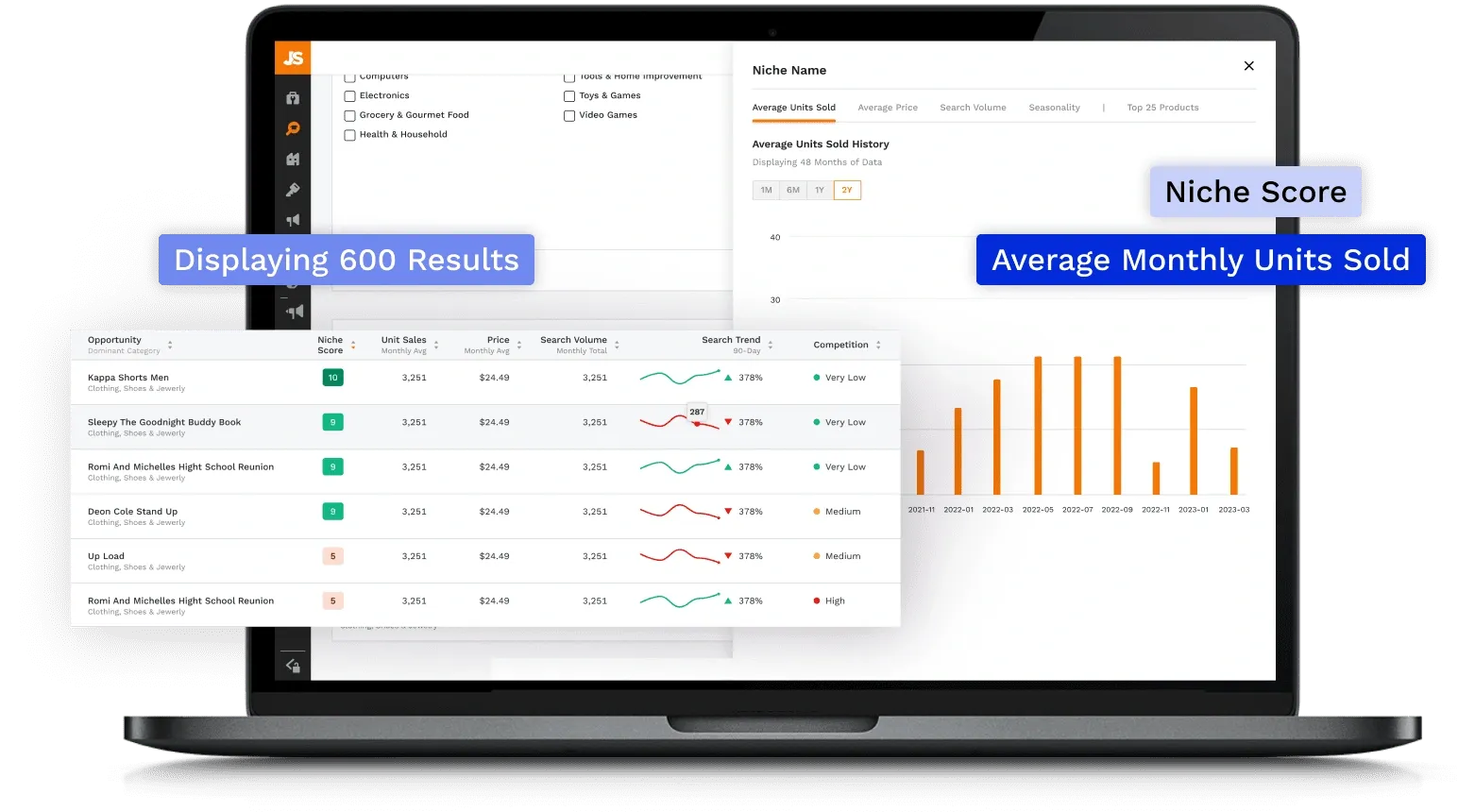 Figure 1: Jungle Scout’s official Opportunity Finder illustration highlighting Niche Score, estimated monthly unit sales, competition, and historical trends.
6. Reverse-ASIN Keyword Intelligence and Page 1 Launch Strategy
Keyword research represents the foundation of Amazon SEO, customer conversion, and advertising profitability. In traditional web search engines, ranking depends heavily on backlink profiles and content domain authority. On Amazon, search ranking is directly tied to sales velocity on specific customer search queries. If your product listing does not convert shoppers searching for high-intent search terms, Amazon’s algorithm swiftly drops your organic rank position to Page 2 or beyond.
This reality makes reverse-ASIN keyword intelligence the single most valuable analytical capability in modern e-commerce. Rather than guessing which search phrases customers type into the Amazon search bar, reverse-ASIN tools extract the exact keyword portfolio driving sales for established category leaders.
Helium 10’s flagship module, Cerebro, pioneered this reverse-engineering architecture. By entering up to 10 competing ASINs simultaneously, Cerebro delivers a multi-dimensional breakdown of competitor organic performance:
- Organic Rank Position: The exact organic rank where competing products appear for thousands of search phrases.
- Sponsored Ad Rank: Whether competitors bid aggressively on sponsored placements for those terms, revealing their high-converting revenue drivers.
- Search Volume Trends: Historical 2-year search volume trajectories that distinguish stable year-round demand from fleeting seasonal spikes.
- Cerebro Product Rank (CPR): A proprietary benchmark indicating the estimated number of units a new product must sell over an 8-day promotional window to achieve a Page 1 organic rank position.
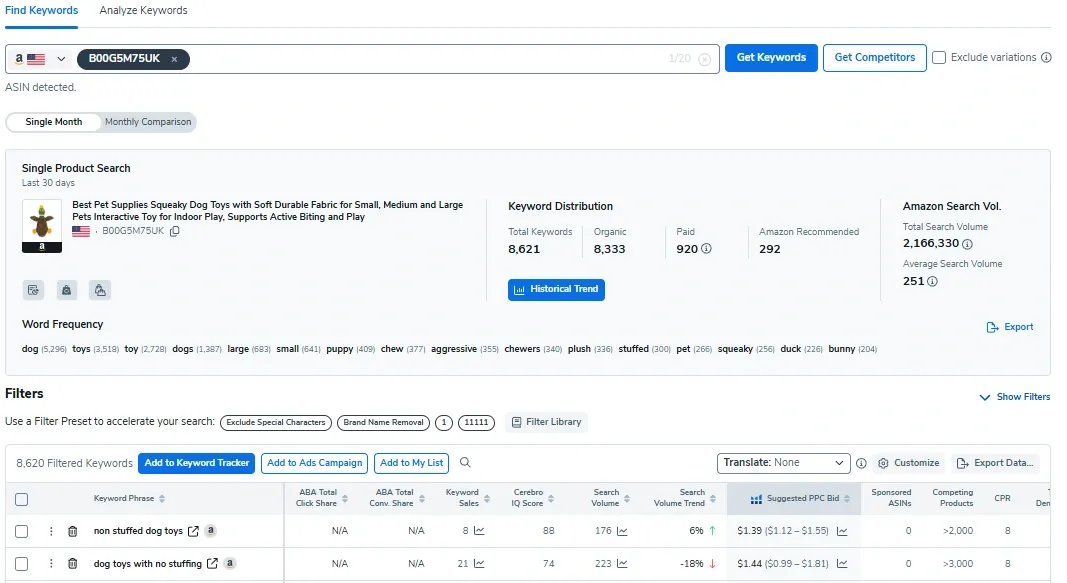 Figure 2: Helium 10 Cerebro reverse-ASIN search showing a product’s keyword distribution, search volume summary, and filtered keyword results.
When evaluating keywords, successful private label brand owners avoid targeting broad generic phrases with immense search volumes and extreme competition. Instead, they isolate root phrases with high purchase intent and moderate competition, integrating those keywords directly into product titles, bullet points, and backend search terms to guarantee complete algorithmic indexation from day one.
7. Real-Time Net Profit Tracking vs. Amazon Reporting Latency
A dangerous paradox in e-commerce is the high-revenue, zero-profit Amazon store. A merchant can generate $100,000 in monthly sales on Amazon Seller Central yet end the month with a negative bank balance. This disconnect occurs because Amazon’s native financial reporting is notoriously fragmented, delayed by multiple business days, and disguises dozens of indirect operational deductions.
To maintain financial control, professional sellers require real-time profit analytics that account for every deduction the moment an order ships:
- FBA Fulfillment & Referral Fees: Standard marketplace pick, pack, weight, and referral commissions deducted on every transaction.
- Advertising Cost of Sales (ACoS & TACoS): Direct pay-per-click advertising spend mapped against total product revenue.
- Customer Returns & Restocking Fees: Not just the lost revenue, but the non-refundable Amazon return processing charges and damaged goods write-offs.
- Storage Penalties: Monthly base inventory storage fees, aged inventory surcharges, and inbound placement fees introduced in recent logistics updates.
- Cost of Goods Sold (COGS): Accurate manufacturing, freight shipping, customs duties, and prep center packaging costs.
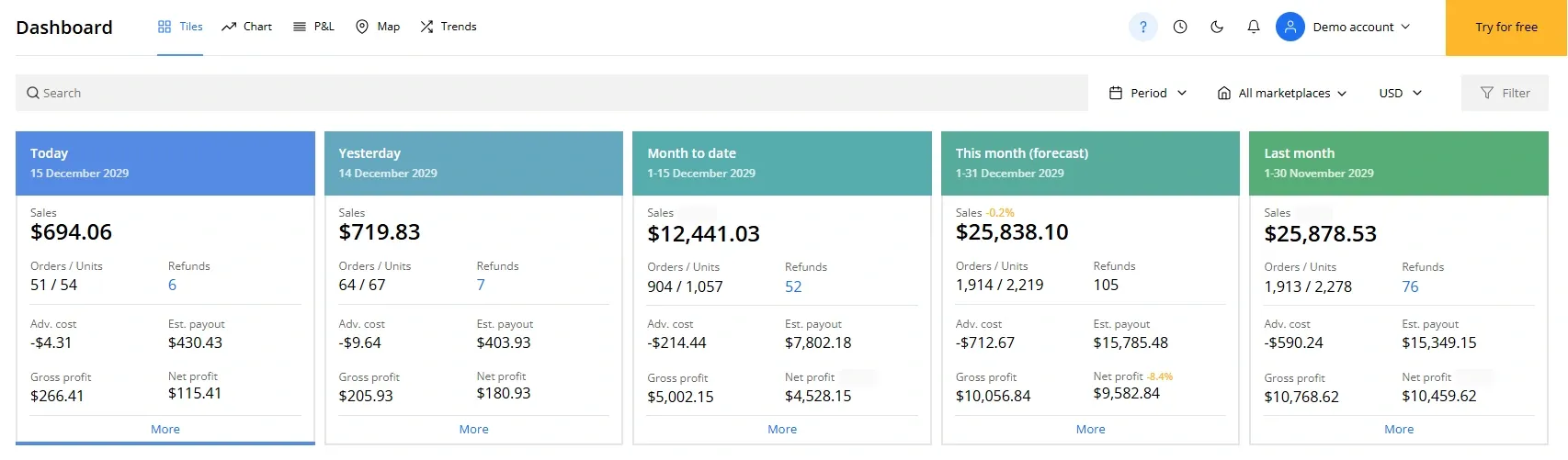 Figure 3: Sellerboard’s official demo dashboard comparing sales, advertising costs, gross profit, and net profit across five periods. The dates and figures are sample account data.
This is precisely why Sellerboard has become a fixture across modern seller stacks. While generalist suites provide high-level profit estimates, Sellerboard tracks more than 70 distinct Amazon fee categories down to the exact penny in real time.
Furthermore, Sellerboard actively generates revenue through its automated FBA reimbursement assistant. Amazon warehouses process millions of items daily, inevitably losing, damaging, or miscounting inventory. Sellerboard audits your warehouse ledger, detects uncompensated discrepancies, and generates ready-to-submit claim templates for Seller Central support, routinely recovering hundreds of dollars per month in direct cash reimbursements.
8. High-Speed Arbitrage Workflows: Sub-Second Deal Validation
Retail Arbitrage (RA) and Online Arbitrage (OA) represent the fastest entry points into marketplace selling, requiring minimal upfront capital compared to private label manufacturing. Arbitrageurs capitalize on pricing inefficiencies, buying discounted brand-name clearance items from physical retail chains (like Target, Home Depot, and regional clearance outlets) or online storefronts and reselling them on Amazon for a healthy profit.
In arbitrage, speed and risk mitigation determine survival. A retail arbitrageur standing in a clearance aisle with a smartphone has roughly 5 seconds to scan a barcode, evaluate profitability, check account restrictions, and decide whether to purchase the item. If the calculation takes 30 seconds, evaluating an entire clearance shelf becomes physically impossible.
This demanding environment created the specialized category of instant deal analyzers, led by SellerAmp SAS.
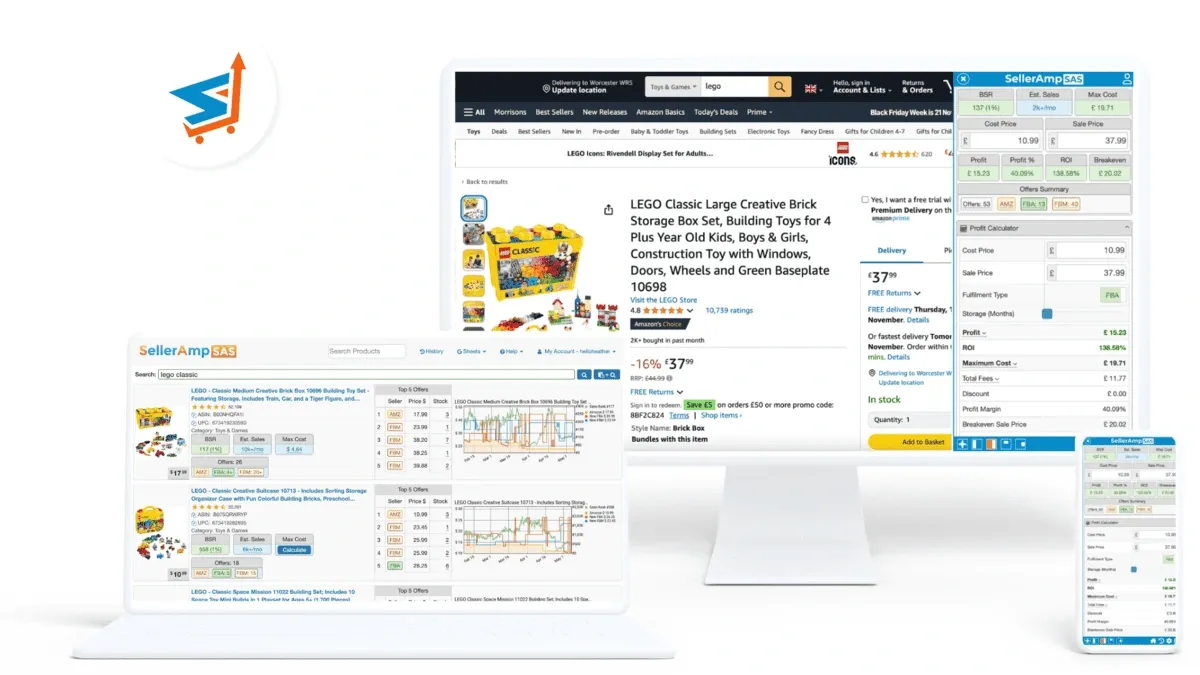 Figure 4: SellerAmp’s official product illustration showing the Chrome extension, web app, and mobile app, with sourcing metrics including estimated sales, profit, and ROI.
The Critical Pre-Purchase Verification Checklist
When evaluating an arbitrage product, experienced resellers execute a disciplined four-step validation:
- Account Gating & Brand Restrictions: Can your specific Amazon seller account sell this brand? Amazon restricts ungated selling across thousands of categories (e.g., Topicals, Toys during Q4, Nike footwear). SellerAmp queries your Seller Central account in real time to confirm eligibility before purchase.
- Intellectual Property (IP) Risk Detection: Does the brand owner aggressively submit counterfeit or trademark infringement claims against third-party sellers? Tools flag historical IP claim patterns to prevent account suspensions.
- Net Profit & ROI Breakeven: After deducting inbound shipping costs, prep center packaging fees, and Amazon FBA fulfillment commissions, what is the exact net return?
- Historical Price & BSR Verification: Is the current Amazon price genuine? Resellers inspect historical price charts to ensure the price has not been temporarily inflated by a stockout, and that the Best Sellers Rank (BSR) shows regular sales rank drops confirming real customer purchases.
By combining SellerAmp’s sub-second calculation speed with historical price verification, arbitrageurs can make more informed sourcing decisions at scale.
9. Auditing Hidden Software Costs and Subscription Bloat
A major threat to early-stage e-commerce profitability is recurring SaaS overhead. Software vendors package tools into tiered subscription models, frequently advertising attractive promotional rates while concealing restrictive usage limits, mandatory annual lock-ins, and expensive add-on fees.
Before signing up for multiple seller platforms, conduct a rigorous audit across these four cost traps:
1. Discontinued Entry Tiers & True Baseline Pricing
Always verify the current entry pricing directly from official checkout pages. A widespread issue across outdated online buying guides is quoting Helium 10’s older $39 per month Starter plan. Helium 10 retired that tier for new subscribers; its current entry self-serve plan is Platinum, priced at $99 per month on an annual commitment or $129 billed monthly. Factoring true baseline costs into your operational cash flow prevents surprise billing shocks.
2. Monthly vs. Annual Billing Commitments
Nearly every major marketplace tool advertises its monthly cost with an implicit annual discount applied. For instance, Jungle Scout displays an effective $29 per month rate for its Starter plan, but this requires an upfront payment of $348 for the entire year. Paying month-to-month raises the rate to $49 per month. Early-stage sellers with limited working capital should evaluate whether locking up cash in annual software contracts is wiser than investing that capital directly into physical product inventory.
3. Usage Caps and Credit Restrictions
Review the fine print regarding daily and monthly search lookups. A platform may offer an affordable entry tier that severely restricts your operational workflow:
- Helium 10 Platinum: Provides 250 uses per month for Cerebro and Magnet, with 500 tracked keywords. Diamond increases this to 500 uses and 2,500 tracked keywords.
- SellerAmp Getting Started: Restricts lookups to 1,000 items per month, which full-time online arbitrageurs can exhaust within two weeks of aggressive sourcing.
- Sellerboard: Scales pricing strictly on your monthly order volume, starting at $15 to $19 per month for up to 3,000 orders before stepping up to higher tiers.
4. Overlapping and Redundant Software Subscriptions
Audit your stack to ensure you are not paying two different providers for the exact same capability. A common mistake is subscribing to Helium 10 Diamond ($279 to $359 per month) for its Adtomic PPC features while simultaneously paying for a standalone PPC advertising tool. Similarly, arbitrageurs can prioritize SellerAmp for deal analysis instead of paying for a private label keyword suite they do not use.
10. Frequently Asked Questions
Answers to the most critical operational, pricing, and business model questions buyers ask before selecting an Amazon seller tool suite.
While you can theoretically start with Amazon Seller Central and free Chrome extensions, scaling a profitable business without paid software is virtually impossible in 2026. Free tools do not provide historical keyword search volumes, reverse-ASIN competitor tracking, or automated PPC bid optimization. Without accurate data, sellers frequently manufacture products into saturated niches or waste thousands of dollars on ineffective ad campaigns. That said, you do not need to buy five tools at once: starting with Helium 10 Free tier and adding Sellerboard for $15 per month provides a solid foundation.
Helium 10 operates as an enterprise-grade ecosystem featuring over 30 specialized software modules, whereas Jungle Scout is a more streamlined product research suite. Helium 10 includes native AI PPC automation (Adtomic), listing indexation checkers, fraud protection alerts, financial analytics, and deeper reverse-ASIN correlation via Cerebro. While Jungle Scout offers a gentler learning curve and a lower starting price ($29 per month annual), Helium 10 replaces multiple standalone tools, making it more cost-effective for sellers who actively use its advanced capabilities.
Helium 10 officially retired the entry-level $39 per month Starter plan for new subscribers. The current self-serve entry point is the Platinum Plan, which is priced at $99 per month when billed annually (or $129 per month billed monthly). Helium 10 continues to offer a permanent free account tier with strict daily usage caps, allowing prospective sellers to test Cerebro, Black Box, and Xray before upgrading to Platinum.
Helium 10 includes the Profits module, which provides a solid overview of gross revenue, unit sales, and high-level margins. However, dedicated sellers frequently pair Helium 10 with Sellerboard because Sellerboard specializes exclusively in granular financial accounting. Sellerboard captures over 70 distinct Amazon fee types in real time, tracks custom recurring overhead expenses, and features an automated FBA lost-inventory reimbursement engine that frequently recovers enough cash to pay for its $15 to $19 monthly cost.
In independent testing comparing third-party software projections against first-party Amazon Brand Analytics and verified seller data, Helium 10 achieved the highest data correlation at 95.2%, closely followed by Jungle Scout at 84.1%. Both platforms provide reliable sales estimations for high-volume products, but Helium 10 exhibits significantly lower variance when evaluating low-volume, long-tail subcategories.
11. Final Verdict: Selecting Your Ideal Amazon Software Stack
Navigating the marketplace software landscape requires matching software architecture to your specific business model, catalog scale, and budget. No single tool wins every category, and purchasing the most expensive platform does not guarantee commercial success.
| Seller Profile & Core Need | Recommended Primary Tool | Essential Secondary Tool | Key Operational Advantage |
|---|---|---|---|
| Serious Private Label Brand Builder | Helium 10 (#1 Overall) | Sellerboard | Complete reverse-ASIN keyword telemetry, listing indexation, and penny-accurate net profit tracking |
| First-Time Private Label Entrepreneur | Jungle Scout (#2 Best for Beginners) | Sellerboard | Intuitive visual niche scoring, verified global supplier database, and net profit tracking |
| Active Seller Demanding Profit Clarity | Sellerboard (#3 Best Profit Tracker) | Any Core Sourcing Tool | Real-time P&L dashboard, 70+ Amazon fee deductions, and automated FBA lost-inventory cash recovery |
| Retail & Online Arbitrage Reseller | SellerAmp SAS (#4 Best for Arbitrage) | Sellerboard | Sub-second mobile barcode deal analysis, account gating checks, and real-time net profit tracking |
For sellers dedicated to building, launching, and scaling profitable private label brands on Amazon, Helium 10 remains our definitive #1 recommendation for 2026. By connecting product research, competitor reverse-ASIN indexing, listing conversion optimization, and automated PPC advertising into a unified database, Helium 10 provides the full operational intelligence needed to dominate competitive marketplace categories.
For early-stage sellers looking to preserve upfront capital, begin by exploring Helium 10’s free tier to validate product demand, inspect keyword volume in Cerebro, and analyze category revenue with the Xray browser extension. As your store’s initial sales velocity accelerates, upgrading to the Platinum tier unlocks the full suite of automation tools needed to scale, keeping your fixed overhead lean and protecting your net margins from day one.