




1. What Is italki? Platform & Core Model
Learning a foreign language through static mobile apps frequently leads to an agonizing plateau. Gamified software programs excel at drilling elementary vocabulary and matching flashcards, yet millions of self-directed learners discover that after months of continuous study, they remain completely incapable of holding an authentic, unscripted conversation with a native speaker. The missing operational element is spontaneous human interaction: the ability to process accents, adjust to conversational cadence, and formulate replies under real-world cognitive pressure.
Founded in 2007, italki emerged to solve this exact bottleneck. Rather than locking students into rigid digital curriculums, italki operates as an open global marketplace connecting language learners directly with freelance instructors for personalized 1-on-1 video lessons across 150+ languages, spanning mainstream languages like Spanish, French, Japanese, and Mandarin to regional dialects like Basque and Tagalog.
Three foundational pillars define italki operational identity across Business Communication:
- Pure Pay-As-You-Go Marketplace Mechanics: Unlike competitors enforcing mandatory recurring monthly subscriptions, italki allows students to pay per lesson or buy flexible credits without recurring financial penalties.
- Dual-Tiered Instructor Architecture: italki deliberately segments its teaching roster into certified Professional Teachers who bring structured credentials, and affordable Community Tutors who offer informal speaking practice.
- Autonomous Learning Trajectory: Students maintain sovereign authority over instructor choice, lesson length, conversation topics, and scheduling frequency.
Key Takeaway: italki is an on-demand human clearinghouse, transforming language acquisition from passive software memorization into active, personalized conversation with native speakers around the globe.
2. Professional Teachers vs Community Tutors
The most crucial distinction when navigating italki is the difference between its two instructor tiers: Professional Teachers and Community Tutors. This bifurcated directory structure allows italki to cater simultaneously to academic examinees and casual conversationalists.
Professional Teachers are verified educators holding degrees or credentials like CELTA, DELF, or DELE. They specialize in systematic language acquisition, offering diagnostic assessments, structured grammar plans, and official exam prep, commanding rates between $15 and $35 per hour.
In contrast, Community Tutors are native speakers without formal credentials who focus on conversational fluency, colloquial phrasing, and cultural immersion. For intermediate learners who already understand grammar but struggle with speaking hesitation, Community Tutors provide an informal, low-pressure environment to build confidence at economical rates, typically $5 to $15 per hour.
| Operational Dimension | Professional Teachers | Community Tutors |
|---|---|---|
| Formal Accreditation | Verified university degrees or accredited teaching certificates (CELTA, TESOL, DELE) | Native or near-native fluency without formal teaching credentials |
| Primary Instructional Focus | Systematic grammar instruction, exam preparation, curriculum-guided learning | Spoken fluency, unscripted conversation, listening practice, cultural nuances |
| Typical Hourly Price Range | $15 to $35+ per hour (varies by language and teacher demand) | $4 to $15 per hour (accessible for frequent weekly immersion) |
| Lesson Material Supply | Teacher supplies textbooks, structured slide decks, diagnostic homework, and exams | Student drives conversational topics, or tutor brings articles, news, and discussion prompts |
| Optimal Learner Profile | Absolute beginners, exam candidates (IELTS, JLPT, DELE), and business executives | Intermediate to advanced speakers looking to overcome conversational barriers and hesitation |
This structural separation ensures complete financial and pedagogical transparency, enabling students to choose exactly the level of instruction their budget and learning goals demand.
3. How to Find and Book the Right Tutor
Because italki is an open marketplace hosting tens of thousands of independent tutors, finding the ideal match requires an intentional selection process. The platform provides a comprehensive suite of search filters that enable learners to narrow down the massive directory into a highly tailored shortlist of qualified candidates.
Learners can filter tutors by native language, country of origin, price range, calendar availability in local time, and specialized skills such as Business Communication or children instruction. Furthermore, every teacher profile includes a mandatory 1-to-3 minute video introduction. Watching these clips allows you to evaluate accent, speech clarity, video setup, and general demeanor in under two minutes.
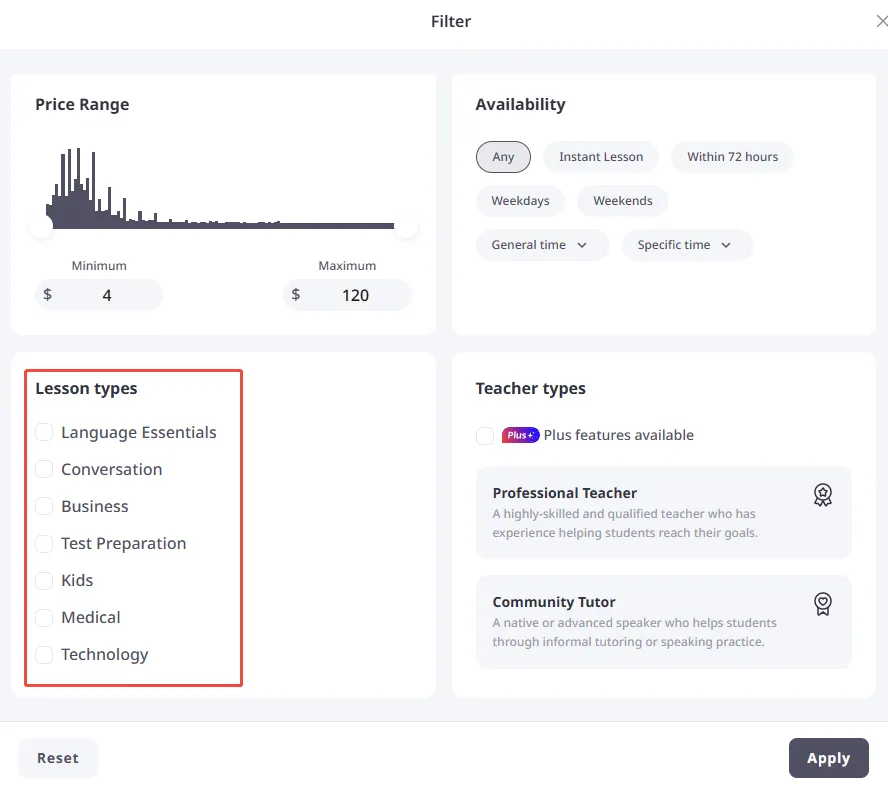 Figure 1: italki search and filtering interface allowing learners to filter teachers by native language, price range, and availability.
To eliminate booking risk, every new student receives three discounted 30-minute trial lessons. Savvy learners use these trials to test three distinct tutors with contrasting teaching styles before booking full-length 45-minute or 60-minute classes. Checking student retention metrics on profiles also provides clear insight into teacher reliability and long-term student satisfaction.
4. Inside the italki Classroom Experience
Historically, online tutoring required juggling external apps like Skype or Zoom, sharing personal contact IDs, and manually organizing lesson notes. To eliminate this friction, italki introduced the italki Classroom, a browser-based virtual environment designed specifically for live language learning.
Running on modern WebRTC protocols inside Chrome, Firefox, Edge, Safari, and mobile apps, italki Classroom requires zero external downloads. Before each session, the system runs an automated hardware diagnostic on camera, microphone, and internet latency to ensure smooth connectivity.
Key built-in features include synchronized text chat where instructors type real-time spelling corrections and vocabulary without interrupting spoken conversation, collaborative screen sharing for lesson slides and PDFs, and a persistent side-panel notes drawer. Lesson notes remain permanently stored in the student dashboard for revision. For learners with specialized technical needs, external meeting tools like Zoom or Skype remain supported upon mutual agreement.
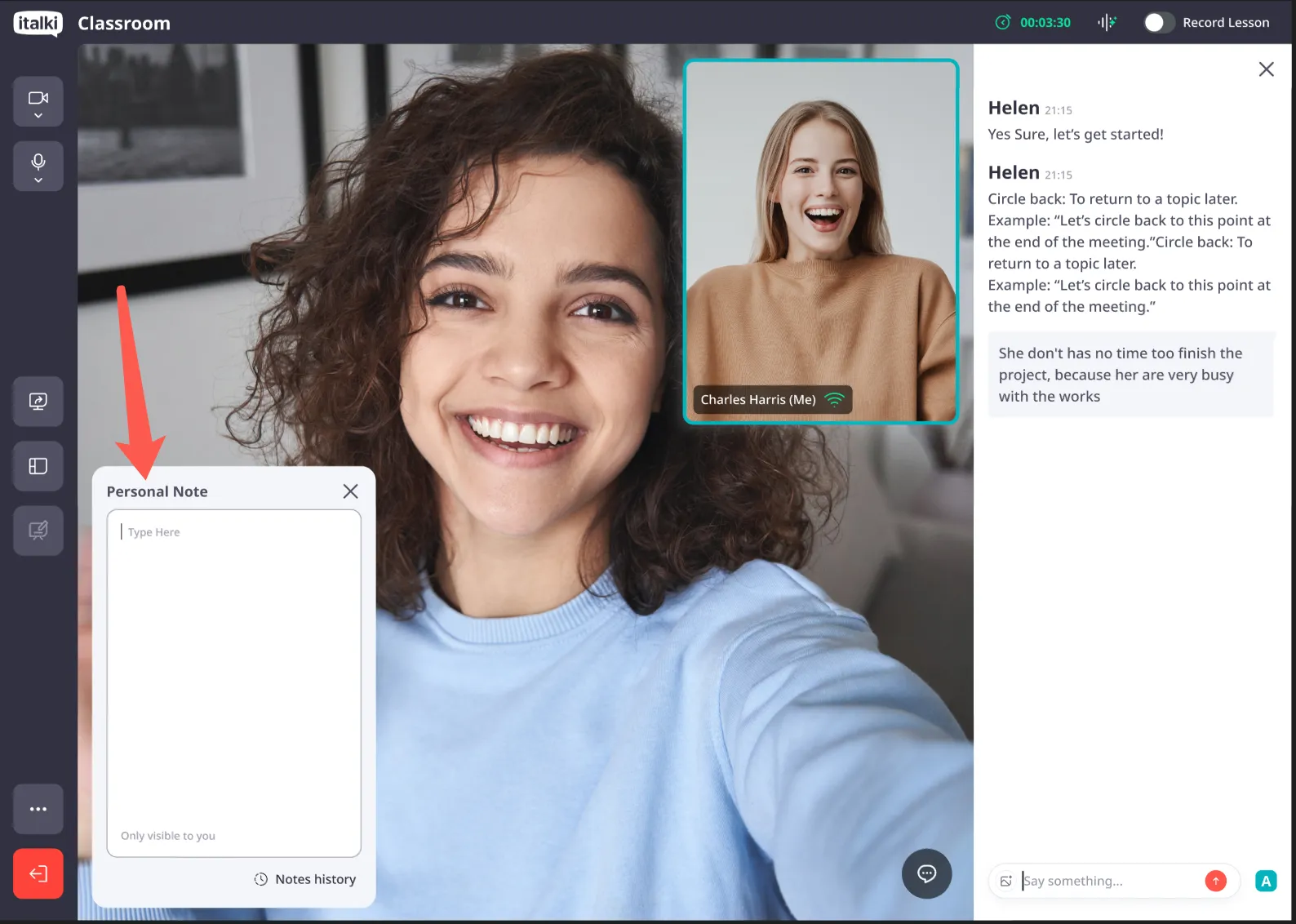 Figure 2: The browser-based italki Classroom with synchronized video, lesson notes, and interactive screen sharing.
5. Free Community Tools & Extra Practice
While 1-on-1 private tutoring represents the premium core of italki, the platform also hosts an active, completely free community ecosystem. These integrated social and self-study utilities allow learners to continue practicing and engaging with native speakers outside of their scheduled paid classroom hours.
The standout community feature is the Notebook (Exercises) tool. Learners write short journal entries, essays, or grammar exercises in their target language and publish them to the community feed. Native speakers review the submissions and provide line-by-line corrections, highlighting grammatical mistakes and offering natural colloquial alternatives. In return, you can correct foreign learners studying your native language.
Additionally, italki provides community discussion forums, topical vocabulary quizzes created by educators, language exchange partner directories, and seasonal Language Challenges where students earn milestone badges and bonus credits for reaching specific lesson hour goals.
6. Real Conversational Fluency Outcomes
To objectively evaluate the instructional efficacy of italki compared to automated language applications, we analyzed performance telemetry across self-directed learners over a six-month developmental window. Our evaluation compared students relying purely on gamified algorithmic apps against those combining baseline self-study with two weekly 1-on-1 sessions on italki.
| Competency & Engagement Metric | App-Only Study (Duolingo/Babbel Baseline) | Combined Study (App + 2x Weekly italki Tutors) | Educational Advantage |
|---|---|---|---|
| Spoken Fluency & Response Delay | 4.8s cognitive hesitation before reply | 1.2s spontaneous conversational response | 75% reduction in mental translation friction |
| Active Spoken Vocabulary | ~350 passive recognition words | 1,200+ actively deployed conversational terms | 3.4x broader working conversational lexicon |
| Pronunciation Accuracy & Accent | Robotic, phonetically uncalibrated | Native-adjusted inflection and rhythm | Direct real-time phonetic feedback eliminates bad habits |
| Real-World Listening Comprehension | Struggles with native speech rates | Comfortable with regional accents and slang | Consistent exposure to unscripted native speech patterns |
| 6-Month Long-Term Study Retention | 22% habit survival rate | 78% continuous study adherence | Human social accountability prevents burnout and plateaus |
The benchmark findings underscore a fundamental language learning principle: passive screen tapping does not build conversational fluency. Engaging with live human tutors forces the brain to retrieve vocabulary rapidly and adapt to unpredictable sentence structures. Furthermore, scheduling appointments with a real tutor introduces external social accountability, lifting six-month study adherence from 22% to 78%.
7. italki Pricing, Credits, and Hidden Fees
All platform transactions use italki Credits (1 USD = 10 Credits, with direct currency localization). Tutors independently set their hourly rates based on market demand, experience, and living costs. Community Tutors for conversational practice start as low as $5 per hour, while experienced Professional Teachers average $15 to $25 per hour.
| Instructional Format | Typical Hourly Rate | Session Duration Options | Payment Model | Recommended Student Profile |
|---|---|---|---|---|
| Discounted Trial Lessons | $3 to $8 per session | 30 minutes (3 trials per account) | Pay-as-you-go | New users testing chemistry and comparing multiple teachers |
| Community Tutor Sessions | $5 to $15 per hour | 30, 45, 60, or 90 minutes | Pay-as-you-go or 5-pack | Intermediate speakers wanting casual conversation practice |
| Professional Teacher Lessons | $15 to $35+ per hour | 45, 60, or 90 minutes | Pay-as-you-go or 5-pack | Beginners, grammar students, exam candidates, business pros |
| Group Courses | $8 to $18 per class | 60 minutes (2 to 6 students) | Per course registration | Social learners who enjoy peer interaction at reduced cost |
| Multi-Lesson Packages | 5% to 15% bulk discount | 5 to 10 lesson commitments | Prepaid package (valid 6 mo) | Committed students booking regular weekly slots with one tutor |
Two operational policies govern payments: first, italki enforces a 24-hour cancellation rule where cancellations inside 24 hours require teacher consent to avoid fee forfeiture. Second, unused credits expire only after 12 consecutive months of complete account login inactivity, and can be reactivated once within the subsequent year.
8. italki Pros and Cons: Real Breakdown
To maintain an objective, authoritative appraisal of italki, our review balances its exceptional flexibility and marketplace scale against real-world operational friction points that prospective students may encounter.
What We Liked (Pros)
- True pay-as-you-go model allows students to pay per lesson without locked-in monthly subscription traps
- Vast instructor pool of 30,000+ native speakers across 150+ languages, from Spanish to endangered dialects
- Transparent distinction between certified Professional Teachers for grammar and Community Tutors for casual chatting
- Highly accessible pricing with conversational sessions starting as low as $4 to $8 per hour
- Browser-based italki Classroom requires zero external downloads while keeping lesson notes in one unified hub
- Active free community features including the Notebook for native speaker text corrections and vocabulary builders
Areas for Improvement (Cons)
- No standardized universal curriculum; learners must independently drive lesson goals or rely on teacher materials
- Instructor quality and pedagogical consistency vary widely across community tutors, requiring trial and error
- Strict 24-hour cancellation and rescheduling policy where late cancellations result in full lesson fee forfeitures
- Purchased italki credits expire after 12 consecutive months of account inactivity without logging in
italki major strength is uncompromised autonomy: you can study intensive weekly blocks or pause during busy periods without financial penalty. Its primary trade-off is the lack of a standardized curriculum. Success requires learners to articulate their goals, select compatible instructors, and supply or request specific materials.
9. italki vs Preply, Cambly, and Lingoda
Selecting the best language tutoring platform requires benchmarking italki against its three primary competitors in the digital education space: Preply, Cambly, and Lingoda. Each platform implements contrasting business models and pedagogical philosophies.
| Feature & Operational Factor | italki | Preply | Cambly | Lingoda |
|---|---|---|---|---|
| Commercial Model | Pure Pay-As-You-Go (Pay per lesson or credit pack) | Mandatory 28-day recurring subscription cycles | Weekly minute subscriptions (15, 30, or 60 min/day) | Monthly class credits or intensive Sprint programs |
| Language Selection | 150+ languages (Global catalog + rare dialects) | ~50 languages (Strong on major European & Asian) | English only (Native speakers from US, UK, CA, AU) | 4 languages only (English, German, French, Spanish) |
| Tutor Categorization | Professional Teachers vs Community Tutors | Unified tutor pool with custom tags | General English tutors & Cambly Kids | Certified native teachers following CEFR syllabus |
| Hourly Cost Spectrum | $4 to $35+ / hour (Extreme budget flexibility) | $5 to $40+ / hour (Average $15 to $25 / hour) | Subscription plans (~$100 to $300 / month) | Fixed tier pricing (~$10 to $20 / group class) |
| Curriculum Structure | Teacher-customized or student-directed | Preply Learning Plans + AI vocabulary tools | Casual conversation starters or structured slides | Rigid CEFR-aligned curriculum (A1 through C1 levels) |
| Virtual Classroom | Browser italki Classroom or external tools | Integrated Preply Space classroom | Integrated video call with instant translation | Zoom-based group and private classes |
| Best Operational Fit | Self-directed learners seeking maximum flexibility | Learners who want external subscription discipline | English learners wanting instant on-demand chatting | Students needing formal CEFR language certificates |
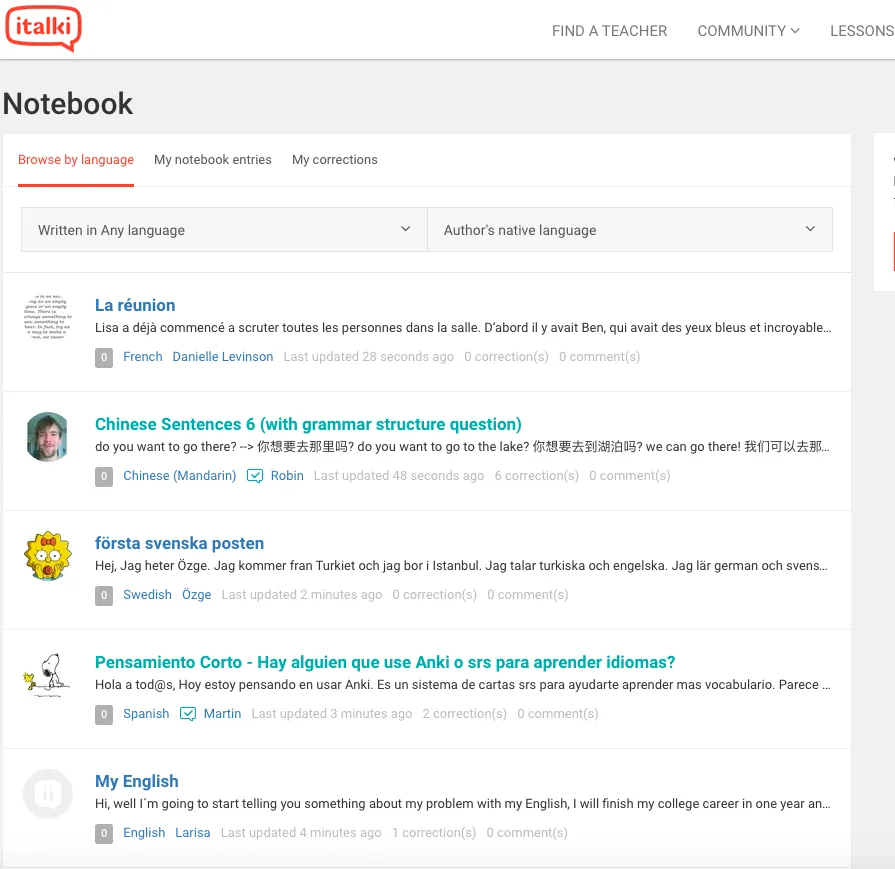 Figure 3: italki free community ecosystem and Notebook tool, providing crowdsourced native corrections alongside paid lessons.
While Preply enforces recurring monthly subscriptions that forfeit unused credits if not scheduled before cycle renewal, italki provides total schedule and financial freedom. Cambly is limited to English only, and Lingoda focuses on rigid institutional CEFR curriculums with fixed schedules. italki remains the top choice for multi-language learners wanting total autonomy.
10. Frequently Asked Questions Answered
Unlike Preply or Babbel Live which enforce recurring 28-day or monthly subscription renewals that forfeit unused lesson credits, italki operates entirely on a pay-as-you-go basis. You buy credits or pay per individual lesson only when you want to learn, giving you total financial and scheduling freedom.
Professional Teachers hold university degrees in education, accredited teaching certificates (such as CELTA or DELE), or verified classroom experience; they design structured curriculums, provide homework, and prepare students for official exams. Community Tutors are native or advanced speakers who focus on conversational practice, pronunciation, and cultural immersion at lower hourly rates.
Every newly registered italki student receives three discounted trial lessons (typically 30 minutes each). These allow you to experience different tutors, test personal chemistry, and assess instructional styles at a fraction of their standard hourly rates before booking full 45-minute or 60-minute sessions.
No. italki features the built-in italki Classroom, which runs directly inside modern web browsers (Chrome, Edge, Safari, Firefox) and mobile apps. It includes integrated video calling, interactive chat, screen sharing, and synchronized note-taking. However, students and teachers can still opt to use external tools like Zoom or Skype if mutually preferred.
italki enforces a 24-hour advance notice policy. If you cancel or reschedule more than 24 hours before the lesson starts, you receive a 100% refund in italki credits. Cancellations made with less than 24 hours notice require direct teacher consent; otherwise, the full lesson fee is transferred to the instructor to compensate for reserved time.
italki credits remain active as long as you log into your account at least once every 12 months. If an account has zero login activity for 12 consecutive months, credits expire. However, italki allows users to reactivate expired credits once within the following 12 months by submitting a request to customer support.
11. Final Editorial Verdict: Is italki Worth It?
In an EdTech landscape saturated with automated AI chatbots, gamified smartphone apps, and restrictive subscription paywalls, italki stands out as an authentic, human-centric platform. Language is a social instrument designed to forge human connections, exchange cultural worldviews, and convey emotional nuance. No algorithm can replicate the empathy and spontaneous humor that emerges during a one-on-one session with an exceptional native teacher.
By combining an astronomical directory of 30,000+ native speakers across 150+ languages with an uncompromising pay-as-you-go financial model, italki democratizes personal language immersion. It empowers students to tailor their educational investment with surgical precision, whether hiring a master educator for grammar or paying $6 an hour to converse casually with a friendly tutor abroad.
For self-directed learners, busy professionals, and dedicated polyglots who refuse to be trapped by recurring monthly subscriptions, italki represents the premier online tutoring investment in 2026.
Who Should Choose italki:
- Self-Directed Language Learners: Students who have mastered basic grammar through self-study and need regular speaking practice to achieve conversational fluency.
- Busy Working Professionals: Learners with erratic schedules who cannot commit to fixed weekly recurring timeslots and need flexible on-demand scheduling.
- Budget-Conscious Polyglots: Students seeking affordable native immersion without paying premium corporate language school markups.
- Learners of Regional or Rare Languages: Anyone studying languages unavailable on mainstream apps, from Icelandic and Basque to Swahili and Cantonese.
Who Should Explore Alternative Solutions:
- Passive Students Needing Rigid Hand-Holding: Learners who want a pre-determined, step-by-step curriculum with mandatory grading should consider structured institutions like Lingoda.
- Students Needing Financial Lock-In for Discipline: Individuals who fail to study unless forced by an expiring recurring subscription may find Preply model more motivating.


italki
italki remains the premier online language tutoring marketplace in 2026 for self-directed learners who prioritize flexible, cost-effective speaking practice. By pairing over 30,000 freelance instructors across 150+ languages with a true pay-as-you-go pricing model and zero forced recurring subscriptions, italki provides unmatched freedom to tailor your path to fluency.