





Table of Contents
In modern B2B sales development, outbound success hinges on two operational fundamentals: contact data accuracy and execution velocity. Sales development representatives (SDRs) cannot afford to spend hours navigating corporate switchboards, dealing with 20% email bounce rates, or manually copy-pasting lead details across fragmented sales tools.
In this competitive landscape, Lusha and Apollo.io represent two distinct schools of sales technology. Lusha is a specialized B2B contact intelligence platform renowned for its frictionless browser extension and verified direct mobile phone numbers verified through live telecom lookups. Conversely, Apollo.io is an all-in-one sales execution platform (Sales OS) uniting a global database of over 275 million contacts with multi-channel email sequencing, a native VoIP cloud dialer, and pipeline tracking under a single subscription.
1. Quick Overview: Lusha vs Apollo.io

- Frictionless Chrome extension delivering 85%+ direct mobile phone connect rates on LinkedIn
- Proprietary B2B community exchange with 280 million business profiles and live telecom HLR pings
- Direct 1-click CRM synchronization into Salesforce, HubSpot, and Pipedrive with duplicate checks

- End-to-end sales execution platform combining 275M+ contacts, email sequencing, and dialer
- Multi-channel outreach sequences with automated steps, A/B testing, and AI-assisted copywriting
- Native single-line and international cloud dialer with local presence and call recording
Key Specifications & Architecture Breakdown
| Feature / Metric | Lusha | Apollo.io | Direct Advantage |
|---|---|---|---|
| Primary Platform Role | Surgical Contact Intelligence & Enrichment | Full-Stack Sales Engagement & Database | Architectural Difference |
| Database Scale | 280M+ Business profiles, 100M+ Direct dials | 275M–300M+ Contacts, 73M+ Companies | Apollo.io (Raw volume) |
| Direct Mobile Phone Accuracy | 85%+ Live connect rate (HLR telecom verification) | 65%–75% (Varies by region and tier) | Lusha |
| Email Sequencing & Cadences | Basic email cadences via Gmail/Outlook | Advanced multi-channel automated sequences | Apollo.io |
| Native Cloud Phone Dialer | No (Enrichment and export only) | Yes (Single-line US dialer and Int’l VoIP) | Apollo.io |
| Chrome Extension Experience | Ultra-fast 1-click reveal with zero clutter | Feature-rich (Reveal, add to list, enroll in sequence) | Lusha (Speed) / Apollo (Depth) |
| Email Verification | Proprietary algorithm + SMTP validation | Built-in 5-stage verification (Secondary check advised) | Tie |
| Buyer Intent Data | Bombora B2B Intent (12,000+ topics) | Bombora Intent + Hiring / Funding Signals | Tie |
| CRM Direct Integrations | Salesforce, HubSpot, Pipedrive, Outreach, Zoho | Salesforce, HubSpot, Outreach, Salesloft | Lusha (Clean mapping) |
| Credit Model for Phones | 5 credits per phone reveal | 8 credits per phone reveal | Lusha (Lower ratio) |
2. Architectural Philosophy: Point Solution vs Sales Operating System
To choose between Lusha and Apollo.io, sales leaders must first decide between two divergent software architectures: specialized point tools versus all-in-one platforms.
Lusha: The Surgical Contact Intelligence Tool
Lusha is engineered with a strict focus on data precision and minimal workflow disruption:
- Zero-Friction Workflow: Lusha does not attempt to be your CRM, your dialer, or your email inbox. It operates as an unobtrusive layer that sits on top of your existing workspace (LinkedIn, LinkedIn Sales Navigator, Salesforce, or HubSpot).
- Sub-Second Lookup Latency: When an SDR opens a prospect profile on LinkedIn, Lusha indexes its verified community database and returns verified direct dials and corporate emails in less than 500 milliseconds.
- Bi-Directional CRM Sync: Contact records are sanitized, matched against existing accounts to prevent duplicate records, and mapped directly into Salesforce or HubSpot custom fields.
- Target Audience: Account Executives (AEs), senior SDRs, and recruiters who prioritize immediate live phone connections over massive email blasts.
Apollo.io: The Complete Outbound Sales OS
Apollo.io takes the opposite approach by collapsing the entire sales tech stack into a single interface:
- Consolidated Software Footprint: Instead of paying separate subscriptions for ZoomInfo (database), Outreach (email sequencing), and Aircall (cloud phone dialer), Apollo provides all three capabilities under one roof.
- Closed-Loop Feedback: Because prospecting, sending emails, making calls, and logging responses occur within the same application, Apollo’s algorithms track which buyer personas and subject lines yield the highest pipeline conversion.
- Continuous Workflow Automation: A sales rep can build a filter of 500 VP-level targets, click once to enrich verified emails, and automatically enroll them into a 5-step nurture sequence without exporting a single CSV.
- Target Audience: Early-stage startups, lean outbound teams, sales agencies, and mid-market organizations seeking maximum software ROI.
3. Database Depth & Contact Data Accuracy
Data accuracy is the single most critical factor in outbound sales. A database of 300 million records is worthless if 30% of the emails bounce and phone numbers connect to retired corporate switchboards.
| Accuracy Dimension | Lusha | Apollo.io | Evaluation Note |
|---|---|---|---|
| Direct Mobile Phone Quality | 85%+ Live connect rate | 65%–75% Average connection rate | Lusha verifies lines via live network status |
| Global Email Deliverability | 90%–94% Valid deliverability | 88%–92% Valid deliverability | Both provide high email baseline accuracy |
| International Coverage | Strong in North America and Western Europe | Extensive global coverage (200+ countries) | Apollo has deeper emerging market coverage |
| Data Verification Method | Telecom HLR lookups + Community validation | SMTP handshakes + Web scraping algorithms | Lusha emphasizes live phone validation |
Direct Mobile Dial Connect Rates
Lusha has built its brand reputation on direct mobile phone accuracy. The platform validates telephone numbers through real-time Home Location Register (HLR) network pings. This technical check queries telecom networks to confirm whether the cellular subscriber identity is currently active, provisioned, and assigned to a real handset. As a result, SDR teams using Lusha typically report direct connection rates exceeding 85% in North America and the UK.
Apollo.io has expanded its phone database significantly, offering millions of direct dials. However, Apollo sources phone records through a combination of public web aggregation, contributor data networks, and algorithmic matching. While its mobile coverage is broad, sales reps frequently encounter personal mobile numbers that have been reassigned, corporate headquarters switchboards routed through automated phone trees, or outdated office lines.
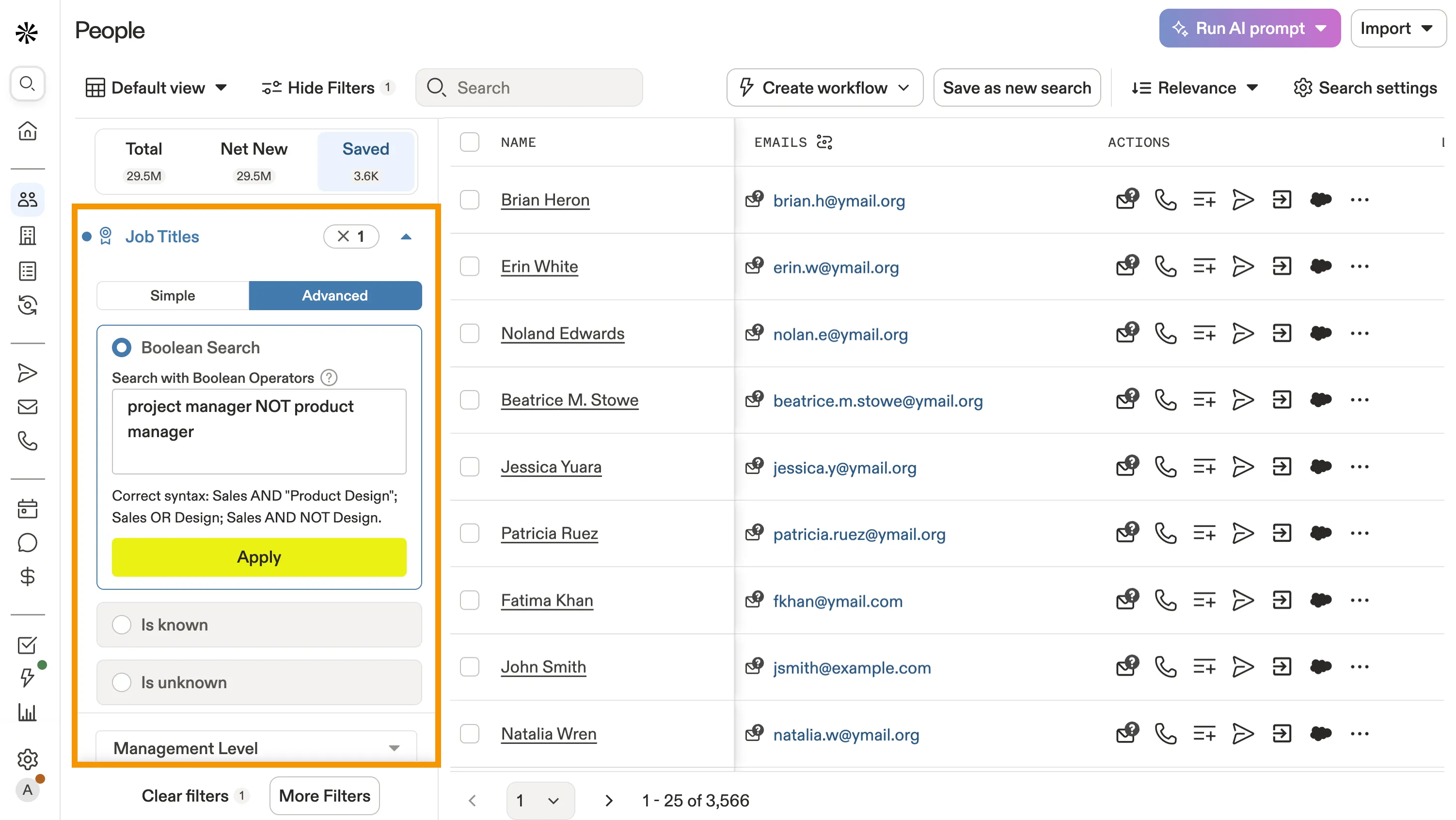 Figure 1: Apollo.io multi-parameter search engine filtering over 275 million business contacts by buyer intent, technographics, and funding rounds.
Email Freshness and Bounce Rate Realities
Both platforms maintain rigorous email verification protocols, checking domain MX records and performing SMTP server handshakes.
In production environments, Apollo.io offers an exceptional volume of verified business emails. However, because Apollo’s database is massive and rapidly expanding, contact records for high-turnover industries (such as tech startups and retail) can occasionally suffer from data decay. High-volume outbound teams frequently pair Apollo with secondary email verification tools (such as ZeroBounce) before launching large campaigns to keep domain bounce rates strictly below 2%.
Lusha’s email database is slightly smaller in raw quantity but exhibits lower decay rates on average, particularly for enterprise decision-makers across healthcare, finance, and industrial manufacturing sectors.
4. Prospecting Speed: Chrome Extension on LinkedIn & CRMs
For outbound SDRs, the browser extension is the primary daily workhorse. Reps spend hours prospecting on LinkedIn Sales Navigator, making extension speed and usability vital.
Lusha Chrome Extension: Lightweight Precision
Lusha’s Chrome extension is widely regarded as one of the cleanest in the industry:
- Non-Intrusive Overlay: The extension docks neatly to the side of the browser, activating automatically when you visit a LinkedIn profile, company page, or supported CRM record.
- 1-Click Reveal: Clicking “Show Contact” instantly reveals the direct mobile phone and business email without reloading or slowing down the tab.
- Duplicate Prevention: If a contact already exists in your connected CRM (such as HubSpot or Salesforce), Lusha displays an indicator badge to prevent reps from wasting credits on existing leads.
- Direct CRM Mapping: With one click, the contact and its firmographic data are pushed directly into your CRM with account ownership properly assigned.
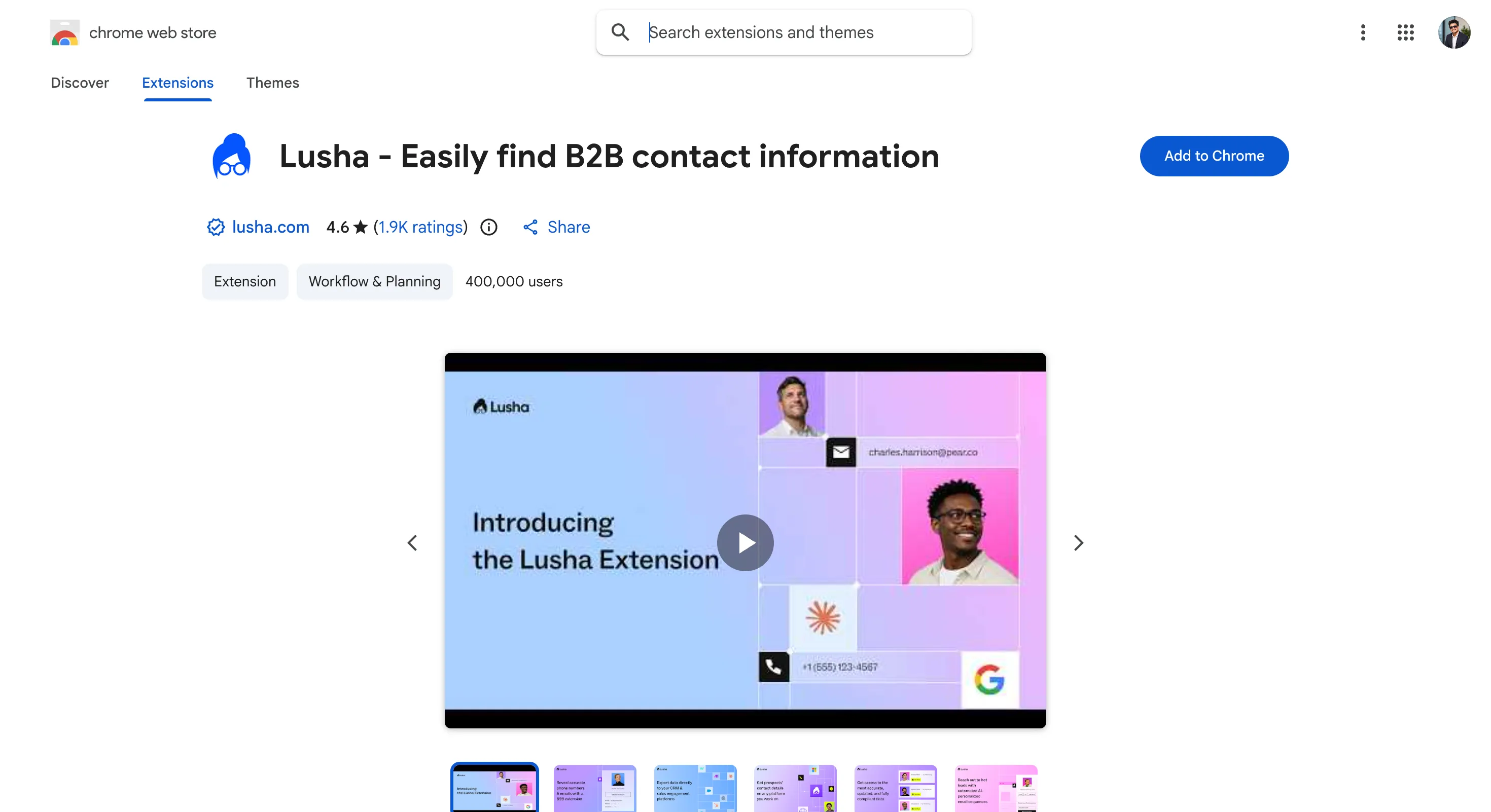 Figure 2: Lusha lightweight Chrome extension revealing verified direct mobile numbers and business emails directly within LinkedIn and company websites.
Apollo.io Chrome Extension: Power and Multi-Tasking
Apollo’s Chrome extension functions as a full-featured control center:
- Comprehensive Data Access: In addition to emails and phone numbers, the extension displays complete company revenue, employee count, funding history, and technology stacks directly inside LinkedIn.
- Direct Sequence Enrollment: Reps do not need to switch tabs to execute outreach. You can reveal a contact and immediately add them to an active multi-step email sequence right from LinkedIn Sales Navigator.
- Bulk Page Extraction: Apollo allows reps to select all 25 prospects on a LinkedIn search results page and save them in bulk to an Apollo contact list.
- Trade-off: Because it loads substantial company data, sequencing logic, and task management tools, the Apollo extension can occasionally experience slight UI rendering lag compared to Lusha’s lightweight sidebar.
5. Outreach Execution: Cold Email Sequences & Built-in Dialers
This is the category where the philosophical divergence between Lusha and Apollo becomes absolute.
Apollo.io: Full-Cycle Sales Engagement Platform
Apollo.io eliminates the need for standalone email sending tools like Lemlist or Outreach:
- Multi-Channel Sequences: Create automated drip sequences combining personalized cold emails, automated follow-ups, LinkedIn connection reminders, and phone call steps.
- Native Cloud VoIP Dialer: Built directly into the platform, Apollo’s dialer supports single-line calling, local presence (matching the area code of the prospect), automatic call recording, and real-time call transcription.
- Deliverability Protections: Apollo includes custom tracking domains, sending rate limits, automated mailbox warmup integrations, and inbox rotation to protect sender reputation.
- AI-Powered Personalization: An integrated AI writing assistant analyzes prospect profile data and company news to generate contextual email openers and customize value propositions.
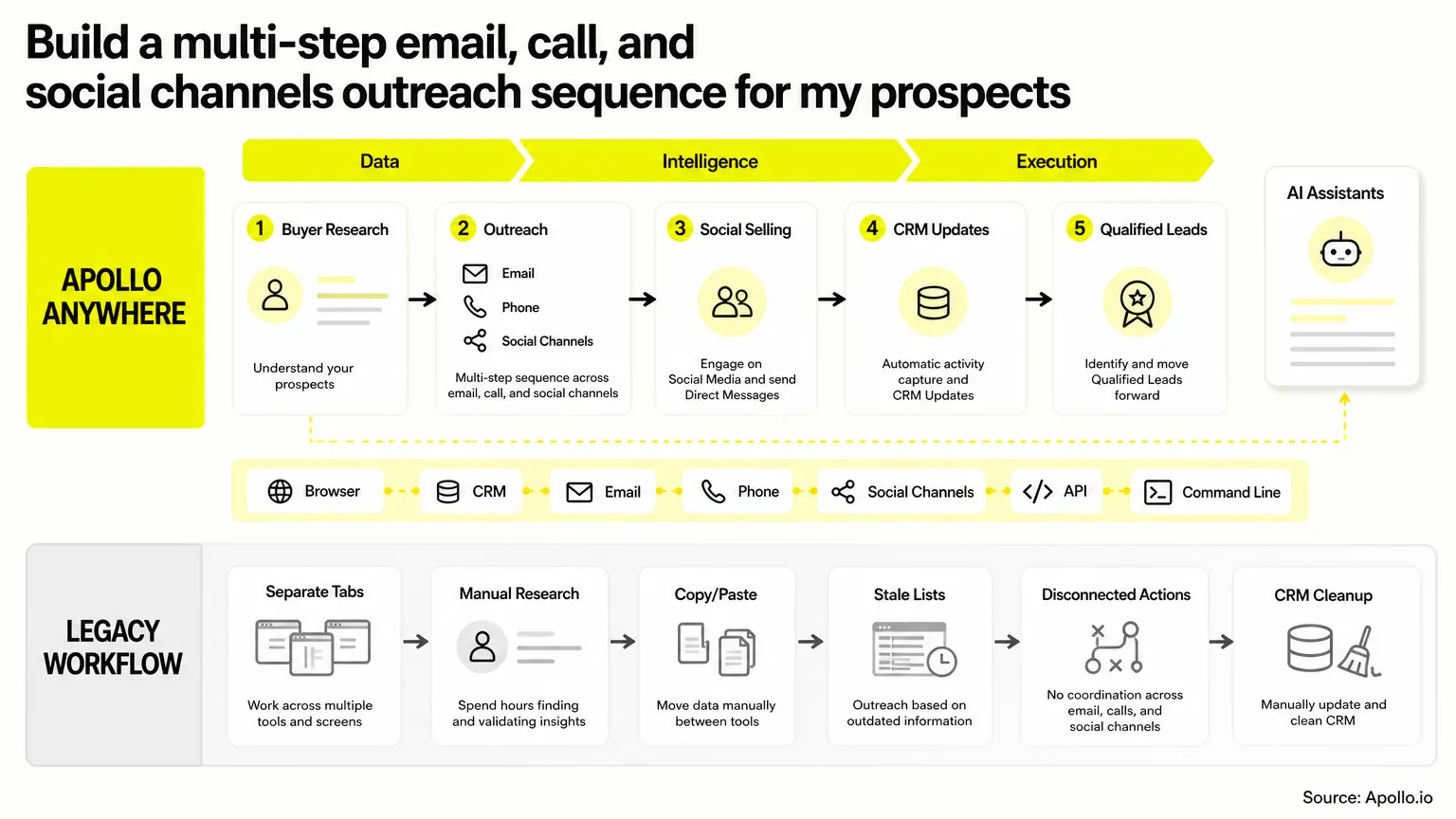 Figure 3: Apollo.io sequence builder orchestrating automated email follow-ups, LinkedIn touchpoints, and scheduled phone calls.
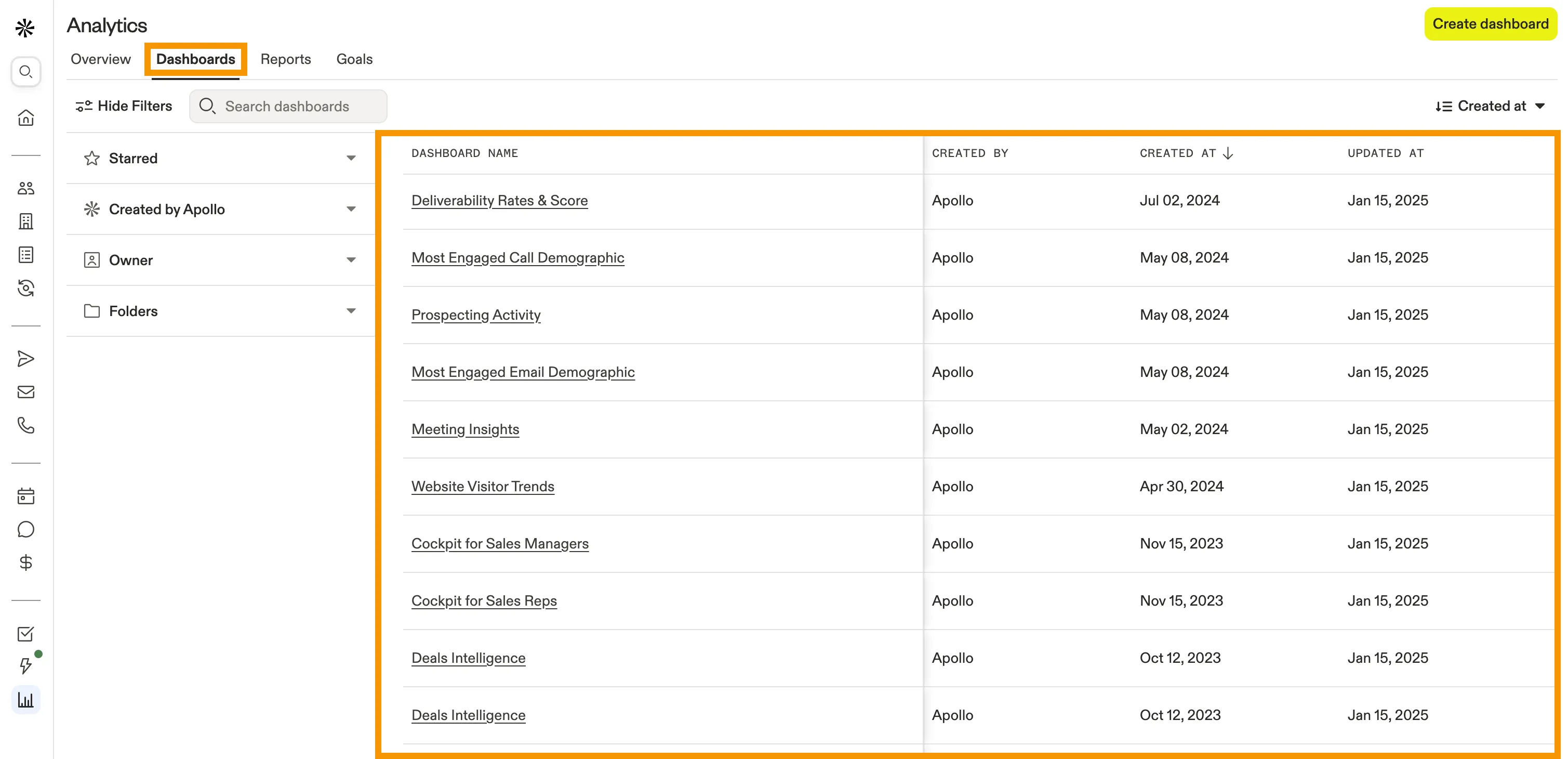 Figure 4: Apollo.io native dialer analytics recording sales calls, generating transcripts, and identifying keyword objections.
Lusha: Engagement as a Secondary Feature
Lusha approaches engagement through a basic utility called Lusha Engage:
- Lightweight Email Cadences: Sales reps can send sequential follow-up templates directly through their connected Google Workspace or Microsoft Outlook accounts.
- No Built-in Phone Dialer: Lusha does not provide a VoIP calling engine. Reps must manually dial revealed numbers on their personal phone, click-to-call via external browser extensions, or export phone data into an external dialer like Dialpad or Outreach.
- No Advanced Automation: Lusha lacks native A/B testing, webhook automation, smart sequence branching, or deliverability analytics.
Outreach Verdict: Apollo.io wins decisively. If you need an engine to actually execute outreach, Apollo provides an entire sales engagement stack that would cost hundreds of dollars per month as separate software.
6. Buying Signals: Intent Data & Technographic Targeting
Modern outbound prospecting requires reaching decision-makers at the exact moment they are in-market for your category.
Lusha’s Bombora-Powered Intent Intelligence
Lusha partners directly with Bombora, the gold standard in B2B intent monitoring:
- 12,000+ B2B Intent Topics: Monitors content consumption across a cooperative network of thousands of premium B2B publishing websites.
- Intent Surge Scoring: Alerts sales teams when target companies are consuming 3x to 5x more content on specific software topics than their normal baseline.
- Account Prioritization: Reps can filter their account lists to focus exclusively on accounts exhibiting active buying intent, maximizing the efficiency of expensive phone credits.
 Figure 5: Lusha intent search engine tracking high-velocity purchase spikes across B2B enterprise categories.
Apollo.io’s Technographic and Intent Grid
Apollo provides a multi-layered signal engine:
- 1,500+ Technographic Signatures: Search accounts based on the specific software technologies they currently use (such as Salesforce, AWS, Marketo, Shopify, or React).
- Hiring & Funding Signals: Track companies that recently raised Series A/B rounds or expanded their engineering and sales headcount by more than 20% in the last 90 days.
- Integrated Buyer Intent: Apollo incorporates Bombora intent data directly into its advanced search filter, allowing reps to cross-reference intent surges with technographic profiles.
7. Dual Pros & Cons Breakdown
 Lusha Pros & Cons
Why Choose Lusha (Pros)
- Industry-leading direct mobile phone connection rates (85%+ verified via live telecom network lookups)
- Ultra-fast, clean Chrome extension that reveals data seamlessly on LinkedIn without browser slowdown
- Seamless bi-directional synchronization with Salesforce, HubSpot, and Pipedrive with duplicate suppression
- Strict data compliance certifications including ISO-27701, GDPR, and CCPA enterprise safeguards
- Bombora buyer intent integration tracking surges across 12,000+ distinct B2B purchase topics
Where Lusha Falls Short (Cons)
- Steep credit consumption for phone numbers (5 credits consumed per revealed mobile number)
- No native VoIP cloud dialer or call recording capabilities included in the platform
- Email sequencing (Lusha Engage) is basic and lacks advanced multi-channel branching and A/B testing
- Significantly higher cost per revealed contact compared to all-in-one data platforms
 Apollo.io Pros & Cons
Why Choose Apollo.io (Pros)
- Exceptional all-in-one value combining 275M+ database, email sequences, and dialer under one roof
- Advanced multi-channel sequencing with automated steps, A/B testing, and AI email generation
- Built-in cloud phone dialer with local presence, call recording, and conversation intelligence
- Deep technographic filtering across 1,500+ installed technologies and real-time funding alerts
- Extensive free plan and affordable entry tiers suitable for startups, freelancers, and small sales teams
Where Apollo.io Falls Short (Cons)
- Direct mobile phone accuracy is lower than Lusha, with occasional switchboard or outdated office lines
- High phone credit deduction (8 credits consumed per direct mobile phone number reveal)
- Massive database volume means occasional email bounce rates that require external verification checks
- Broad feature set creates a steeper initial learning curve for individual sales reps
8. When to Choose Lusha vs When to Choose Apollo.io
- ✓Your sales team relies heavily on cold calling and requires verified direct mobile phone numbers that ring on the first attempt
- ✓Your reps spend 80%+ of their prospecting hours directly inside LinkedIn and LinkedIn Sales Navigator
- ✓Your organization already has an established sales engagement platform (such as Outreach, Salesloft, or Lemlist) and only needs clean contact data
- ✓You require strict enterprise data compliance (ISO-27701, GDPR, CCPA) with verified opt-out safeguards
- ✓Your target market is concentrated in North America, the UK, or Western Europe enterprise accounts
- ✓You are building an outbound sales process from scratch and want data, email sequencing, and a dialer in one unified platform
- ✓You want to eliminate multiple separate software subscriptions and consolidate your outbound tech stack budget
- ✓You rely on high-volume, multi-touch email cadences with automated follow-ups and A/B testing
- ✓You need deep technographic search capabilities to target companies based on their installed software stacks
- ✓You are a startup, agency, or lean sales team operating on a controlled outbound budget
The Hybrid Stack: How Top Enterprise SDR Teams Combine Both
In real-world sales operations, enterprise SDR teams frequently adopt a hybrid tech stack that leverages the unique strengths of both platforms:
- Top-of-Funnel List Building via Apollo: Sales operations uses Apollo’s vast 275M+ database to build broad account lists, filter by technographic stack, and execute initial multi-touch automated email nurturing cadences.
- Signal Filtering: When prospects engage with the campaign (opening emails multiple times, clicking case study links, or visiting landing pages), they are flagged as high-priority accounts.
- Surgical Mobile Dials via Lusha: For these warm, high-intent accounts, SDRs open the prospect’s LinkedIn profile using the Lusha Chrome extension to extract a verified direct mobile phone number.
- Execution: The SDR calls the prospect directly on their mobile phone, combining Apollo’s email nurturing context with Lusha’s superior phone connect rate.
This hybrid approach optimizes budget efficiency: teams do not waste high-cost Lusha phone credits on cold lists, while avoiding the frustration of bad phone numbers on high-value qualified opportunities.
9. Pricing Tiers & Credit Economics Breakdown
Understanding the actual cost of Lusha and Apollo requires analyzing how their respective credit systems function in practice.
| Plan Tier | Lusha (Annual Billing) | Apollo.io (Annual Billing) | Core Credit & Feature Differences |
|---|---|---|---|
| Free Plan | $0 / mo (40 credits / month) | $0 / mo (~900 credits / yr) | Lusha: Chrome extension testing; Apollo: 2 sequences included |
| Entry Plan | Starter: ~$37.45 / mo (400 credits/mo) | Basic: $49 / user / mo | Apollo includes 10,000 email credits and basic sequencing |
| Mid-Tier Plan | Pro: ~$52.45 / mo (600 credits/mo) | Professional: $79 / user / mo | Apollo adds unlimited email sequences and single-line US dialer |
| High-Tier Plan | Premium: ~$299.95 / mo (3,400 credits/mo) | Organization: $119 / user / mo (min 3 seats) | Apollo adds international dialer, call recording, and SSO |
| Credit Rollover | Annual credits valid for full contract year | Unused monthly credits do not roll over | Lusha annual pool is more flexible for fluctuating prospecting |
The Real Cost of Direct Mobile Phone Numbers
Both platforms treat email reveals and phone number reveals as asymmetric credit events:
- Lusha Credit Logic: Revealing a verified email costs 1 credit. Revealing a direct mobile phone number costs 5 credits.
- Apollo Credit Logic: Revealing a verified email costs 1 credit. Revealing a direct mobile phone number costs 8 credits.
Monthly Scenario: Sourcing 500 Direct Mobile Numbers
Suppose an SDR requires 500 verified direct mobile phone numbers per month for outbound calling:
- On Lusha: 500 mobile reveals x 5 credits = 2,500 credits per month. This requires Lusha’s Premium tier (or a custom Scale contract), equating to approximately $300 to $400 per month. However, you achieve an estimated 85%+ live connection rate (around 425 working dials).
- On Apollo: 500 mobile reveals x 8 credits = 4,000 credits per month. On Apollo’s Professional plan, phone credit allotments are capped, requiring additional credit add-on purchases. While base subscription costs are lower ($79/mo), phone volume add-ons quickly escalate the monthly bill to $250 to $350. Furthermore, at an estimated 70% live connection rate, those 500 numbers yield approximately 350 working dials.
Takeaway: If your primary outbound acquisition channel is cold calling, Lusha’s higher per-contact cost is offset by higher connect rates and fewer wasted dials. If your primary channel is email, Apollo offers vastly superior economics with practically unlimited email credits on its paid tiers.
10. Final Editorial Verdict

 VS

Final Editorial Verdict: Lusha vs Apollo.io in 2026
Apollo.io earns our recommendation as the best all-in-one sales execution platform for modern outbound teams, delivering an unbeatable combination of database depth, automated email sequences, and native cloud dialers at an accessible price. Lusha remains the gold standard point solution for sales professionals who require the highest possible direct mobile phone accuracy and lightning-fast LinkedIn prospecting.

 Apollo.io
Best for All-in-One Lead Database, Multi-Channel Sequences & Dialers
11. Frequently Asked Questions
Lusha provides higher direct mobile phone accuracy, averaging over 85% live connection rates in benchmark testing across North America and the UK. Lusha validates numbers using live telecom network lookups, whereas Apollo.io relies more heavily on aggregated web data, yielding connect rates closer to 65% to 75%.
Yes. For many startups and mid-market companies, Apollo.io can fully replace standalone sales engagement platforms. Its Professional and Organization plans feature multi-channel sequences, automated drip follow-ups, A/B testing, and a native VoIP dialer, eliminating the need to pay for separate sequencing tools.
Both platforms consume more credits for phone numbers than emails. On Lusha, revealing an email costs 1 credit while a phone number costs 5 credits. On Apollo.io, revealing an email costs 1 credit while a direct mobile phone number consumes 8 credits.
Yes. Many high-performing enterprise sales teams utilize a hybrid model. They use Apollo.io for high-volume list building, technographic filtering, and initial automated email sequences, then switch to Lusha's Chrome extension to extract verified direct mobile phone numbers for warm, high-intent prospects.
Both platforms comply with major data privacy regulations including GDPR and CCPA. Lusha holds ISO-27701 certification and provides simple automated opt-out mechanisms for data subjects. Apollo also maintains strict privacy safeguards, opt-out registries, and SOC 2 Type II security certifications.
Apollo.io offers a more functional free plan, including access to basic search filters, Chrome extension lookups, and up to 2 active automated email sequences. Lusha's free plan provides 40 monthly credits primarily intended for short-term testing of its Chrome extension.