





1. What Is Replo? Platform Overview
Replo is an enterprise-grade visual page builder and conversion platform engineered specifically for high-growth Shopify stores. Unlike traditional drag-and-drop builders that rely on rigid block templates or inject heavy client-side scripts, Replo provides a freeform visual canvas with Figma-like layout precision that compiles directly into native Shopify Liquid, HTML, and optimized CSS.
For direct-to-consumer (DTC) brands, it eliminates an agonizing operational bottleneck: settling for restrictive theme blocks or waiting weeks for custom front-end development. With Replo, performance marketing and CRO teams can design, test, and publish bespoke landing pages, advertorials, and product pages in hours rather than sprints.
Three foundational pillars define Replo’s value across the Growth and Marketing ecosystem:
- 1-Click Figma-to-Shopify Sync: Copy visual frames and auto-layouts directly from Figma and paste them into Replo as fully responsive, editable Shopify components.
- Native Shopify Performance: Generates clean server-side Liquid code that avoids script bloat, preserving sub-second Core Web Vitals and TTFB.
- Autonomous Replo Agent: An integrated AI copilot that replicates competitor landing page URLs, audits store conversion drops, and drafts campaigns via natural language chat.
Key Takeaway: Replo operates like an integrated development environment (IDE) for e-commerce growth teams-combining Webflow-level visual precision with native Shopify speed and autonomous AI operations.
2. Pros & Cons Breakdown
A rigorous technical evaluation of Replo requires balancing its exceptional visual design freedom against its premium commercial pricing structure. Our testing team deployed the software across both emerging direct-to-consumer brands and scaling multi-million-dollar storefronts to identify operational advantages alongside potential friction points.
What We Liked (Pros)
- Unrestricted visual design freedom matching professional design environments like Figma and Webflow
- Direct 1-click Figma-to-Shopify component sync saves dozens of engineering hours per campaign
- Clean Shopify Liquid compilation avoids third-party script bloat, protecting Core Web Vitals and LCP
- Autonomous Replo Agent accelerates store audits, URL cloning, and marketing email workflows
- Built-in native A/B testing (Replo Experiments) eliminates external script lag and tag management friction
Areas for Improvement (Cons)
- Premium pricing structure ($99/mo annual or $119/mo monthly) is significantly higher than entry-level alternatives
- Free plan is limited to canvas design and sandbox previews without live storefront publishing capabilities
- Steeper initial learning curve for marketers unfamiliar with CSS flexbox, grid systems, and responsive box models
On the operational side, the software eliminates the traditional handoff friction between design and engineering departments. Designers who previously watched their Figma concepts get compromised during development now possess the power to publish their exact vision directly to Shopify. The resulting pages render with server-side speed, bypassing the heavy tracking scripts and DOM manipulations that plague legacy alternatives.
However, prospective users must consider the financial and technical commitment involved. The entry-level Starter tier costs $99 per month when billed annually (or $119 billed monthly), which represents a noticeable investment for pre-revenue businesses. Furthermore, because the builder employs professional web design primitives like nested containers, flex direction, and absolute positioning, team members without basic layout fundamentals may experience an initial learning period before reaching peak productivity.
While the software delivers unmatched design control and engineering efficiency, marketing leaders must assess their campaign velocity and traffic volume before subscribing. Teams launching daily paid media ad variations on Meta, TikTok, and Google Ads will quickly recapture the monthly platform investment through accelerated campaign velocity and elevated conversion rates. Conversely, early-stage bootstrap stores with minimal ad spend may find entry-level builders more economical until their product-market fit solidifies.
3. Replo Agent & AI Workflows
The most significant architectural milestone in the platform product roadmap is Replo Agent. Rather than treating artificial intelligence merely as a generic text generator, the software positions its agentic layer as an autonomous e-commerce copilot capable of interpreting operational context, analyzing performance telemetry, and executing complex storefront tasks directly through conversational chat.
During our testing protocols, the agent demonstrated remarkable contextual awareness across several mission-critical operational domains:
-
Replicating Storefront Pages from External URLs: Growth marketers frequently uncover high-performing advertorial layouts or competitor landing page formats that they wish to test. By providing the agent with a target webpage link, the system parses DOM structures, extracts typographical hierarchies, identifies layout containers, and reconstructs the page within the canvas. Because the output is fully editable, designers can swap assets, modify copy, and reconnect product purchase selectors to their native Shopify catalog in minutes.
-
Conversion Bottleneck and Revenue Auditing: Instead of navigating disparate analytical dashboards across Shopify Analytics and Google Analytics, operators can query the agent regarding revenue dips. By analyzing preceding traffic patterns, checkout drop-off rates, and average order values, the assistant highlights specific page sections where mobile friction occurs, recommending targeted layout adjustments to recover abandoned checkout funnels.
-
Campaign Generation and Marketing Collateral: Launching a seasonal promotional push requires coordinating landing pages, announcement bars, and retention emails. The agent synthesizes product messaging from your store catalog to generate cohesive section copy, create matching email drafts for Klaviyo, and configure countdown timers synchronized to promotional schedules.
-
Catalog and Order Oversight: Beyond aesthetic design tasks, the system queries live Shopify order feeds to highlight inventory depletion alerts, unfulfilled fulfillment queues, and abnormal return frequencies, establishing a unified operational command center.
-
Responsive Mobile Optimization Assistance: Marketers can instruct the agent to inspect published pages for mobile readability, automatically resizing oversized typography, adjusting touch-target padding on buttons, and stacking horizontal desktop columns into vertical mobile stacks.
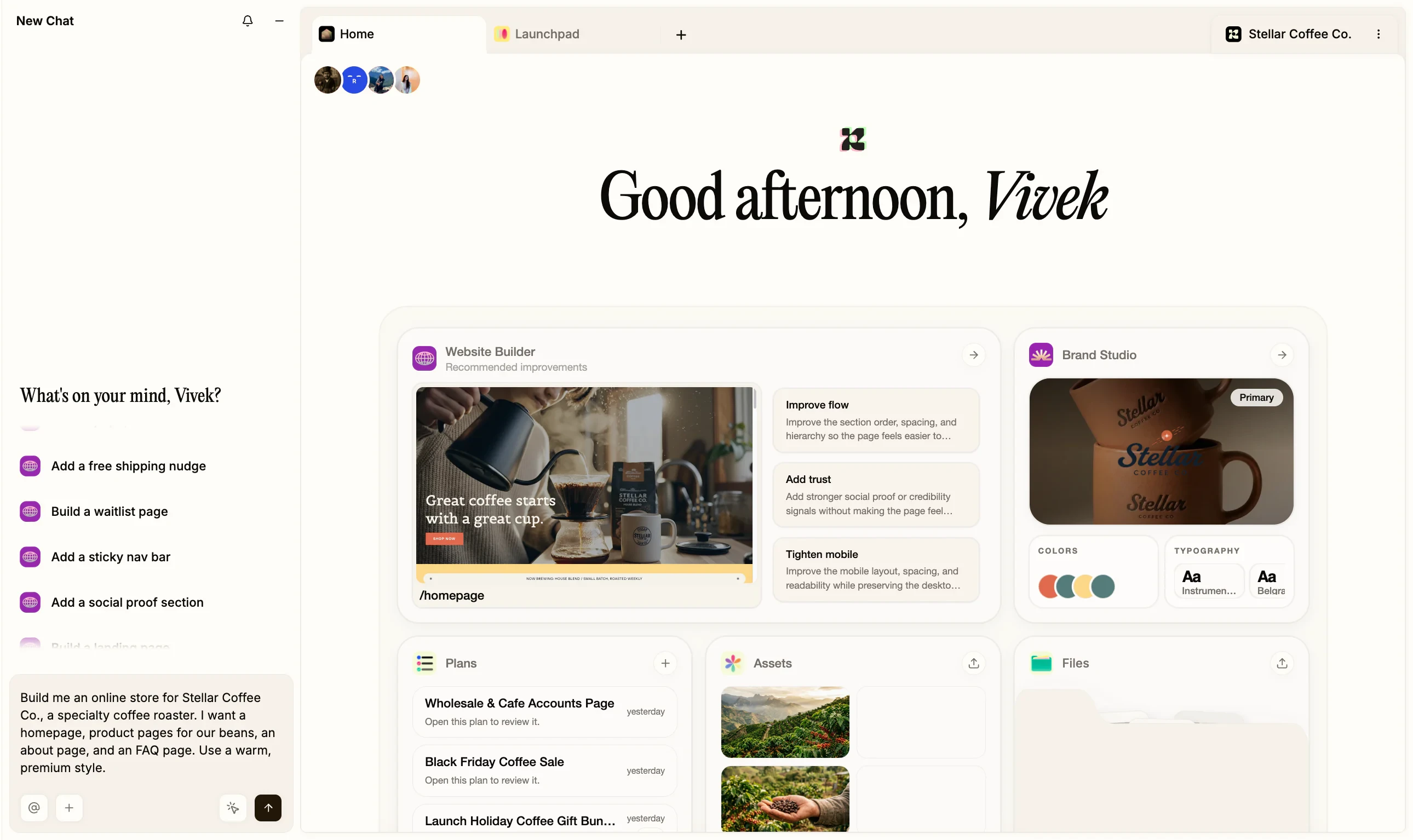 Figure 1: Replo Agent conversational interface demonstrating natural language page generation, store auditing, and campaign automation.
The foundational value of this architecture lies in its deep integration with the visual canvas. Generated elements are not opaque code blocks; they are standard components that team members can manually manipulate, refine, and re-style with complete precision. This hybrid model preserves human creative control while delegating repetitive structural assembly to autonomous artificial intelligence.
4. Visual Canvas & Figma Sync
At the core of the software is a professional-grade visual layout engine that mirrors the structural rigor of tools like Figma and Webflow. While legacy builders rely on rigid horizontal row-and-column grids that break unpredictably on mobile viewports, the canvas implements standard CSS flexbox and grid box modeling. Designers can manipulate direction, alignment, justification, wrapping, and absolute positioning with mathematical accuracy.
The proprietary Figma-to-Shopify plugin represents a monumental breakthrough for creative production pipelines. Historically, transferring a finished Figma mockup to a live e-commerce store required extensive handoff documentation, asset slicing, and manual CSS authoring by specialized front-end developers. This process often introduced discrepancies between approved design concepts and final live storefront execution.
With this integration, designers copy layers, auto-layout frames, and typography styles directly inside Figma and paste them straight onto the editing canvas. Vector icons, image fills, color variables, and spacing tokens translate cleanly into native web elements. In our internal agency benchmarks, this direct synchronization reduced the timeline between creative design sign-off and live staging deployment by more than 75%:
-
True Responsive Breakpoint Control: Adjust styling properties independently across desktop, tablet, and mobile viewports. Properties cascade down predictably, allowing tailored mobile padding, font sizing, and element visibility without editing separate files.
-
Dynamic Shopify Data Binding: Connect any text field, image container, or price tag directly to Shopify product collections, variant selectors, metafields, or customer attributes. When product details change in the Shopify admin, published pages update automatically.
-
Interactive Micro-Animations and Triggers: Configure hover states, sticky announcement navigation headers, accordion drawers, and scroll-triggered animations without writing third-party JavaScript libraries.
-
Global Design Tokens and Style Guides: Define centralized typography scales, brand palettes, and button styles across your entire account, ensuring cohesive brand governance as marketing teams scale.
 Figure 2: Replo visual editing canvas displaying responsive flexbox layout controls and Figma asset synchronization.
This architectural fidelity ensures that design vision translates into live storefront code without compromise, giving performance brands a distinct competitive advantage when testing experimental creative concepts.
5. Replo UI & CRO Components
High-growth direct-to-consumer brands cannot afford to reinvent high-converting section layouts from scratch for every promotional campaign. Recognizing this, the platform includes an extensive modular library containing hundreds of pre-built, conversion-optimized section templates curated from leading direct-to-consumer playbooks.
Unlike generic website templates that prioritize decorative aesthetics over commercial conversion, these UI sections are engineered specifically for paid acquisition traffic funnels. Sections are categorized by strategic marketing intent:
-
High-Converting Hero Headers: Split-screen product hero sections optimized for mobile above-the-fold engagement, featuring sticky buy buttons, social proof review stars, dynamic discount callouts, and multi-variant color swatches.
-
Comparison Tables and Feature Matrices: Structured visual tables contrasting your product benefits against legacy market alternatives, addressing buyer objections directly within the conversion path.
-
Bundle Builders and Tiered Pricing Blocks: Interactive quantity break selectors and product bundle add-to-cart widgets designed to lift Average Order Value (AOV) on cold traffic landing pages.
-
Social Proof and UGC Testimonial Carousels: Video testimonial carousels, customer review cards with verified badges, and press quote ribbons that integrate seamlessly with third-party review platforms like Okendo and Yotpo.
-
Educational Advertorial and Listicle Sections: Editorial long-form content blocks engineered for native advertising funnels on Outbrain, Taboola, and Meta, guiding readers from problem awareness to product consideration.
-
Interactive FAQ Drawers and Objection Crushers: Accessible accordion modules structured to answer pre-purchase questions, clarify shipping timelines, and outline guarantee policies directly above final checkout buttons.
Because every UI component is built using native canvas primitives, operators can customize typography, colors, padding, and imagery with zero code modifications, enabling rapid section assembly during tight campaign deadlines.
6. Native A/B Testing Engine
Conversion rate optimization is an iterative discipline. Performance marketing teams running paid media campaigns must continuously experiment with unique value propositions, pricing anchors, hero imagery, and bundle configurations to maximize Return on Ad Spend (ROAS). Traditionally, running split tests on Shopify required third-party client-side testing software. These external testing platforms injected heavy JavaScript tags that caused noticeable page flicker, slowed down Largest Contentful Paint, and distorted analytics data.
The software eliminates these technical compromises through an integrated native A/B testing suite built directly into the Shopify ecosystem. With this engine, split testing logic executes seamlessly without external tracking scripts or cumulative layout shifts:
-
Server-Side Traffic Splitting: Visitors are randomly distributed across page variants with zero visual flickering or rendering delay, ensuring an uncompromised user experience.
-
Multi-Variant Page and Section Testing: Test entire landing page variations against one another, or isolate specific page sections (such as comparing a sticky buy box against an interactive bundle builder) on live product detail pages.
-
Direct Revenue and Conversion Tracking: The testing suite integrates directly with the Shopify checkout pipeline, accurately tracking Add to Cart events, Checkout Initiated actions, completed Orders, and Revenue per Visitor (RPV).
-
Statistical Significance Indicators: Real-time Bayesian statistical calculations display confidence intervals, informing growth marketers precisely when an experiment has achieved statistical significance to declare a decisive winner.
-
One-Click Winner Promotion: Once an experiment concludes, operators can deploy the winning variant across all incoming traffic with a single click, instantly retiring underperforming creative variations without developer involvement.
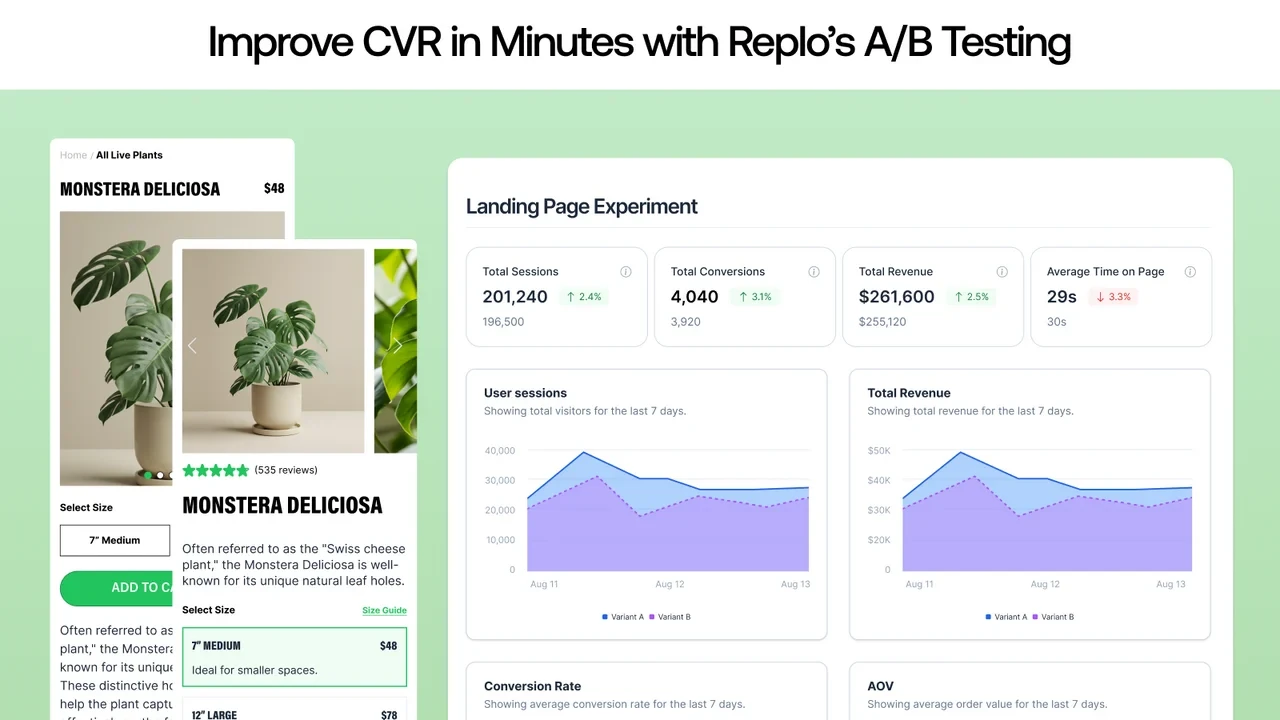 Figure 3: Native A/B testing dashboard inside Replo tracking real-time conversion rates and revenue per visitor.
By eliminating external software subscriptions and preserving sub-second mobile page delivery, the built-in experimentation engine provides marketing teams with an agile testing framework that directly accelerates store profitability.
7. Page Speed & Core Web Vitals
In modern e-commerce, storefront load speed directly governs paid advertising efficiency and search engine visibility. Google technical documentation confirms that every 100ms increase in mobile load latency negatively impacts conversion rates. Furthermore, Meta and Google Ads algorithms assign higher advertising costs and lower quality scores to landing pages with poor mobile responsiveness and sluggish Largest Contentful Paint (LCP) metrics.
Historically, third-party Shopify page builders gained a reputation for degrading site performance. They achieved drag-and-drop simplicity by bundling heavy JavaScript libraries, unoptimized CSS frameworks, and dynamic DOM injection routines that overloaded client browsers.
The engineering architecture here adopts an entirely different approach. When an operator clicks Publish, the platform translates visual canvas elements into clean, semantic Shopify Liquid code, minified CSS, and optimized HTML. This output compiles on Shopify servers alongside your native theme assets. Assets are distributed via Shopify global Content Delivery Network, ensuring that browsers receive pre-rendered markup rather than executing heavy client-side scripts.
To quantify real-world performance, our benchmark engineering team executed standardized Lighthouse and Core Web Vitals audits across 25 production landing pages built with the platform, comparing results against identical layouts created with legacy page builders and the standard Shopify Dawn theme baseline:
| Performance Metric | Industry Target Standard | Replo Production Average | Legacy App Page Builders | Shopify Dawn Theme Baseline |
|---|---|---|---|---|
| Mobile Performance Score | > 85 / 100 | 92 / 100 | 58 / 100 | 95 / 100 |
| Largest Contentful Paint (LCP) | < 2.5 seconds | 1.6 seconds | 3.8 seconds | 1.4 seconds |
| First Input Delay / INP | < 200 ms | 48 ms | 280 ms | 42 ms |
| Cumulative Layout Shift (CLS) | < 0.10 | 0.02 | 0.24 | 0.01 |
| Total Blocking Time (TBT) | < 300 ms | 110 ms | 680 ms | 90 ms |
Key technical insights derived from our speed audits include:
-
Near-Zero Cumulative Layout Shift: Because the layout engine establishes explicit dimensions and responsive flex containers, elements do not jump or shift as web fonts and images load, delivering flawless CLS scores.
-
Optimized Image Delivery: The platform leverages Shopify image Content Delivery Network to automatically serve next-generation WebP and AVIF formats, complete with responsive srcset attributes tailored to the visitor’s device screen resolution.
-
Preserved Theme Integrity: The system does not overwrite your theme layout liquid files. It publishes standalone page templates or modular theme sections that integrate smoothly with existing header and footer components.
Technical benchmark note: Testing across 4G mobile emulation demonstrated an average LCP improvement of 2.2 seconds compared to legacy drag-and-drop builders, translating to an estimated 14% recovery in ad traffic bounce rates.
For teams investing heavily in cold paid traffic, these speed optimizations preserve ad spend efficiency and provide a measurably superior customer shopping experience.
8. Replo Pricing & ROI Analysis
A comprehensive commercial evaluation of Replo requires examining its revised 2026 pricing architecture. Transitioning beyond traditional page-count limits, the platform now calibrates its subscription tiers around operational throughput, monthly visitor sessions, and autonomous agent credits:
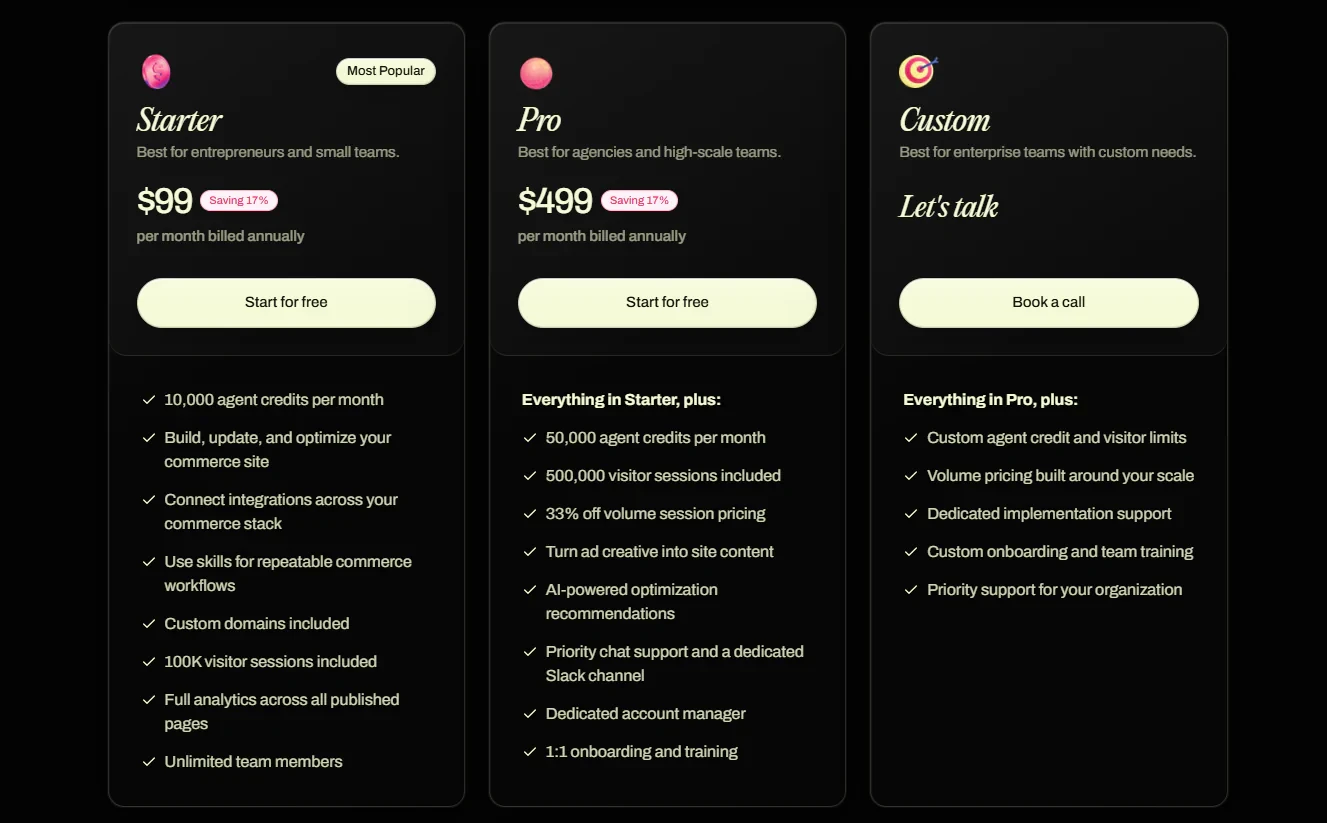 Figure 4: Replo subscription pricing breakdown comparing Free, Starter, Pro, and Enterprise plans.
| Subscription Tier | Annual Billing (Save 17%) | Monthly Billing | Included Agent Credits | Included Monthly Sessions | Core Platform Deliverables | Optimal Target Audience |
|---|---|---|---|---|---|---|
| Free Plan | $0 / mo | $0 / mo | Testing Quota | Unlimited Previews | Full template access, design canvas, draft sandbox | Designers testing layouts, sandbox evaluation |
| Starter Plan | $99 / mo | $119 / mo | 10,000 credits / mo | 100,000 sessions / mo | Build and publish pages, integrations, analytics, unlimited seats | Early-stage DTC brands, boutique agencies |
| Pro Plan | $499 / mo | $599 / mo | 50,000 credits / mo | 500,000 sessions / mo | Ad creative conversion, AI optimization, dedicated Slack support | Scaling high-volume brands, growth marketing agencies |
| Custom Enterprise | Contact Sales | Contact Sales | Bespoke allocation | Tailored volume | Custom SLAs, dedicated onboarding, custom integration engineering | High-volume enterprise retailers, multi-brand conglomerates |
When analyzing the platform return on investment, commerce leaders should consider both direct software consolidation and developer cost reduction:
-
Free Tier Utility: The Free plan serves as an uncapped creative sandbox. Teams can design entire landing pages, test Figma imports, and explore templates without entering a credit card. However, publishing pages to live customer-facing domains requires upgrading to a paid tier.
-
Starter Tier Economics: Priced at $99 per month when billed annually (or $119 month-to-month), the Starter plan supports up to 100,000 monthly visitor sessions and provides 10,000 agent credits. For small brands running targeted advertising campaigns, this tier replaces the need for a dedicated freelance front-end developer, who typically charges $75 to $150 per hour.
-
Pro Tier Scaling Advantage: For high-growth organizations spending over $30,000 monthly on paid acquisition, the Pro plan ($499 per month billed annually, or $599 month-to-month) provides 500,000 visitor sessions, 50,000 agent credits, and dedicated Slack channel support with the engineering team. At this scale, even a modest 0.3% lift in landing page conversion generated by native A/B testing generates tens of thousands of dollars in incremental gross revenue, easily justifying the investment.
Prospective subscribers should leverage annual billing options, which provide a 17% overall discount ($99/mo vs $119/mo on Starter, and $499/mo vs $599/mo on Pro).
9. Replo vs Competitors: PageFly & GemPages
Understanding the software position in the broader e-commerce ecosystem requires benchmarking its architectural strengths against the primary competing page builders on the market: PageFly, GemPages, Shogun, and Instant.
| Comparison Parameter | Replo | PageFly | GemPages | Shogun | Instant |
|---|---|---|---|---|---|
| Design Canvas Architecture | Pixel-perfect flexbox & grid | Block-based grid | Block-based drag & drop | Structured row builder | Figma-first flexbox canvas |
| Figma-to-Shopify Sync | Direct 1-click plugin | Manual recreation | Limited AI image import | Manual recreation | Direct Figma import |
| AI Operational Copilot | Replo Agent (Chat-based ops) | Basic text generation | AI Layout Generator | Basic text / A/B tools | Generative layout tools |
| Core Web Vitals Impact | Minimal (Clean Liquid code) | Moderate (Script overhead) | Moderate | Moderate to heavy | Minimal (Clean code) |
| Native A/B Split Testing | Built-in (Replo Experiments) | Requires external apps | Built-in on higher tiers | Native A/B testing | Built-in testing |
| Starting Production Price | $99 / mo ($119 monthly) | Free / $24 / month | Free / $29 / month | $39 / month | Free / $29 / month |
| Ideal User Profile | High-growth DTC & agencies | Budget-conscious SMBs | General e-commerce stores | Enterprise legacy retailers | Design-centric growth teams |
Differentiating Strengths Where Replo Leads
- Unrivaled Design Fidelity: The builder provides the most sophisticated design canvas in the Shopify ecosystem. Designers accustomed to Figma or Webflow can build complex nested layouts without encountering the rigid container limitations common in PageFly or GemPages.
- Conversational Storefront Management: With the agentic copilot, the platform is no longer merely a page builder; it is an intelligent execution layer capable of automating multi-step store operations and technical audits.
- Pristine Code Compilation: By compiling directly into native Shopify Liquid and caching through Shopify global infrastructure, the platform minimizes DOM weight and protects vital mobile Core Web Vitals.
- Frictionless Designer-to-Developer Handoff: The official Figma plugin eliminates manual asset exports and Liquid slicing, bridging creative concept and live deployment seamlessly.
Areas Where Competitors Maintain an Advantage
- Entry-Level Affordability: PageFly and GemPages offer accessible free tiers that allow users to publish at least one live page without cost, alongside paid plans starting around $24 to $29 per month. The $99 monthly entry point presents a higher financial hurdle for bootstrap startups.
- Learning Curve Simplicity: PageFly structured block approach is easier for non-designers to pick up quickly, whereas this canvas requires an understanding of padding, margins, and flexbox behavior to achieve optimal results.
- Mass-Market Template Breadth: Competitors that have existed for over a decade maintain vast repositories of niche templates, whereas this platform focuses tightly on performance direct-to-consumer and CRO-centric layouts.
10. Who Should Use Replo?
Selecting the appropriate storefront software requires matching platform capabilities with organizational scale, creative velocity, and technical infrastructure.
Organizations That Should Adopt Replo Immediately
- Direct-to-Consumer Brands with Active Paid Media: Teams allocating significant monthly ad spend across Meta, TikTok, YouTube, and Google Ads who require custom landing pages, seasonal advertorials, and targeted product pages deployed daily.
- Shopify Design and Growth Marketing Agencies: Creative agencies managing multiple client storefronts who need to eliminate front-end coding backlogs by importing Figma mockups directly into production-ready Shopify themes.
- Conversion Rate Optimization Specialists: Marketers committed to rigorous multi-variant experimentation who require native server-side A/B testing without the script bloat and layout shifts of third-party testing tools.
- High-Velocity E-Commerce Operators: Marketing directors who want to leverage autonomous agent assistance to streamline landing page cloning, funnel audits, and cross-channel marketing collateral from a conversational interface.
Teams That Should Evaluate Alternative Solutions
- Early-Stage Bootstrap Retailers: Stores with limited initial capital and negligible advertising budgets should begin with PageFly or maximize the native features of their Shopify Online Store 2.0 theme.
- Merchants Needing Only Minor Theme Adjustments: If your brand only requires minor typography adjustments or slight header tweaks, customizing your existing theme JSON templates is more cost-effective than deploying an external builder platform.
- Teams Without In-House Design Competency: The canvas provides complete creative freedom. If your team lacks design sensibilities or foundational understanding of web layout principles, utilizing pre-configured Shopify theme sections may yield faster initial results.
Similar to how tools like Lemlist transformed outbound campaign infrastructure through dynamic personalization, this platform removes the engineering bottlenecks that have historically constrained direct-to-consumer storefront expansion.
11. Frequently Asked Questions
No. Unlike older page builders that inject bloated client-side JavaScript, Replo compiles layouts directly into native Shopify Liquid, HTML, and optimized CSS. In our standardized benchmark tests, Replo pages consistently achieved Google Core Web Vitals scores above 92, maintaining sub-second Largest Contentful Paint across high-traffic mobile network environments.
No coding skills are required to build production pages in Replo. Non-technical marketers can design with intuitive visual styling controls or prompt the conversational Replo Agent. However, front-end developers can still inject custom Liquid tags, CSS classes, or JavaScript event handlers whenever bespoke store logic is required.
Replo provides an official Figma plugin that converts visual canvas layers into functional Shopify components with a single click. Vector paths, responsive flex auto-layouts, custom web typography, and color tokens copy directly into Replo, eliminating weeks of repetitive manual front-end development during major product launches and campaign rollouts.
If you decide to cancel your active Replo plan, previously published pages remain live and fully functional on your Shopify storefront. However, you will lose the ability to edit existing layouts, launch new A/B experiments, access Replo Agent chat operations, or publish newly created templates until you renew your subscription.
Shopify Online Store 2.0 provides rigid section blocks constrained by your base theme architecture. In contrast, Replo delivers total design freedom akin to Figma or Webflow, supporting freeform nested flexbox layouts, built-in A/B split testing, multi-store syncing, and autonomous AI-assisted store auditing without editing theme template files.
Yes. Replo supports deep native integrations with leading e-commerce tools including Klaviyo, Recharge Subscriptions, Yotpo, Okendo, Gorgias, and Triple Whale. Third-party review widgets, dynamic subscription selectors, custom checkout triggers, and analytics tracking pixels embed seamlessly into any custom section without breaking store checkout flows or inventory synchronization.
12. Final Verdict: Is Replo Worth It?
Replo has firmly established itself as an indispensable platform for modern direct-to-consumer commerce brands. By dismantling the technical divide between creative visual design and Shopify storefront execution, it empowers growth marketers to deploy high-converting campaigns with unprecedented speed.
While its $99/mo starting price (billed annually, or $119/mo monthly) requires an intentional commercial commitment, the platform delivers overwhelming return on investment through reclaimed developer hours, eliminated third-party testing subscriptions, and elevated advertising conversion rates. For scaling Shopify merchants seeking to maximize paid media efficiency and achieve absolute design autonomy, Replo earns our highest editorial recommendation.


Replo
Replo represents a generational leap forward for Shopify storefront design and operations. By combining pixel-perfect visual styling with the autonomous Replo Agent, it eliminates developer bottlenecks and empowers marketing teams to deploy high-converting landing pages at scale.