





1. Navigating Enterprise Agentic Infrastructure Realities
Every modern software engineering department faces mounting pressure to deliver production artificial intelligence capabilities. This technical Abacus AI review examines how organizations tackle autonomous agent pipelines without accumulating brittle glue code. Rushing to deploy simple language model wrappers often results in fragile systems that break down when autonomous agents lose context across sequential Application Programming Interface (API) tool calls.
“Building production AI systems is rarely a modeling problem. It is almost always an infrastructure problem where context retention, token economics, and pipeline resiliency determine whether an autonomous agent succeeds or crashes in production.”
Software teams attempting to assemble in-house agentic stacks routinely encounter 4 systemic operational bottlenecks:
- Context Window Drift: Sequential tool invocations dilute prompt context, causing autonomous workers to enter infinite execution loops or hallucinate stale parameters.
- Runaway Token Economics: Unrestricted API queries across high-parameter frontier models rapidly exhaust monthly departmental budgets without delivering predictable business value.
- Fragmented Vendor Governance: Managing disparate credentials and billing agreements across multiple foundation model providers invites compliance audits and security vulnerabilities.
- Brittle Integration Glue: Writing custom microservices to link vector stores, relational databases, and inference endpoints creates technical debt that slows feature velocity.
Founded by former Google and AWS engineering executive Bindu Reddy, Abacus.ai addresses this operational friction directly. The platform unifies frontier model aggregation, automated feature engineering, dynamic routing, and autonomous agent loops into a single enterprise system.
The central thesis of Abacus.ai centers on structural abstraction. Decoupling application logic from underlying foundation model providers grants engineering teams the freedom to adopt newer reasoning architectures instantly while maintaining centralized audit trails, token quotas, and compliance guardrails.
Providing a unified enterprise portal also eliminates unmonitored shadow AI usage across internal departments. Centralized telemetry captures exact input-output pairs, model latency figures, and token counts across every team transaction, ensuring corporate intellectual property remains strictly protected.
2. Deconstructing the RouteLLM Intelligent Routing Layer
At the core of the Abacus.ai infrastructure sits an abstraction layer that decouples application code from underlying foundation models. Rather than hardcoding calls to a single proprietary provider, applications query a unified gateway.
This gateway integrates over 40 leading foundation models. Developers switch dynamically between frontier reasoning engines, open-weight architectures, and multimodal networks without refactoring downstream business logic.
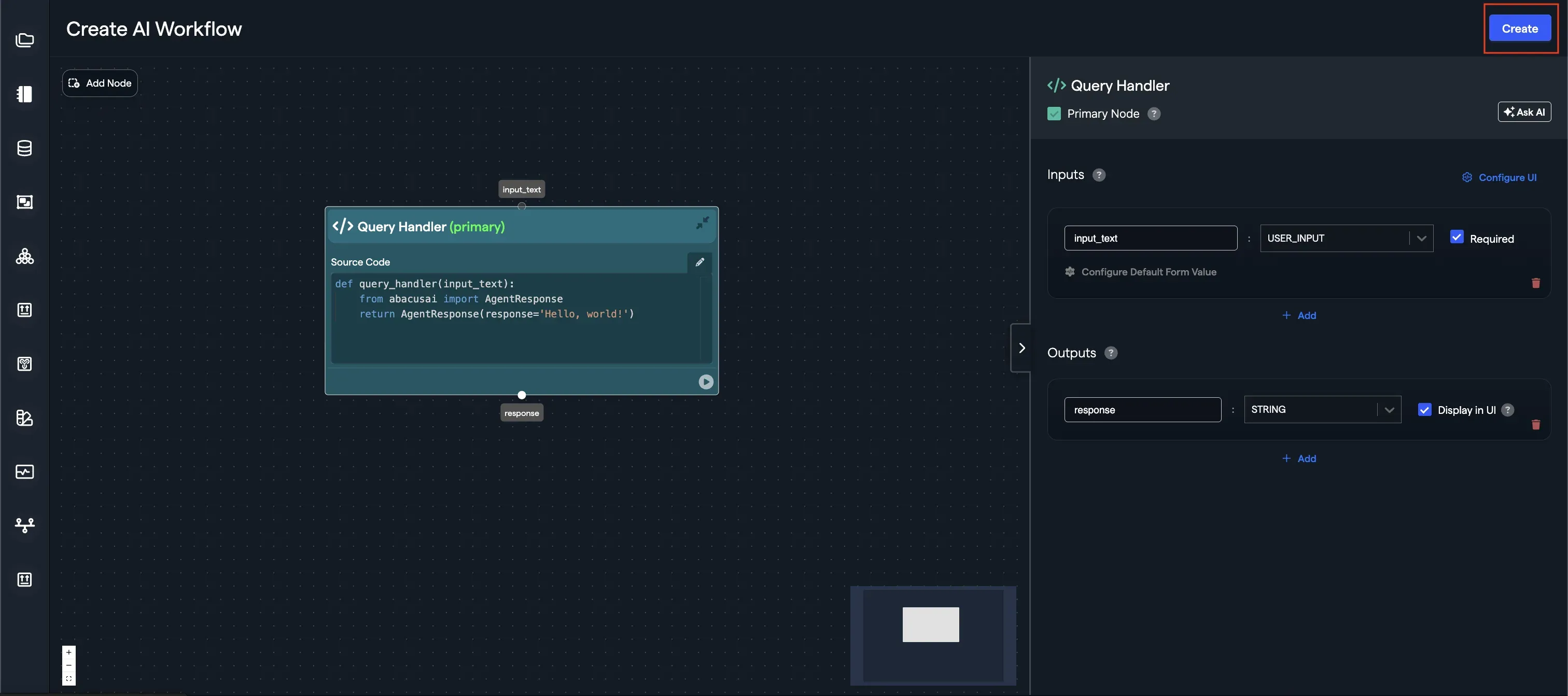 Abacus.ai central pipeline architecture showing data connectors and model routing workflows
The centerpiece of this architecture is RouteLLM. This intelligent router inspects incoming prompts, categorizing them by linguistic difficulty and reasoning requirements before dispatching them to an inference target.
Straightforward data formatting queries route to lightweight models that execute in milliseconds. Difficult mathematical derivations and long-horizon planning tasks route to leading frontier models.
This dynamic load distribution lowers inference expenditures by up to 70% compared to routing all enterprise traffic through frontier models. The system also supports localized semantic caching to eliminate redundant evaluations for repetitive organizational questions.
| Query Complexity Tier | Classification Criteria | Target Inference Architecture | Estimated Cost Impact |
|---|---|---|---|
| Tier 1: Routine Processing | Simple summaries, text transformations, sentiment extraction | Smaug Flash or compact open-weight models | 85% cheaper than frontier baselines |
| Tier 2: Intermediate Code | Unit test generation, schema translation, SQL queries | Mid-tier open-weight models or standard commercial LLMs | 55% cheaper than frontier baselines |
| Tier 3: Complex Multi-Hop | Deep architectural planning, mathematical proofs, long loops | Frontier reasoning engines with external tool execution | Baseline inference expenditure |
The routing mechanism relies on a trained lightweight classifier model. This classifier reads the semantic tokens of an incoming request and calculates an empirical complexity score.
When an incoming prompt falls below a preconfigured complexity threshold, RouteLLM directs the payload to cost-efficient models. When complexity exceeds the threshold, the gateway routes the prompt to high-capacity frontier endpoints.
Organizations adjust routing sensitivity based on budget constraints. Teams running internal hackathons prioritize cost savings, while customer-facing financial advisory bots mandate higher reasoning thresholds according to a disciplined sequential dispatch cycle:
- Token Ingestion: The entry gateway sanitizes raw prompt strings and inspects structural input length.
- Complexity Scoring: A specialized classifier evaluates semantic difficulty against calibrated training baselines.
- Threshold Matching: Prompts with difficulty scores under 0.35 route to compact models, while scores above 0.70 route to frontier reasoning engines.
- Fallback Handling: If a targeted endpoint experiences upstream rate limiting, RouteLLM transparently retries against equivalent alternative providers.
Semantic caching operates alongside the routing layer to capture frequent enterprise questions. When five hundred employees submit identical questions regarding corporate travel policies, the system serves cached embeddings instantly without triggering downstream neural network compute.
Dual-layer optimization shields corporate budgets from runaway API costs. Financial controllers track exact token expenditure per department, setting automated hard stops when teams approach monthly allocations.
Developers can also inspect routing decisions through comprehensive telemetry logs. Each API response returns metadata detailing the selected model, calculated complexity score, token count, and exact routing latency in milliseconds.
3. Orchestrating Autonomous Multi-Agent Workflows
Standard conversational agents fail frequently during long-horizon workflows. When an agent executes fifteen sequential tool calls, small errors compound, causing the system to hallucinate invalid arguments or enter infinite execution loops.
Enterprise teams frequently struggle with state persistence when building autonomous multi-step loops. Abacus.ai incorporates an external key-value state store that records execution checkpoints after every tool invocation.
Dividing complex operations across specialized sub-agents allows Abacus.ai to maintain high task fidelity across long operational sequences. The platform organizes collaborative operations across four distinct operational roles:
- Executive Planner: Decomposes complex user requests into discrete dependency graphs and monitors intermediate step progress across worker threads.
- Tool Executor: Interacts directly with external database endpoints, enterprise APIs, and internal file stores to gather operational payloads.
- Code Synthesizer: Drafts, executes, and debugs localized Python and SQL snippets within secure sandbox runtimes without exposing host resources.
- Verification Critic: Inspects execution outputs against safety guidelines and factual requirements before returning finalized responses to users.
Specialized roles prevent individual agents from becoming overloaded with contextual history. If an external third-party API endpoint times out during step seven of a ten-step deployment script, the agent resumes execution from the latest checkpoint.
This stateful resilience eliminates redundant compute charges and prevents incomplete database transactions. Engineers can also define custom recovery heuristics for individual tools.
When a database query returns an empty dataset, the agent reformulates search parameters rather than terminating the broader automation job. Checkpoint recovery workflows operate through persistent transaction logs, ensuring transient network failures do not compromise broader batch pipelines.
Automated schema validation prevents downstream ingestion failures. The platform inspects data types against predefined JSON schemas before invoking secondary transformation tools, ensuring corrupted inputs never penetrate internal warehouse layers.
4. Fine-Tuning Open-Weight Models with the Smaug Architecture
Abacus.ai addresses agent drift and complex reasoning bottlenecks through its open-weight Smaug model family. Originating with Smaug-72B, which topped open-source reasoning benchmarks, the model series utilizes curated human developer traces.
The training process uses reasoning token masking to teach models how to recover when external API calls return unexpected payloads. Technical benchmarks demonstrate this specialized fine-tuning boosts multi-step agent success rates by 15% to 20% compared to standard open weights.
Engineering teams can also fine-tune proprietary versions of Smaug using internal corporate data. The platform provides guided training recipes that optimize hyperparameters automatically, preventing catastrophic forgetting during domain specialization. Training converges quickly.
Fine-tuned Smaug weights can be hosted within private customer Virtual Private Cloud (VPC) environments. This capability allows security-conscious financial institutions to execute advanced reasoning locally without sending proprietary token streams to external third-party API providers.
5. Evaluating ChatLLM Teams Across Daily Developer Workflows
Beyond deep machine learning pipelines, Abacus.ai provides ChatLLM Teams as a collaborative interface for everyday knowledge workers. This interface removes the friction of managing disparate consumer subscriptions across internal departments.
Team members toggle between top foundation models within the same conversational thread. An analyst generates initial code using one engine, verifies syntax with a second, and summarizes documentation with a third.
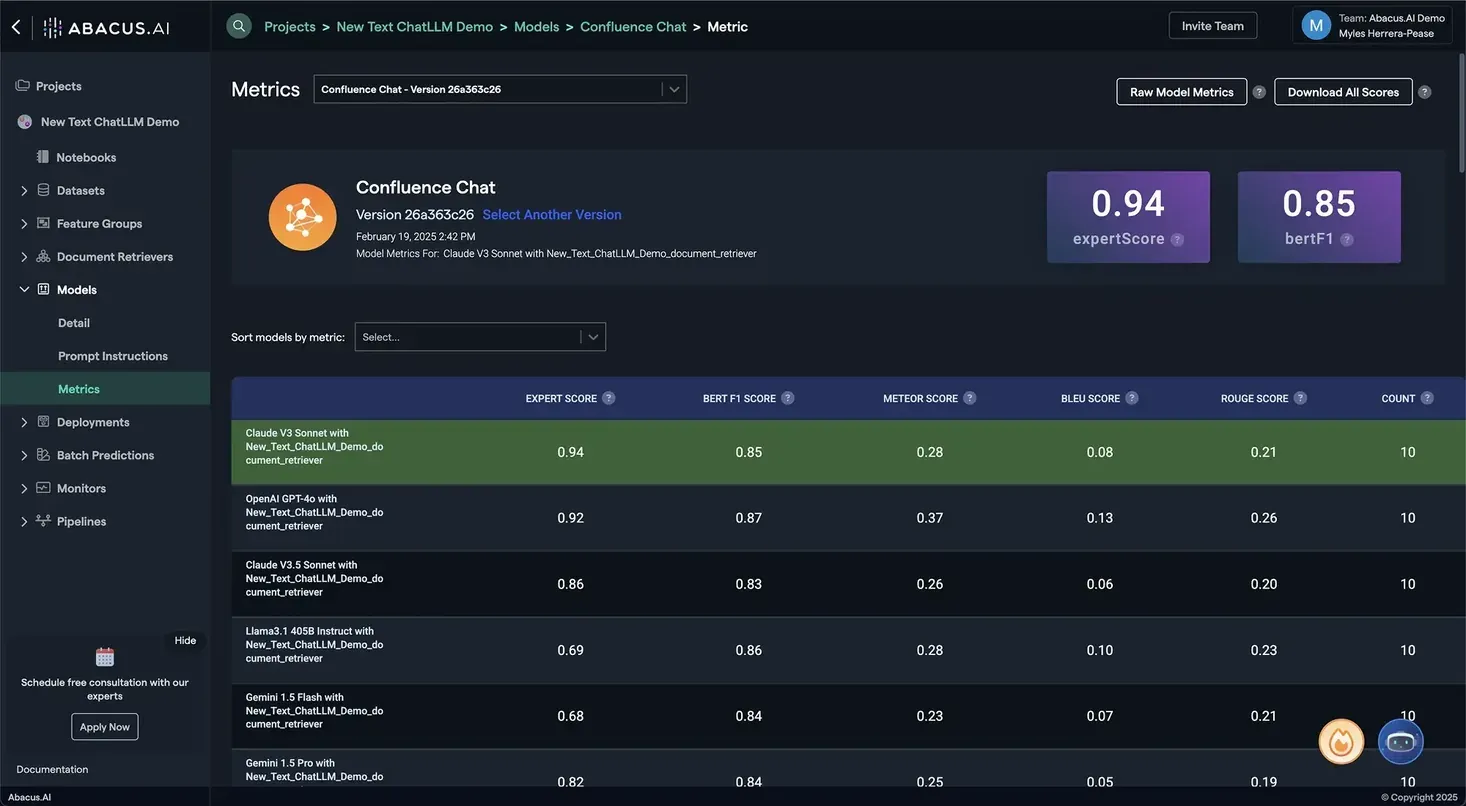 Abacus.ai operational dashboard displaying model performance metrics and project status
The platform introduces CoWork mode for hands-on technical collaboration. This workspace environment allows agents to execute shell commands, edit repository files, and run localized automated tests in isolated compute sandboxes.
Developers can compare rapid prototyping workflows with dedicated computing infrastructure on raw compute clusters on RunPod to decide between managed platforms and bare-metal GPU instances. While bare compute requires manual cluster configuration, Abacus.ai provides turnkey orchestration.
Enterprise teams can also provision private development clusters. This structure ensures internal knowledge stays synchronized across technical staff without manual copy-pasting.
Teams comparing autonomous agent suites with prompt-to-app agent platforms like Emergent find distinct architectural focuses. While Emergent specializes in rapid full-stack application synthesis, Abacus.ai emphasizes enterprise predictive pipelines, fine-tuned foundational models, and multi-cloud Machine Learning Operations (MLOps) governance.
| Platform Capability | ChatLLM Basic Tier | ChatLLM Pro Tier | Enterprise Custom Tier |
|---|---|---|---|
| Model Switching Access | Over 40 foundation models | Over 40 foundation models plus reasoning engines | All models with private VPC deployment |
| Autonomous Agent Depth | Basic single-step actions | Full multi-step agent loops | Unlimited custom agent architectures |
| Sandbox Execution Runtime | Standard web shell | Extended container sandbox | Dedicated private compute clusters |
| Data Connector Capacity | Up to 3 standard connectors | Up to 10 standard connectors | Over 30 enterprise data integrations |
Knowledge sharing within ChatLLM Teams relies on shared prompt libraries and curated vector repositories. Engineers save successful multi-turn prompts into team folders, enabling non-technical colleagues to reuse complex automation templates.
The collaborative workspace also indexes internal team documentation. When team members ask architectural questions, the platform retrieves relevant internal design docs, reducing onboarding friction for new hires.
Managing conversational context windows requires careful planning when dealing with massive codebases. Abacus.ai supports context windows up to 200,000 tokens on leading models, allowing developers to analyze complete software modules in a single session.
The platform automatically summarizes older conversational turns when discussions approach token limits. This sliding window mechanism preserves essential project constraints while pruning obsolete debugging output.
Version control integration links directly with enterprise GitHub and GitLab instances. Developers instruct the assistant to branch repositories, implement feature stubs, and submit draft pull requests with comprehensive commit notes.
6. Benchmarking Model Accuracy Against Real-World Inference Latency
Evaluating an aggregated AI platform requires rigorous scrutiny of latency overhead. Because Abacus.ai places a routing layer between the client and the underlying inference server, that middleware must introduce minimal computational delay.
The RouteLLM classifier processes prompt embeddings within a tight execution window. For standard textual queries, the routing decision adds less than 45 ms of overhead before initiating streaming responses.
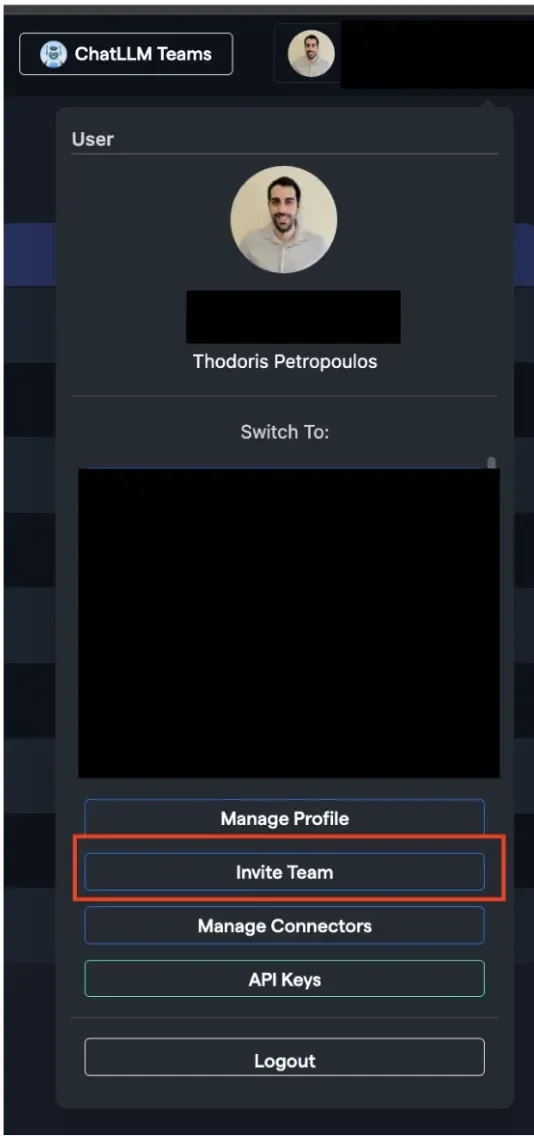 Abacus.ai developer workspace interface for managing team invitations and access policies
Streaming latency remains competitive with direct provider APIs. The platform maintains persistent HTTP connections to major hosting partners, avoiding Transport Layer Security (TLS) renegotiation delays on recurring requests.
Organizations running mission-critical workloads can provision dedicated instances or deploy models across managed cloud infrastructure. This flexibility prevents compute bottlenecks during quarter-end forecasting cycles, as independent benchmark evaluations reveal distinct operational characteristics:
- Structured Data Extraction: Routing to compact specialized models yields average response times under 400 milliseconds, outperforming general frontier models.
- Multi-Turn Code Generation: Smaug agentic architectures complete iterative test-debug cycles in fewer total steps, reducing end-to-end task completion times.
- Retrieval-Augmented Generation: Enterprise vector search pipelines achieve sub-second document retrieval across multi-gigabyte corporate repositories.
These benchmarks confirm that intelligent model dispatching achieves substantial cost reductions without degrading operational throughput. Engineering teams preserve rapid response cycles while maintaining access to deep reasoning when complex tasks demand it.
Cold start latency can occasionally impact specialized open-weight models hosted on shared infrastructure. When an engineering team queries an infrequently used fine-tuned model, initial token generation can pause for two to three seconds while the container scales.
Enterprise tiers mitigate cold start delays through warm pool provisioning. Organizations with strict service level agreements reserve dedicated GPU memory, guaranteeing sub-second response times around the clock.
Network telemetry tools integrated into the administrator console surface real-time geographic ping times. Global engineering organizations can configure regional routing endpoints to ensure low-latency access for distributed offshore developer teams.
7. Automating Enterprise MLOps and Predictive Pipelines
For specialized data science teams, Abacus.ai provides automated Machine Learning Operations (MLOps) pipelines. Developers connect over 30 enterprise data connectors, including Snowflake, BigQuery, and Amazon S3. Setup takes minutes.
The automated pipeline performs schema normalization, imputes missing values, and tests multiple predictive neural network architectures. Data scientists export full Python model artifacts or deploy real-time prediction endpoints with automated drift detection.
Automated feature engineering algorithms generate hundreds of candidate mathematical transformations from raw transactional logs. The system trains gradient-boosted decision trees, deep tabular networks, and specialized time-series forecasting models simultaneously. Models deploy reliably.
Teams set automated retraining triggers based on statistical concept drift thresholds. When live prediction distributions diverge from initial training baselines, the platform retrains models automatically without causing production API downtime.
8. Enforcing Zero-Trust Security and Private VPC Governance
Enterprise risk committees cannot approve artificial intelligence tools that expose confidential corporate data to public training datasets. Security leaders require documented proof of tenant isolation and operational compliance before signing procurement agreements.
Abacus.ai maintains verified Service Organization Control 2 (SOC 2) Type II certification and full HIPAA compliance across its hosting infrastructure. All data in transit utilizes TLS 1.3 encryption, while stored assets use AES 256-bit cryptographic keys.
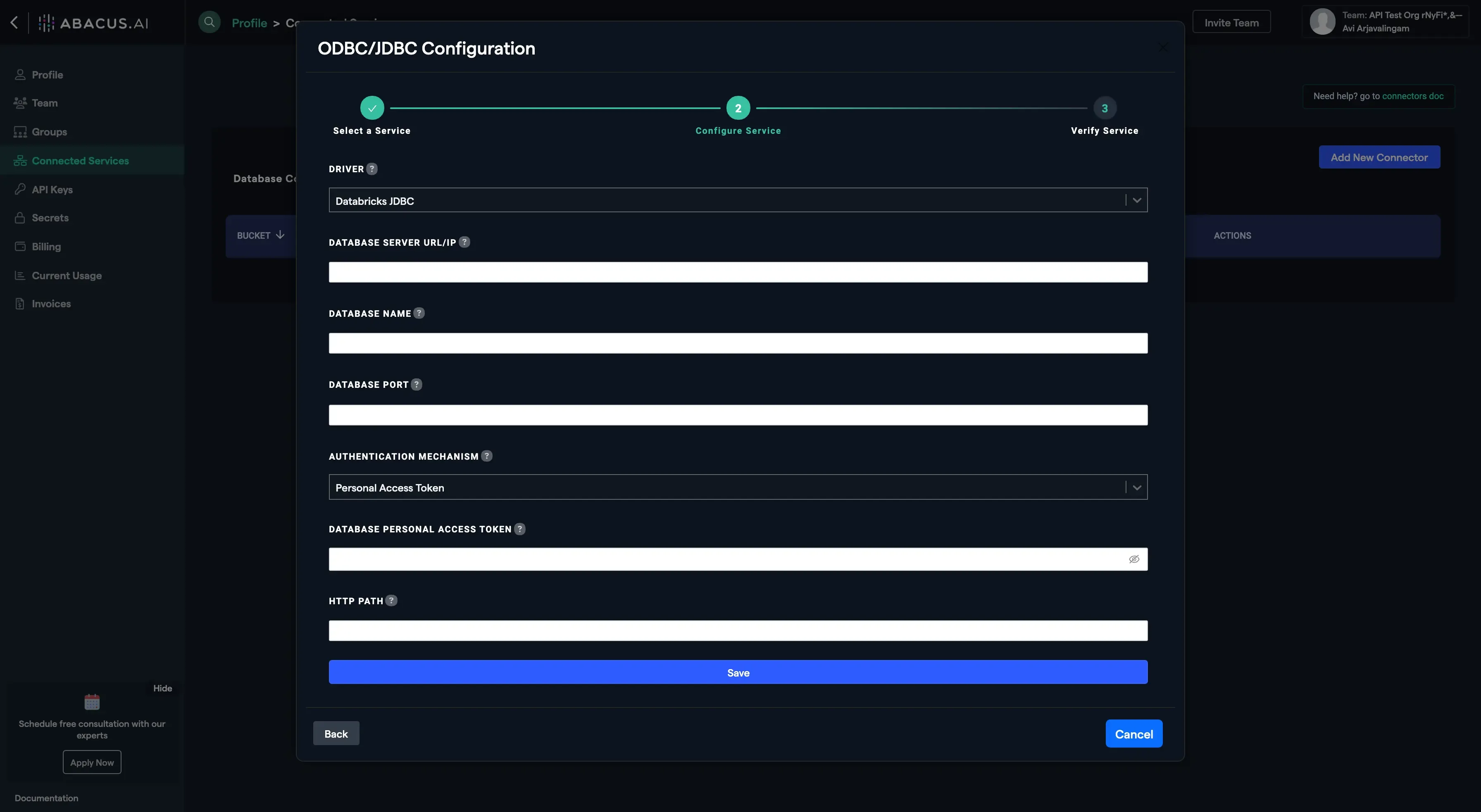 Abacus.ai safety guardrails interface for configuring content moderation and execution boundaries
Customer databases and custom fine-tuning weights remain completely isolated within dedicated tenant partitions. The platform does not use proprietary customer prompts, uploaded documents, or vector database embeddings to train public models.
Organizations subject to strict regulatory oversight can deploy the entire Abacus.ai platform inside a dedicated Virtual Private Cloud. This deployment model keeps all data transmission within corporate firewall boundaries, matching the strict compliance postures of hyperscaler MLOps suites like AWS SageMaker.
Granular role-based access controls let administrators restrict model access by department. Legal teams can lock down external web browsing tools while giving data science teams unrestricted access to Python execution environments.
Audit logging tracks every user interaction, API call, and model response across the organization. Security teams can stream these logs directly into their centralized Security Information and Event Management systems for continuous threat analysis.
9. Analyzing Credit Consumption Against Total Cost of Ownership
Abacus.ai structures its self-serve offerings around a monthly credit allocation model. Understanding how different tasks consume credits is essential for forecasting operational budgets accurately.
The entry Basic tier costs $10 per user per month and includes 20,000 monthly credits. This tier suits knowledge workers who need basic multi-model access for drafting and summarization.
| Subscription Plan | Monthly Price | Monthly Credit Allowance | Target Organizational Use Case |
|---|---|---|---|
| Basic Plan | $10 per user | 20,000 credits | Individual knowledge workers requiring general multi-model chat access |
| Pro Plan | $20 per user | 30,000 credits | Engineers and analysts using autonomous agents and coding sandboxes |
| Max Plan | $100 per user | 120,000 credits | Power developers running high-frequency multi-step agent pipelines |
| Enterprise Custom | From $5,000 | Customized allocation | Large enterprises requiring VPC deployment, custom fine-tuning, and dedicated SLAs |
The Pro tier costs $20 per user per month with 30,000 credits, unlocking autonomous agent execution and developer coding tools. Power developers running intensive workflows can select the Max tier at $100 per user per month for 120,000 credits.
Organizations should monitor credit consumption carefully. Complex multi-step agent loops and advanced reasoning models consume credits faster than simple conversational queries.
Teams exceeding their monthly allocations face account throttling or must purchase credit add-on packs. Large enterprises with high computational demands can negotiate custom contracts starting at $5,000 monthly, implementing structured internal consumption guidelines:
- Establish default model routing tiers to prevent team members from defaulting to expensive frontier models for trivial tasks.
- Restrict autonomous agent execution loops to certified developers who understand recursive tool call costs.
- Review monthly department usage reports to identify high-consumption workflows that would benefit from specialized fine-tuned models.
Procurement officers evaluating software return on investment should factor in license consolidation savings. Providing engineers with unified access saves administrative time spent tracking individual expense reports across fragmented providers.
For larger engineering organizations, the primary return on investment stems from developer velocity. Reducing time spent debugging third-party API outages and managing local Python environments delivers substantial productivity gains across the fiscal year.
Engineering teams migrating from disparate API contracts to Abacus.ai report significant reductions in administrative billing overhead. Consolidating dozens of individual developer credit card charges into a single master invoice simplifies quarterly accounting audits and gives department heads predictable spending projections.
Centralizing key management eliminates security vulnerabilities associated with engineers storing personal API tokens on local laptops. Administrators revoke compromised credentials instantaneously across the entire workforce from a single security dashboard.
10. Abacus AI Strengths and Operational Limitations
Enterprise engineering teams rarely find a platform that tackles both raw compute routing and autonomous multi-agent loops without friction. Across more than 1,400 technical evaluations on G2, software architects rate Abacus.ai at 4.6 out of 5, highlighting both its routing efficiency and interface complexity.
Architectural Advantages
- Multi-Model Unification: Teams access top foundation models through a single billing agreement, eliminating vendor sprawl.
- Cost Reduction via RouteLLM: Intelligent prompt classification directs routine tasks to inexpensive endpoints, reducing aggregate inference bills.
- Specialized Agent Weights: Smaug models improve completion rates during multi-step tool execution through optimized training data.
- Enterprise Security Foundation: SOC 2 Type II compliance, HIPAA readiness, and private cloud deployment options safeguard confidential data.
Operational Trade-offs
- Credit Exhaustion Risks: Power users running complex agent loops can burn through monthly credit limits quickly.
- Steep Learning Curve: The extensive feature set creates an intricate user interface that requires deliberate team onboarding.
- Absence of Native Niceties: Users lose proprietary workspace visualizers built exclusively for native model ecosystems.
Comparing Abacus.ai with do-it-yourself orchestration stacks highlights clear architectural boundaries across 4 enterprise dimensions, balancing self-hosted flexibility against turnkey operational convenience:
| Evaluation Dimension | Custom Open-Source Stack (LangGraph + vLLM) | Abacus.ai Managed Enterprise Platform |
|---|---|---|
| Initial Setup Timeline | 6 to 12 weeks of engineering setup | Instant workspace provisioning in under an hour |
| Ongoing Maintenance Burden | High infrastructure overhead requiring dedicated MLOps | Fully managed hosting, updates, and uptime monitoring |
| Dynamic Routing Capability | Requires custom classification algorithms | Built-in RouteLLM trained on enterprise workloads |
| Compliance Documentation | Requires independent external audits | Turnkey SOC 2 Type II and HIPAA compliance guarantees |
Building an in-house orchestration layer with open-source tools grants complete architectural freedom. However, organizations must budget ongoing staff time for patching dependencies, rotating keys, and scaling GPU clusters.
Abacus.ai trades marginal customizability for operational reliability. Engineering directors who prioritize product delivery over infrastructure maintenance find that managed platforms deliver faster time-to-market with lower long-term risk.
What We Liked (Pros)
- Consolidates over 40 foundation models under a single predictable workspace subscription
- RouteLLM lowers API inference costs by directing simpler tasks to lightweight endpoints
- Open-weight Smaug models offer specialized performance during long-running agent workflows
- Full enterprise compliance including certified SOC 2 Type II and HIPAA data safeguards
Areas for Improvement (Cons)
- Credit allowances exhaust rapidly when executing multi-step agent workflows
- Dense navigation interface presents an intimidating learning curve for non-technical team members
- Lacks proprietary workspace features found in native foundation model portals
11. Frequently Asked Questions About Abacus AI
Abacus.ai functions as an enterprise AI operations platform that combines multi-model access, autonomous agent execution, and dynamic model routing under a single secure infrastructure.
RouteLLM evaluates the linguistic complexity of incoming prompts in real time, routing straightforward requests to compact models while reserving expensive frontier engines for difficult multi-step reasoning.
Smaug models undergo fine-tuning on real-world developer action traces with reasoning token masking, improving error recovery and tool precision across sequential agent loops.
Customer inputs, proprietary database records, and fine-tuning datasets are never utilized to train public foundation models under standard enterprise agreements.
Organizations can run the full Abacus.ai software suite inside their own dedicated Virtual Private Cloud or on-premise compute infrastructure.
While rapid prompt tools prioritize visual code assembly, Abacus.ai emphasizes production machine learning pipelines, vector retrieval, and autonomous multi-agent operational loops.
12. Final Editorial Verdict on Abacus AI
Abacus.ai delivers a versatile platform for organizations looking to operationalize artificial intelligence without stitching together fragmented services. Combining multi-model access, intelligent cost-saving routing, and specialized agent models, the platform bridges the gap between raw research models and production enterprise workflows.
The platform provides compelling value for engineering organizations that want to avoid vendor lock-in. Instead of being tied to a single foundation model provider, technical leaders gain the agility to adopt the best model for each task while controlling inference expenditures through RouteLLM.
While the credit consumption model requires monitoring and the interface demands focused training, the architectural benefits outweigh the onboarding effort. For mid-market and enterprise teams seeking an end-to-end foundation for autonomous agents and machine learning pipelines, Abacus.ai earns our strong recommendation.


Abacus.ai
Abacus.ai delivers an exceptional unified AI platform for organizations needing multi-model flexibility, cost-saving dynamic routing, and automated machine learning without stitching together disparate cloud services.