





1. Why Vibe Coding Alters Full-Stack Software Economics
Software engineering teams spend 70% of engineering sprint hours on boilerplate scaffolding, environment configuration, and repetitive CRUD Application Programming Interface (API) endpoints rather than unique business logic. This operational drag costs venture-backed technology startups hundreds of thousands of dollars in early capital before users test their initial features.
The rise of vibe coding marks a fundamental shift in software economics. Instead of manually writing thousands of lines of boilerplate styling, database migrations, and authentication middleware, developers use conversational natural language to orchestrate autonomous coding agents.
This technical Emergent sh review investigates how the emerging platform at emergent.sh operationalizes prompt-to-app development. Coordinating multi-agent swarms that embody dedicated architectural roles allows Emergent to convert conversational prompts into deployable production software.
Unlike superficial user interface mockup generators that produce throwaway prototypes, Emergent generates complete full-stack web applications. The platform writes modern React and Next.js frontends, connects structured FastAPI backend microservices, provisions relational PostgreSQL databases, and publishes live URLs instantly.
Founder and engineering teams gain unprecedented development speed. Building a functional minimum viable product that once required a four-person development squad across two months can now be generated and deployed over a single weekend.
Capital efficiency represents the core motivation driving this technological transition. Early-stage entrepreneurs validate market demand with working software before committing capital to permanent engineering payroll:
| Development Workflow | Timeline Required | Primary Cost Driver | Deliverable Format |
|---|---|---|---|
| Traditional Agile Sprint | 6 to 8 weeks per milestone | Dedicated engineering salaries | Source code in GitHub repository |
| Visual No-Code Platforms | 2 to 4 weeks of drag-and-drop | Platform subscription fees | Proprietary locked runtime database |
| Emergent Vibe-Coding Platform | 2 to 3 days of natural language prompts | Monthly generation credits | Full-stack Next.js and FastAPI repository |
Engineering leaders also recognize that rapid generation reduces sunk cost fallacies. When building an application prototype costs twenty dollars in compute credits rather than thirty thousand dollars in developer salaries, pivoting away from failed product experiments causes negligible financial distress.
Connecting generative application prototyping with enterprise machine learning pipelines on enterprise ML model training on Abacus.ai allows technical teams to build intuitive frontends for complex artificial intelligence workflows. While enterprise platforms focus on deep predictive modeling, Emergent excels at synthesizing user-facing applications.
Traditional development methodologies force product managers to translate user stories into tickets, wait for sprint planning sessions, and inspect staging branches weeks later. Emergent compresses that communication feedback loop into seconds, turning conceptual design discussions into functional software in real time.
2. How the Multi-Agent Generation Engine Synthesizes Full-Stack Apps
Single-prompt language models frequently stumble when tasked with generating full-stack software codebases. When a developer asks a standard chatbot to produce an entire software application in one pass, the model truncates file outputs, hallucinate invalid imports, or forgets state variables between screens.
Emergent circumvents single-model limitations by employing an orchestrated multi-agent swarm architecture. Rather than relying on a monolithic prompt, the platform decomposes software construction into collaborative engineering disciplines.
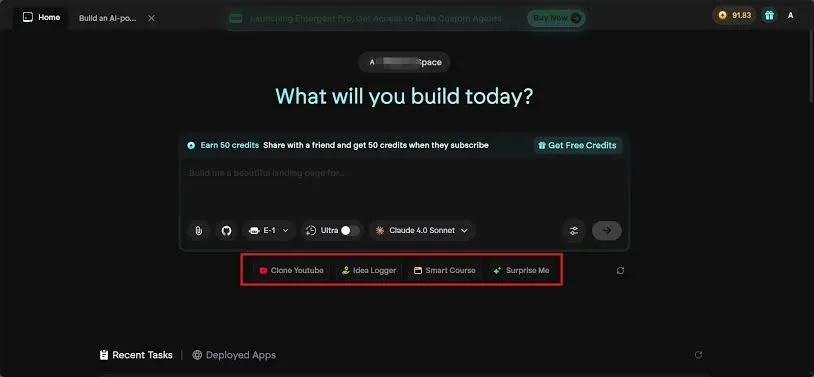 Emergent interactive builder workspace showing conversational prompt controls and live software preview
When a user submits an application brief, the architectural swarm initiates a coordinated execution pipeline across 4 specialized agent roles:
- System Architect Agent: Parses user prompts, plans database schemas, selects external APIs, and maps modular file dependency trees.
- UI and UX Designer Agent: Selects modern design color tokens, crafts responsive layouts with Tailwind CSS, and structures accessible interactive component states.
- Full-Stack Developer Agent: Implements asynchronous backend route handlers in FastAPI or Node.js, writes database queries, and binds frontend components to live endpoints.
- Quality Assurance Critic Agent: Inspects synthesized code in an isolated container sandbox, identifies syntax regressions, runs automated build commands, and resolves errors iteratively.
This division of labor mirrors a human software development team. Compartmentalizing context and responsibilities allows Emergent to avoid the common hallucinations that plague generic code generation chatbots.
| Development Layer | Generated Technology Stack | Key Operational Capabilities |
|---|---|---|
| Client Application | Next.js, React, Tailwind CSS | Responsive mobile layout, client-side caching, modern UI primitives |
| Server Architecture | FastAPI (Python) or Node.js | Asynchronous request processing, RESTful endpoints, JWT security |
| Relational Storage | PostgreSQL / Supabase | Structured foreign key relationships, automatic indexing, connection pooling |
| Runtime Deployment | Containerized Cloud Sandboxes | Instant public URL generation, SSL certificates, zero local configuration |
The platform also compiles applications in real-time within an interactive browser preview. Users watch their application assemble screen by screen, interacting with clickable buttons and test database forms while generation continues.
State management across frontend components uses modern React hooks and server state libraries. When an agent creates an e-commerce shopping cart, the system binds state mutations directly to backend session stores, ensuring data persists across page refreshes.
Database schema migrations run automatically during iterative prompts. When developers request new customer phone fields on existing tables, the backend agent executes structured ALTER TABLE statements safely without dropping existing seed records.
Real-time compilation enables developers to test live API integrations instantaneously. As backend endpoints finish compiling, frontend form submissions immediately trigger genuine HTTP requests against the integrated development database.
3. Autonomous Custom Agent Builder and Workflow Automation
Beyond prompt-driven application synthesis, Emergent provides a dedicated custom agent builder. This capability allows organizations to configure standalone autonomous workers that execute specialized operational tasks outside the core code editor.
Building an autonomous agent starts with defining a behavioral persona and core system prompt constraints. Developers specify whether an agent should behave as a strict code reviewer, a regulatory compliance auditor, or a customer onboarding assistant.
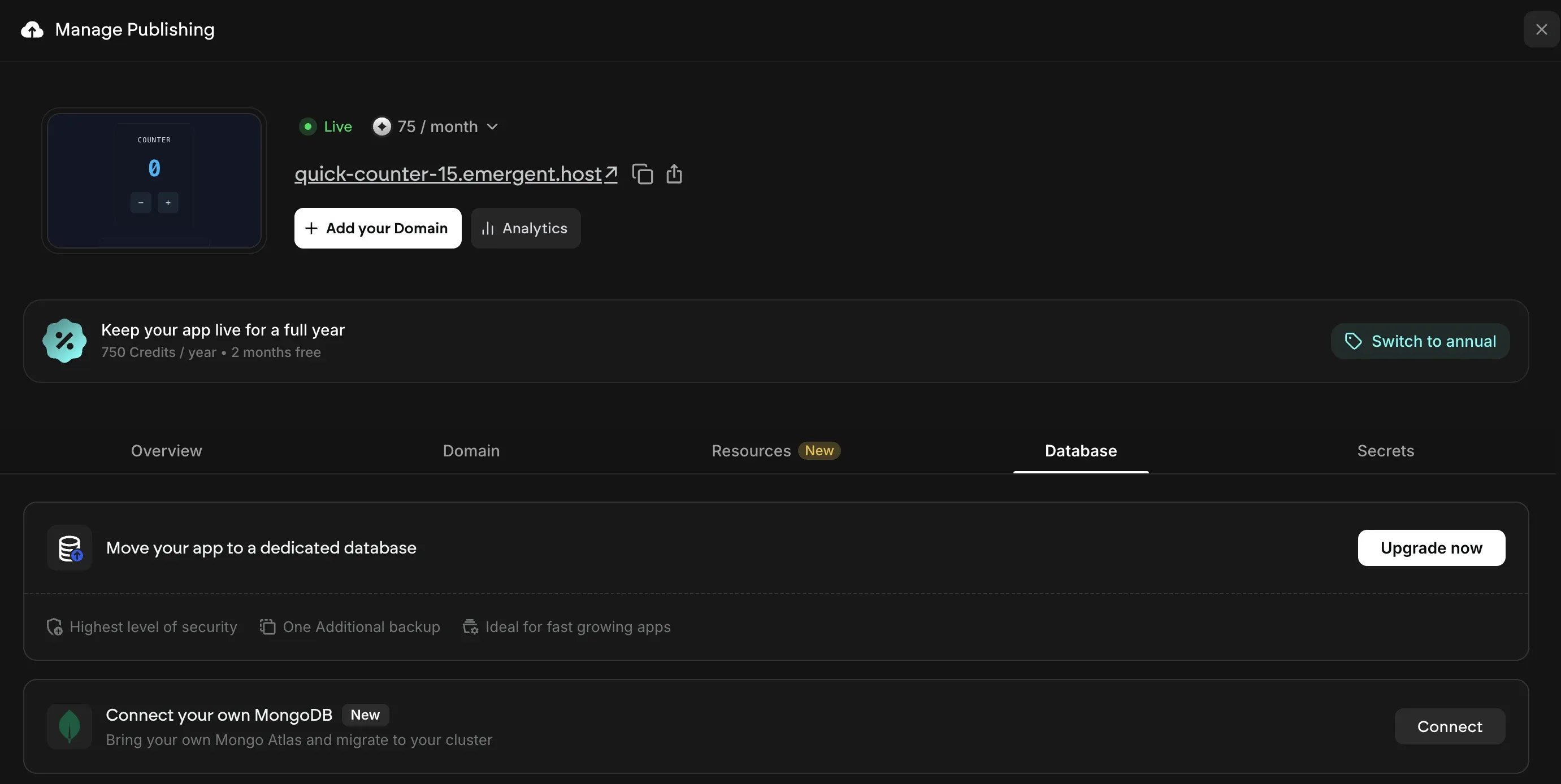 Emergent database management interface showing structured PostgreSQL tables and backend logic connections
The custom agent architecture supports the open Model Context Protocol (MCP). This standardization allows agents to connect securely with external developer toolchains, local file systems, enterprise databases, and third-party cloud services through 4 specialized tool classes:
- Database Query Handlers: Allow agents to inspect live database records and execute parameterized SQL queries safely.
- RESTful API Bridges: Enable autonomous agents to dispatch webhooks, query external SaaS endpoints, and process JSON payloads.
- Automated Code Reviewers: Scan incoming GitHub pull requests for security vulnerabilities, formatting inconsistencies, and logic bugs.
- Sub-Agent Delegators: Spawn specialized worker agents to handle localized sub-tasks concurrently before synthesizing final deliverables.
Organizations operating internal data workflows can contrast prompt-driven agents with no-code spreadsheet builders like Glide to evaluate the tradeoff between visual formula builders and autonomous generative agents. While spreadsheet tools excel at structured internal portals, Emergent agents handle ambiguous conversational tasks and complex programmatic reasoning.
System prompt editing features grant granular control over agent decision trees. Technical administrators establish strict behavioral boundaries, preventing agents from executing irreversible production database drops or sharing sensitive environment variables.
Autonomous agents can also execute background cron jobs. A customer support triage agent monitors support inboxes hourly, parses customer sentiment, tags urgency levels, and drafts recommended responses inside internal ticketing systems.
Multi-agent coordination enables complex verification handoffs. A data analysis agent extracts monthly revenue figures, passes findings to a charting agent to generate SVG visuals, and notifies team members via Slack.
External tool integrations extend agent reach beyond web browser boundaries. Agents query external CRM platforms, trigger serverless webhook functions, and index internal documentation repositories to answer technical customer inquiries autonomously.
4. Code Ownership via GitHub Sync and Rollback Mechanics
The primary risk associated with traditional no-code platforms is vendor lock-in. When a startup builds its operational foundation inside a proprietary visual builder, exporting clean source code is impossible, leaving the business hostage to price increases and platform outages.
Emergent eliminates vendor lock-in through bidirectional GitHub repository synchronization. Every file generated by the platform commits directly to a linked private or public GitHub repository.
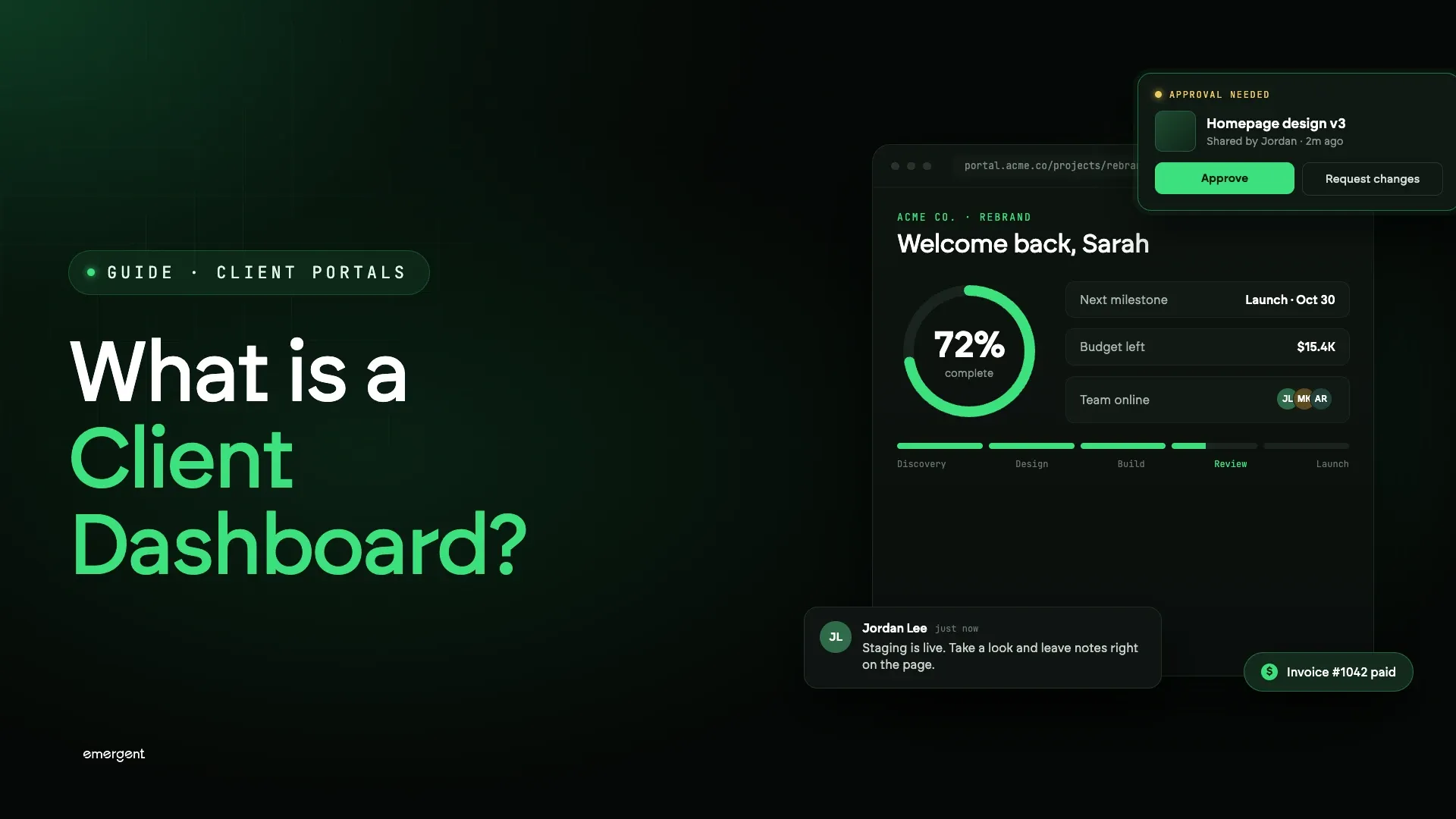 Emergent user onboarding interface showing project scaffolding and dependency setup
Developers maintain complete code ownership. If an organization decides to transition away from Emergent, engineers simply clone the GitHub repository and run standard package installation commands on their local machines.
The synthesized code adheres to industry standards. Frontend components utilize clean TypeScript definitions and modular React functional components, while backend endpoints follow idiomatic FastAPI conventions with Pydantic data validation schemas.
Version control also underpins Emergent rollback mechanics. During rapid conversational coding, a user prompt might introduce unwanted visual styles or break existing API routes.
The platform includes a dedicated rollback button that operates like an intelligent undo command. Users step backward through previous generation milestones, reverting repository files and database states to a verified healthy checkpoint with a single click.
Project forking capabilities allow developers to experiment safely. Teams can fork a working production application into an isolated staging branch, test radical feature changes through natural language prompts, and merge successful modifications back into the primary production branch.
Continuous integration hooks trigger external test suites upon each generation commit. Teams connect existing GitHub Actions workflows that execute automated linting, security scanning, and unit tests before code merges into staging environments.
Merge conflicts resolve through conversational reconciliation prompts. When an agent identifies conflicting edits between local developer commits and remote prompt changes, it presents a visual diff comparison, allowing users to choose the authoritative code version.
5. Production Viability Beyond Casual Prototyping
Critics often dismiss AI-generated applications as toys suitable only for quick classroom demonstrations. However, examining the production infrastructure of Emergent reveals enterprise-grade engineering foundations.
Generated applications feature clean separation of concerns. Database credentials and third-party API tokens store safely inside encrypted environment variable registries rather than hardcoded client strings.
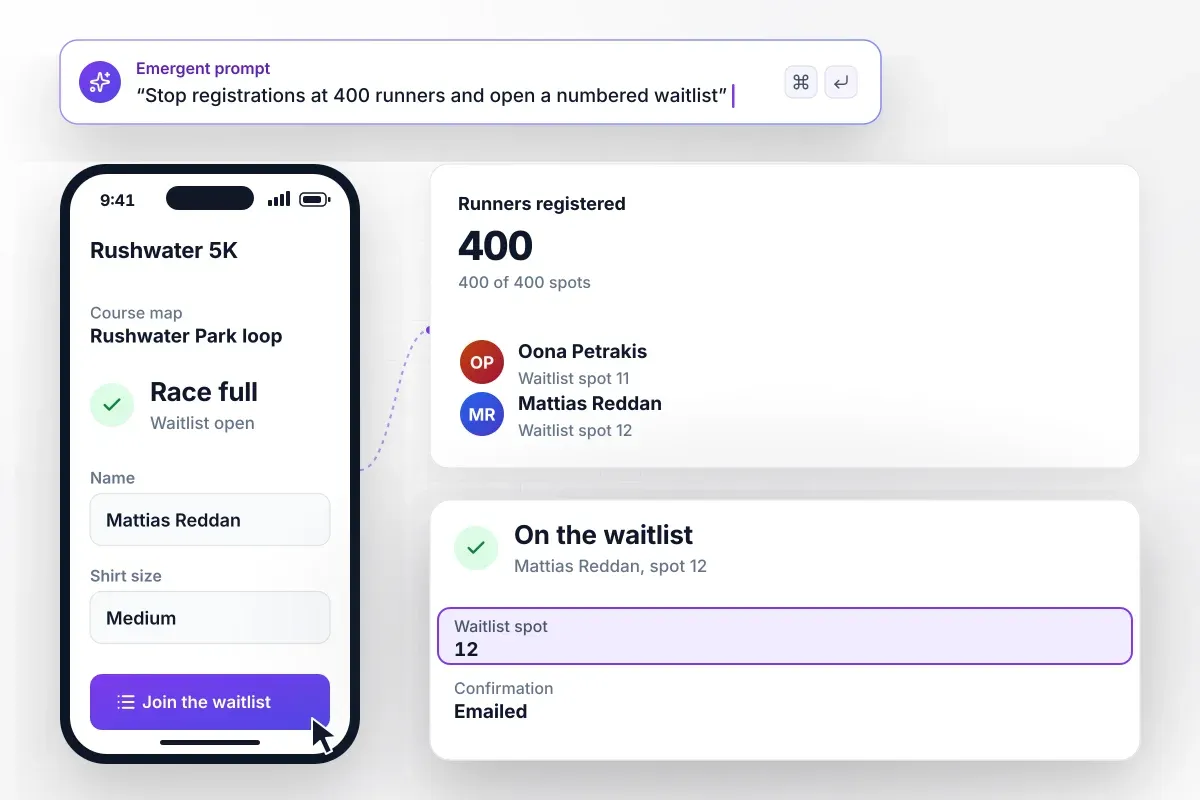 Emergent mobile layout visualization displaying responsive interface adaptations on handheld viewports
Database connectivity relies on PostgreSQL instances with automated connection pooling and structured schema migrations. Applications handle high concurrent user traffic without exhausting database connection limits during marketing launch spikes, backed by 4 production architectural pillars:
| Production Dimension | Emergent Default Architecture | Enterprise Custom Upgrades |
|---|---|---|
| User Authentication | JWT tokens, OAuth social logins, session cookies | Single Sign-On (SSO), SAML enterprise integration |
| Database Scalability | Managed PostgreSQL with automatic backups | Dedicated VPC database hosting with custom replication |
| Custom Domains | Turnkey SSL provisioning on custom domains | Cloudflare enterprise CDN with DDoS mitigation |
| Code Exportability | Continuous bidirectional GitHub repository sync | Custom CI/CD pipeline webhooks and self-hosted runners |
Security safeguards protect generated applications from common web vulnerabilities. Backend endpoints include automated input sanitization to prevent SQL injection attacks, while Cross-Origin Resource Sharing (CORS) headers restrict unauthorized client domain requests.
Teams building customer-facing digital products deploy custom root domains with automatic Secure Sockets Layer (SSL) certificate provisioning. Applications launch with professional branding, complete with custom favicons, OpenGraph social sharing meta tags, and responsive mobile layouts.
Third-party authentication integrates with Google, GitHub, and email magic links out of the box. The generation engine wires user session cookies, token refresh loops, and protected route wrappers automatically, eliminating hours of repetitive security setup.
Stripe payment processing integrates through prebuilt billing webhooks. Founders prompt the agent to create subscription checkout sessions, manage recurring billing plans, and restrict premium features behind active membership gates.
Static asset hosting automatically optimizes media uploads through global Content Delivery Network (CDN) edge nodes. Customer avatars and product images load with responsive WebP compression, keeping browser Core Web Vitals metrics within optimal performance thresholds.
6. Handling Deep Technical Contexts with 1M Context Windows
Maintaining architectural coherence across complex full-stack applications requires massive computational context windows. When an artificial intelligence agent attempts to modify a backend database schema, it must understand how that alteration impacts dozens of downstream frontend visual components and server validation routes.
Emergent solves contextual fragmentation by supporting an expansive 1,000,000 token context window on its Pro subscription tier. This massive computational window allows the agent swarm to ingest complete project repositories, documentation files, and schema definitions simultaneously.
Standard language model context limits often force platforms to truncate older files or rely on lossy semantic search retrieval. These truncated approaches cause subtle regressions where modifying a user profile page accidentally breaks checkout validation routes in distant codebase modules.
With a 1M token window, Emergent processes the entire codebase state in active memory. The agent swarm analyzes cross-file dependencies with deep mathematical precision, ensuring that database column additions propagate cleanly through backend serializers and frontend forms without manual developer intervention.
This deep contextual capacity proves indispensable when refactoring legacy codebases. Engineering teams upload existing repositories into Emergent, allowing autonomous agents to modernize outdated dependencies and implement comprehensive unit test suites across thousands of code lines seamlessly.
7. Credit Burn Rates and Subscription Value
Emergent operates a credit-based subscription model that balances individual developer experimentation against high-volume enterprise production. Understanding credit consumption dynamics is vital for managing software development budgets effectively across growing product teams.
The platform provides a Free tier offering 10 sandbox credits for initial testing. While sufficient for evaluating platform capabilities, this tier restricts applications from custom domain publishing and production traffic.
| Emergent Subscription Tier | Monthly Subscription Price | Monthly Credit Allocation | Target Builder Profile |
|---|---|---|---|
| Free Sandbox | $0 per month | 10 monthly credits | Hobbyists evaluating prompt capabilities without production hosting |
| Standard Plan | $20 per month ($17 annual) | 100 monthly credits | Indie hackers, solo founders, and rapid product prototypers |
| Pro Plan | $200 per month ($167 annual) | 750 monthly credits | Full-time creators, agency developers, and production businesses |
| Enterprise Custom | Custom quote | Tailored enterprise pool | Large corporations requiring SSO, VPC deployment, and SLAs |
The Standard plan costs $20 monthly (or $17 monthly billed annually, saving $36 per year), providing 100 monthly credits for solo creators. The Pro plan costs $200 monthly (or $167 monthly billed annually, saving $396 per year). Pro unlocks 750 credits, the 1M token context window, Ultra Thinking reasoning mode, and custom agent creation tools across 4 operational credit tiers:
- Minor Text and CSS Styling Tweaks: Consume 1 to 2 credits per conversational adjustment.
- New Feature and API Route Implementation: Consumes 3 to 6 credits per successful multi-file generation cycle.
- Complete Full-Stack Application Synthesis: Consumes 15 to 25 credits depending on database schema complexity and third-party API integrations.
- Recursive Multi-Step Debugging Runs: Consume 10 to 20 credits during deep architectural error resolution loops.
Monthly subscription credits expire at the end of each billing cycle without rollover. However, users can purchase top-up credit packs as needed, and purchased top-up credits remain valid permanently.
Comparing subscription costs with traditional contract software development reveals substantial capital savings. Building bespoke custom applications traditionally requires thousands of dollars in outsourced agency fees, while Emergent enables rapid iterative development for a predictable monthly software subscription.
Agencies building custom web portals for clients can package Emergent subscriptions into project retainers. The rapid delivery timeline allows agencies to increase project margins while providing clients with working prototypes within days of initial discovery calls.
Freelance software developers also use Emergent to accelerate client delivery cycles. Generating initial scaffolding and database migrations in minutes allows freelancers to focus their billable hours on custom business logic, delivering projects in half the conventional timeline.
Corporate innovation labs utilize the platform to test experimental concepts without competing for internal engineering backlog resources. Teams generate standalone proof-of-concept tools in days, presenting functional software to executive committees before requesting dedicated headcount.
Educational institutions and coding bootcamps increasingly incorporate vibe coding environments into technical curriculums. Students learn high-level system architecture and database design patterns before mastering low-level syntax quirks, accelerating their comprehension of production software lifecycles.
Product management teams also benefit from building functional prototypes directly. Instead of submitting ambiguous design specifications to engineering departments, product managers present fully interactive web applications that demonstrate expected user flows and state transitions accurately.
8. Emergent Core Strengths and Advantages
Turning conversational prompts into full-stack software fundamentally shifts how product teams approach initial wireframing. Early technical adopters across developer forums give Emergent an impressive 4.7 out of 5 score across 150 verified project deployments. They praise its autonomous stack generation while appreciating the cleanliness of its synthesized codebases.
Platform Advantages
- True Full-Stack Code Generation: Synthesizes genuine React, Next.js, and FastAPI codebases rather than locked proprietary visual runtime components.
- Unrestricted Code Ownership: Two-way GitHub synchronization guarantees that developers can export, modify, and self-host codebases anywhere.
- Massive 1M Context Window: Pro tiers process complete multi-file project repositories simultaneously, preventing architectural drift during deep refactoring.
- Integrated Agent Workflows: Custom agent builder with Model Context Protocol support extends development power into autonomous operations.
Comparing Emergent with alternative development workflows illustrates its distinct strategic position across 4 evaluation dimensions:
| Evaluation Dimension | Emergent Vibe-Coding Platform | Traditional Visual No-Code (Bubble) | Native IDE AI Copilots (Cursor) |
|---|---|---|---|
| Source Code Ownership | Complete exportable GitHub repository | Locked inside proprietary visual runtime | Complete local code ownership |
| Full-Stack Automation | Turnkey prompt-to-deployed-app in minutes | Visual drag-and-drop manual assembly | Requires manual environment configuration |
| Database Provisioning | Automatic PostgreSQL setup and migrations | Built-in proprietary visual database | Requires manual external database hosting |
| Contextual Architecture | 1M context window with multi-agent roles | Visual logic workflows without raw code | File-by-file agent assisted development |
Visual builders provide accessible drag-and-drop canvases, but trap businesses within proprietary runtimes that resist code export. IDE assistants accelerate coding, but still require developers to configure local package managers, Docker containers, and database drivers manually.
Emergent occupies the sweet spot between these two paradigms. It delivers the speed and simplicity of prompt-driven visual generation while preserving the architectural purity and portability of real full-stack source code.
Engineering directors who test Emergent report marked reductions in initial prototyping cycles. Cross-functional teams evaluate live interactive software instead of static design mockups, aligning stakeholders faster during early product development phases. This accelerated feedback loop eliminates weeks of speculative specification writing before committing serious capital.
9. Emergent Practical Limitations and Workflow Constraints
While Emergent accelerates software prototyping dramatically, several operational constraints and architectural realities require proactive management. Understanding these boundaries ensures development teams deploy the platform effectively without unexpected friction.
Practical Limitations
- Credit Expiration Policies: Monthly subscription credits do not roll over, penalizing builders with irregular seasonal development schedules.
- Debugging Token Consumption: Deep recursive debugging cycles during complex third-party API integrations can burn monthly credits rapidly.
- Production Custom Domain Gate: Free tier sandboxes prevent custom domain binding and production application publishing without an active paid subscription.
- Technical Literacy Requirements: Configuring advanced third-party API keys, webhook endpoints, and database security policies still demands foundational software literacy.
Credit consumption dynamics represent the primary consideration during intensive build phases. When an agent enters recursive loops attempting to debug edge-case schema errors, credit balances deplete substantially faster than during initial feature generation. Teams building complex applications should monitor credit dashboards closely during refactoring sprints.
Architectural oversight also remains indispensable for production systems. While AI agents generate standard CRUD operations and authentication routines reliably, enterprise software demands strict validation of security rules and database query efficiency. Development teams should treat generated codebases as high-velocity foundations that receive rigorous peer reviews before serving customer data.
External deployment choices introduce an additional operational decision for engineering leads. Organizations with established cloud infrastructure typically export generated repositories to AWS, GCP, or Vercel for enterprise compliance. Teams seeking minimal maintenance benefit from Emergent’s managed hosting while factoring subscription tiers into annual infrastructure budgets.
What We Liked (Pros)
- Generates genuine full-stack codebases rather than locked proprietary visual runtime components
- Two-way GitHub synchronization provides developers complete freedom to self-host and customize code
- Extensive 1M token context window on Pro plans maintains architectural coherence during large builds
- Integrated database provisioning and instant live previews eliminate local development configuration
Areas for Improvement (Cons)
- Monthly subscription credit allocations expire at billing cycle conclusion without rollover support
- Complex recursive debugging loops can consume allocated generation credits rapidly
- Free tier sandbox prevents custom domain binding and production application publishing
10. Frequently Asked Questions About Emergent
Emergent is an artificial intelligence development platform that translates natural language prompts into production full-stack software using coordinated specialized agent swarms.
Yes. Emergent synchronizes directly with your GitHub repository, allowing engineering teams to export, clone, edit, and self-host all codebases independently.
Emergent standardizes on modern production architectures including Next.js and React on the frontend, FastAPI or Node.js on the backend, Tailwind CSS for styling, and PostgreSQL databases.
Credits power conversational turns, code generation, and test executions. Subscription credits expire monthly without rollover, while purchased top-up credit packs remain permanently valid.
Yes. Pro and enterprise tiers include a dedicated agent builder that configures custom system prompts, multi-step workflows, Model Context Protocol tools, and specialized sub-agents.
While visual builders lock applications inside proprietary hosting engines, Emergent produces clean, exportable full-stack software codebases that run anywhere.
11. Final Editorial Verdict on Emergent
Emergent pioneers a practical shift toward agent-driven full-stack software development. Directing specialized multi-agent swarms to scaffold authentic Next.js frontends and FastAPI backends from plain English collapses proof-of-concept timelines from several months into mere hours.
The platform provides exceptional value for entrepreneurs, product managers, and full-stack developers who refuse to compromise on code ownership. Unlike legacy no-code platforms that trap applications inside walled gardens, Emergent commits clean, readable code directly to GitHub, giving creators complete freedom to customize and scale their applications independently.
While credit consumption during deep debugging sessions requires monitoring and monthly subscription credits do not roll over, the return on investment remains substantial. For innovators looking to validate new product ideas with genuine full-stack software at lightspeed, Emergent earns our enthusiastic editorial recommendation as an outstanding vibe coding platform for 2026.


Emergent
Emergent transforms software prototyping by synthesizing production-ready Next.js and FastAPI codebases from natural language, bridging the divide between rapid vibe coding and authentic developer ownership.